
Light
Full Sun
Requires full sun to maintain dense spination and compact, segmented growth.
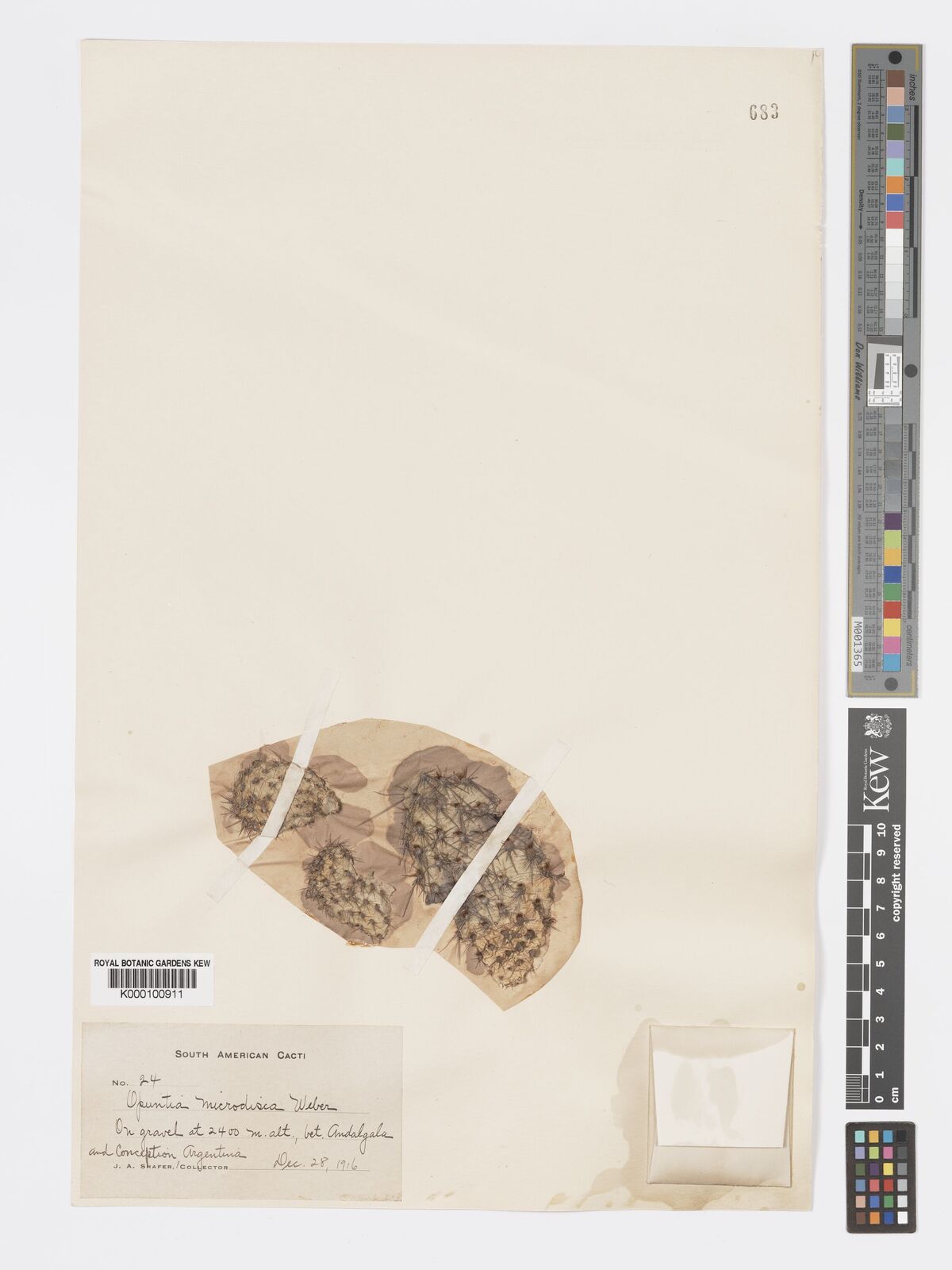 Reference image
Wrinkled Airampoa
Airampoa corrugata is a succulent subshrub belonging to the Cactaceae family, native to the high-altitude arid regions of South America 1. Known for its segmented, jointed stems and formidable spines, it is a fascinating species for specialized cactus collectors.
Originally described under the broad genus Opuntia, it has been reassigned to the genus Airampoa based on distinct seed morphology and molecular studies 2. The genus name originates from the indigenous Quechua word 'airampú', while the specific epithet corrugata refers to the wrinkled, textured surface of the stem segments.
This species is widely distributed across northwestern Argentina (including San Juan, San Luis, Jujuy, Mendoza, Salta, La Rioja, Catamarca, and Tucumán) and southern Bolivia 1. It thrives in dry, rocky shrublands and mountain slopes at elevations ranging from 1,000 to over 3,000 meters above sea level.
It forms low-growing, branched mats of fragile, easily detached joints that are cylindrical to slightly flattened, displaying a characteristic wrinkled appearance. Areoles carry small, irritating glochids along with longer, needle-like central spines. It produces beautiful bell-shaped flowers in shades of yellow, orange, or red during late spring to summer.
In cultivation, Airampoa corrugata requires full sun and exceptionally free-draining mineral soil 2. It is highly drought-tolerant and can survive sub-zero temperatures during winter, provided the soil is kept absolutely bone-dry.
The most prevalent error is overwatering, particularly during winter dormancy, which quickly leads to root rot. Insufficient sunlight causes leggy growth and weakens the structural integrity of the plant's segments.
Requires full sun to maintain dense spination and compact, segmented growth.
Water only when the substrate is completely dry. Keep dry in winter.
Requires a highly mineral, gritty cactus mix with low organic matter.
Contains sharp spines and fine, irritating glochids. Keep out of reach of pets and children.
Moderate. Highly susceptible to overwatering, requiring careful moisture control.
Native to the Andean foothills and high-altitude dry shrublands of northwestern Argentina and neighboring areas, where it grows in rocky, well-draining soils under intense sunlight.
