
Light
Full Sun
Requires full sun or intense direct light for at least 6 hours daily.
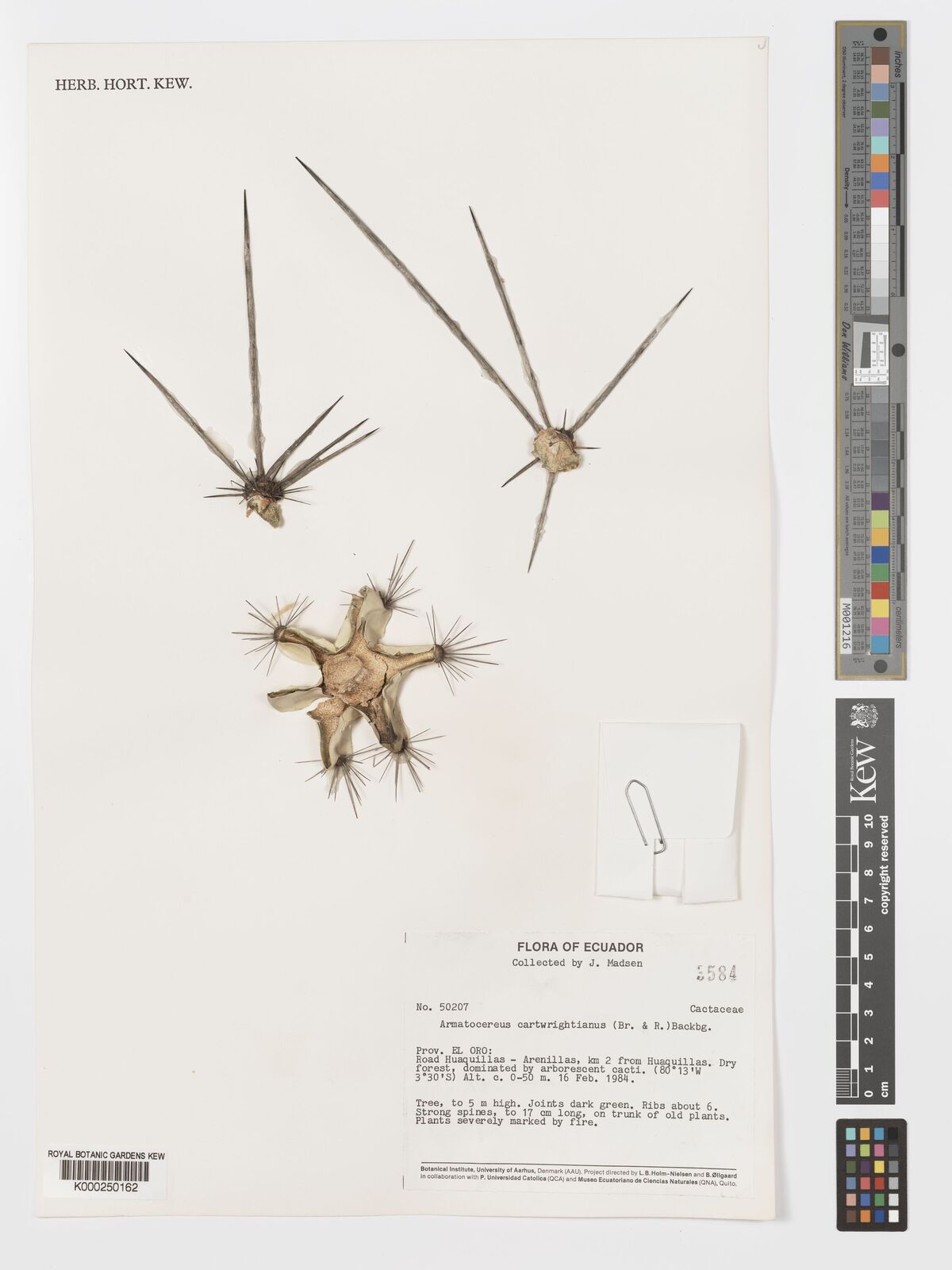 Reference image
Cartwright's Armored Cereus
Armatocereus cartwrightianus is an impressive, tree-like columnar cactus belonging to the family Cactaceae. Known for its robust, multi-branched form and heavy spination, this species is a striking component of South American arid landscapes.
Originally described under the genus Lemaireocereus, it was later combined into Armatocereus 1. The genus name originates from the Latin "armatus" (armed) and "cereus" (candle), referring to its heavily armed ribs. The specific epithet honors Alfred Cartwright, a British consul in Guayaquil, Ecuador 2.
This species is native to the coastal deserts and dry deciduous forest margins of western South America, particularly in southwestern Ecuador and northwestern Peru 2. It thrives in low-elevation, hot, and dry shrublands characterized by prolonged dry seasons.
In its natural habitat, this plant can reach up to 12 meters in height, forming a well-defined woody trunk. The segmented branches are dark green, bearing 7 to 9 deeply notched ribs. The large areoles carry formidable spines that start off yellowish-brown and mature to gray. Nocturnal, funnel-shaped white flowers are followed by edible, spiny reddish fruits.
In cultivation, it requires bright, unfiltered sunlight to maintain its structural integrity and avoid etiolation. A mineral-rich, porous, and fast-draining substrate is critical. Watering should be thorough but infrequent during the active growing season and suspended during the cool winter months.
The most frequent issue is root rot caused by overwatering or soil mixes that retain moisture. Insufficient light leads to weak, thin growth (etiolation), making the massive branches prone to snapping.
Requires full sun or intense direct light for at least 6 hours daily.
Allow soil to dry out fully between waterings; keep almost bone-dry in winter.
Needs an extremely coarse, gritty mix containing pumice, gravel, and sand.
Features extremely sharp, rigid spines. Keep out of reach of children and pets.
Moderate. Requires strict watering discipline to prevent root rot.
Found primarily in the dry deciduous forests and semi-desert coastal areas of southwestern Ecuador and adjacent northwestern Peru, adapting to highly seasonal precipitation.
