
Light
Full Sun
Requires full, direct sun to produce and maintain its protective blue waxy coating.
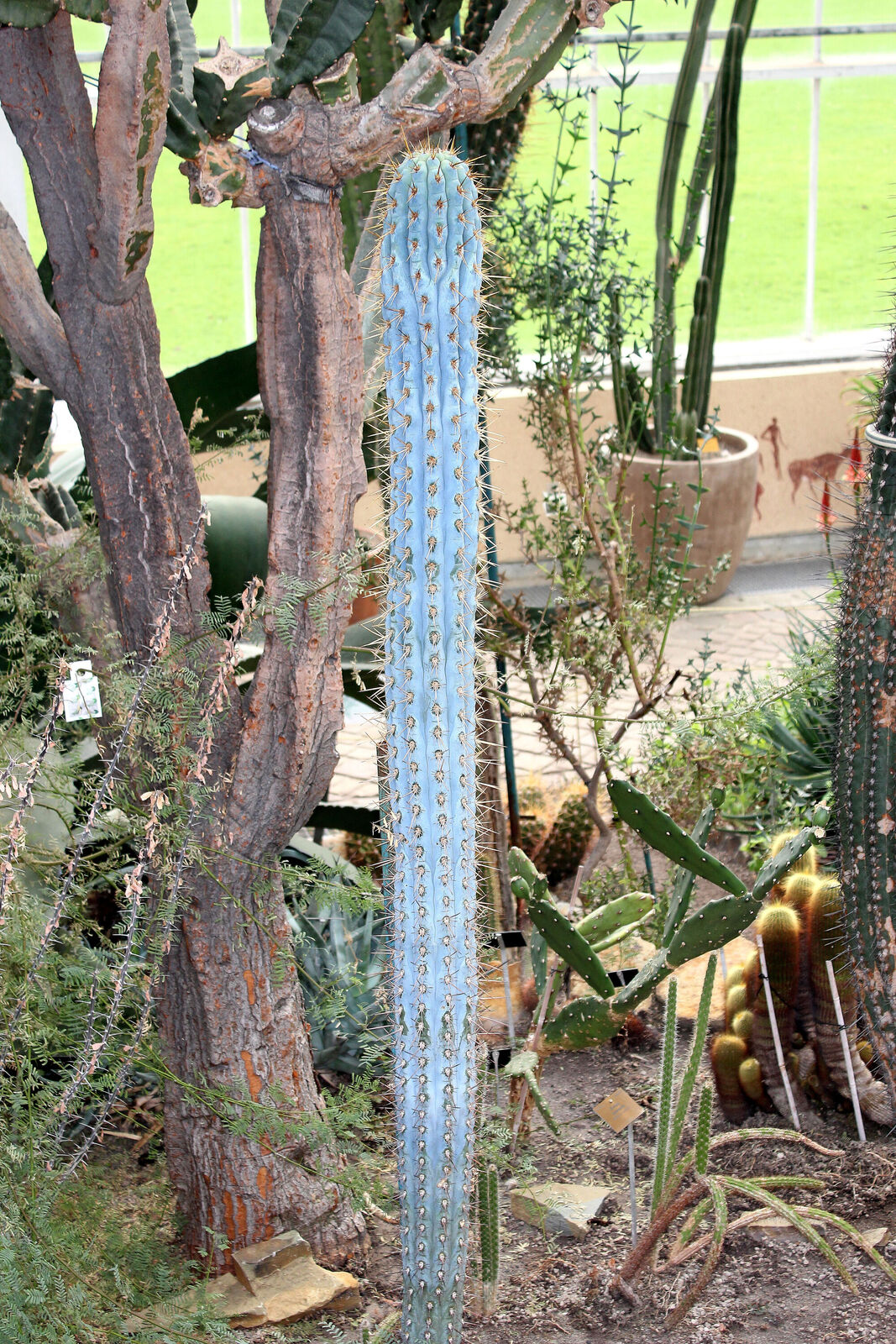 Reference image
Blue Cactus
Browningia hertlingiana, commonly known as the Blue Cactus or Blue Wax Cactus, is a striking, columnar species belonging to the family Cactaceae. Highly prized by collectors for its brilliant metallic blue-azure stem coloration, this plant makes a dramatic statement in xeriscapes and container collections 1.
The genus Browningia is named in honor of W. E. Browning, a former director of the Instituto Inglés in Santiago, Chile. The specific epithet hertlingiana honors the German cactus enthusiast Paul Hertling. It has undergone various taxonomic shifts but remains stable under current Kew databases 2.
This species is native to Western South America, specifically endemic to the dry river valleys of the Andes in Peru. It thrives on rocky, sun-drenched slopes at elevations ranging from 600 to 2,000 meters, adapted to extremely arid and low-nutrient environments 1.
Browningia hertlingiana is a large, tree-like, branching cactus that can reach heights of up to 8 meters in the wild. Its stems are heavily coated with a blue, waxy pruina which protects the plant from intense solar radiation. It features prominent ribs armed with stout, sharp yellowish to brownish spines. Mature specimens produce nocturnal, funnel-shaped white to cream flowers 2.
In cultivation, it requires maximum sunlight to maintain its intense blue coloration. A porous, mineral-rich substrate with excellent drainage is crucial. Water thoroughly during the active growing season (spring and summer) only when the soil is completely dry, and keep dry in winter.
Overwatering and insufficient light are the primary threats. In low light, the plant loses its signature blue wax, becomes etiated (stretched), and is highly prone to root rot 1.
Requires full, direct sun to produce and maintain its protective blue waxy coating.
Strict soak-and-dry method. Keep virtually dry during the cold winter dormancy.
Thrives in mineral-based, gritty cactus mixes containing pumice, perlite, and coarse sand.
Armed with very sharp and sturdy spines. Handle with thick leather gloves and keep away from pets.
Moderate. Easy if you avoid overwatering and provide sufficient, unfiltered sunlight.
Endemic to the inter-Andean valleys of Peru, where it grows on steep, well-draining rocky slopes under harsh, direct equatorial sunlight.
