
Light
Bright Indirect Light
Requires bright indirect light or filtered sun. Strong light is crucial for maintaining its tight, white spine density.
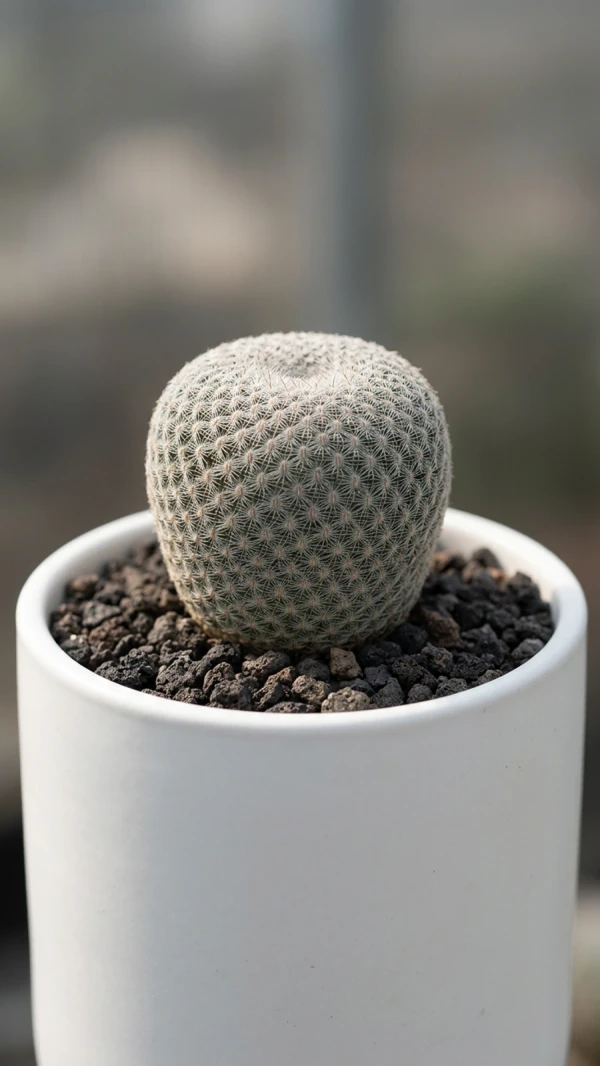
Common Button Cactus
Epithelantha micromeris is one of the smallest and most delicate members of the Cactaceae family. Highly prized by succulent collectors, it is commonly known as the "Button Cactus" due to its miniature, globose growth form and dense covering of tiny white spines 1.
First described by George Engelmann, this species is the type species of the genus Epithelantha. The genus name is derived from the Greek "epí" (upon), "thele" (tubercle), and "anthos" (flower), referring to the position of the flowers near the tubercle tips. The specific epithet "micromeris" translates to "having small parts," highlighting its miniature components 2.
The species is native to southwestern North America, specifically western Texas, southern New Mexico, and northern Mexico (including Coahuila, Chihuahua, Nuevo León, and San Luis Potosí) 1. It grows on rocky limestone slopes, ledges, and gravelly flats within desert shrublands, at elevations ranging from 500 to 1800 meters 2.
This miniature cactus features a globose to short-cylindrical stem, rarely exceeding 5 cm in diameter. The stem is densely covered with hundreds of tiny, white, overlapping radial spines that obscure the green epidermis. In late spring, small pinkish-white flowers emerge from the woolly apex. These are followed by bright red, cylindrical, edible fruits known as "chilitos" 1.
In cultivation, Epithelantha micromeris requires an extremely porous, mostly mineral substrate with added limestone. Watering should be done sparingly during the hot summer months, ensuring the soil dries out completely between waterings. During winter, it must be kept entirely dry. It thrives in bright, indirect light or filtered sun, which helps maintain its dense white spine cover 2.
The most prevalent issue is rot caused by organic-rich soils and overwatering. Lack of sufficient light leads to etiolation, causing the natural globose form to stretch and weaken.
Requires bright indirect light or filtered sun. Strong light is crucial for maintaining its tight, white spine density.
Water only when the substrate is completely dry. Keep absolutely dry during the cold winter months.
Extremely porous mineral mix rich in pumice, coarse grit, and limestone. Avoid organic peat soils.
Non-toxic to pets and humans. Spines are small and dense but not highly dangerous; handle with care.
Slow grower, highly susceptible to rot if overwatered. Requires moderate care and attention to moisture.
Inhabits arid desert areas, specifically rocky limestone hillsides and gravelly ledges throughout Texas, New Mexico, and Northern Mexico.
