
Light
Bright Indirect Light
Thrives in bright indirect light or filtered sun; afternoon shade is recommended in hot climates.
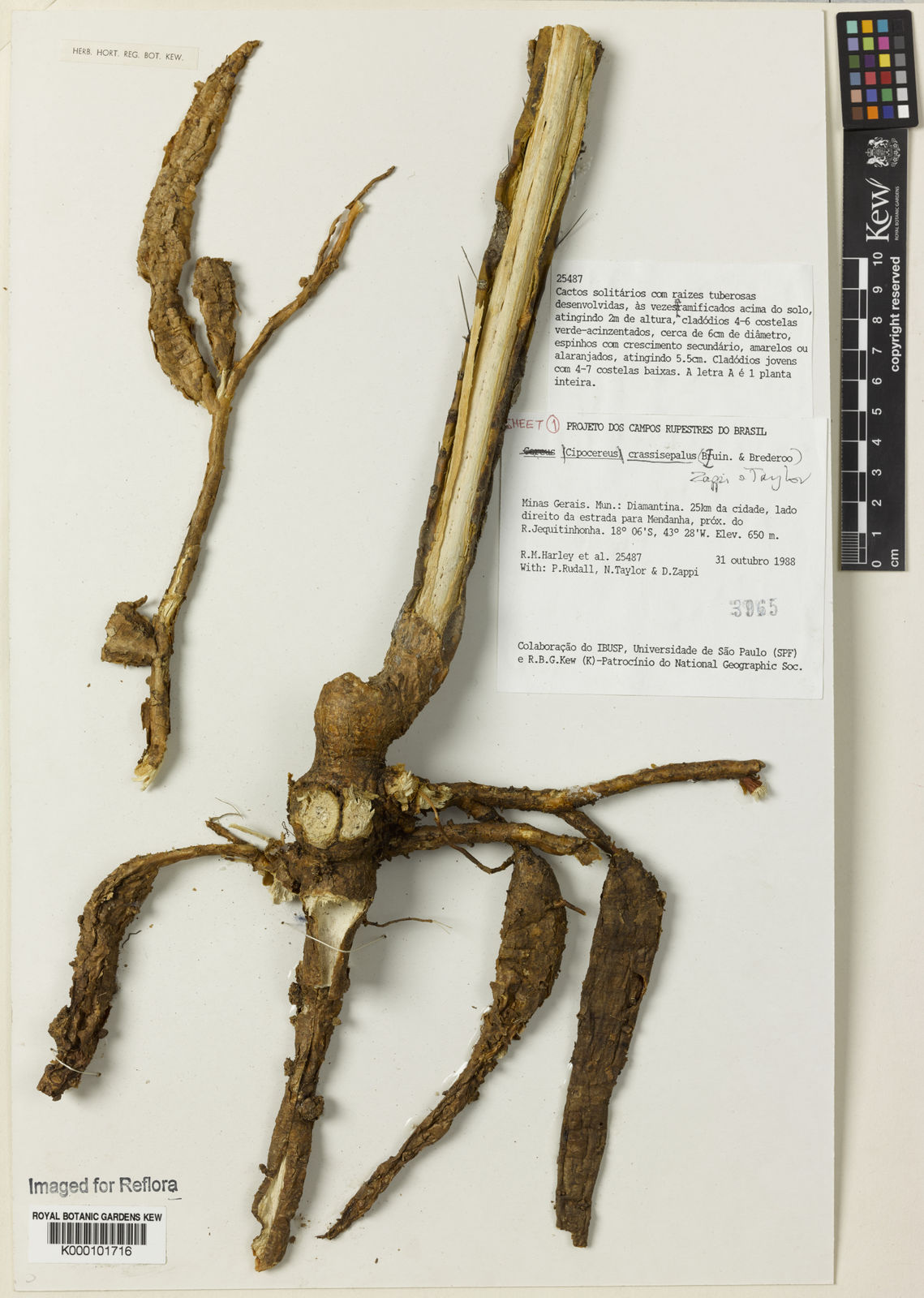 Reference image
Thick-Sepaled Cipocereus
Cipocereus crassisepalus is a rare and striking columnar cactus species endemic to Brazil. Renowned for its distinct glaucous blue stems and robust spine clusters, this succulent shrub is highly sought after by cactus enthusiasts and specialized botanical collections.
Belonging to the genus Cipocereus within the Cactaceae family, this species is closely related to Pilosocereus. The specific epithet 'crassisepalus' translates to 'thick-sepaled' from Latin, highlighting the remarkably thick, fleshy sepals surrounding its floral tube 1.
This species is strictly native to the state of Minas Gerais in southeastern Brazil 2. It thrives at high elevations in rocky, quartzitic habitats known as 'campos rupestres'. These environments are characterized by poor, rocky soils and a seasonally dry tropical climate. Due to habitat loss from quarrying and agricultural expansion, it is listed as Vulnerable (VU) by the IUCN.
Cipocereus crassisepalus exhibits a shrubby, semi-arborescent growth habit, typically reaching heights of 1 to 2 meters. The erect, sparsely branched stems possess 4 to 6 prominent ribs covered in a powdery blue-grey wax. The areoles carry sharp, needle-like spines that range from pale yellow to dark brown. Its nocturnal, funnel-shaped flowers are white or pale cream, adapted for pollination by bats and moths.
In cultivation, it requires conditions that mimic its dry rocky home. High levels of indirect light or filtered sunlight are essential to maintain its blue color. The potting substrate must be extremely porous, consisting mostly of mineral materials like pumice, gravel, and coarse sand. Watering should be deep but infrequent.
The most prevalent failure is root rot caused by organic-heavy soils and poor drainage. Overwatering during the cool winter dormancy will quickly kill the root system. Insufficient light can also lead to etiolation, where the stems stretch and lose their vibrant blue coloration.
Thrives in bright indirect light or filtered sun; afternoon shade is recommended in hot climates.
Allow the potting mix to dry out entirely between waterings. Reduce watering to a minimum in winter.
Requires highly porous, inorganic-rich soil mix with plenty of pumice, coarse sand, and grit.
Equipped with very sharp, stiff spines. Keep out of reach of pets and handle with thick gloves.
Moderate. Requires discipline with watering and protection from cold, damp conditions.
Endemic to southeastern Brazil, specifically the state of Minas Gerais, this cactus is adapted to the harsh conditions of high-altitude rocky savannahs, growing directly in cracks of quartzite rocks under intense sun and seasonal dry spells.
