
Light
Bright Indirect Light
Requires bright, filtered sunlight to maintain its dense, bright silver spine coloration.
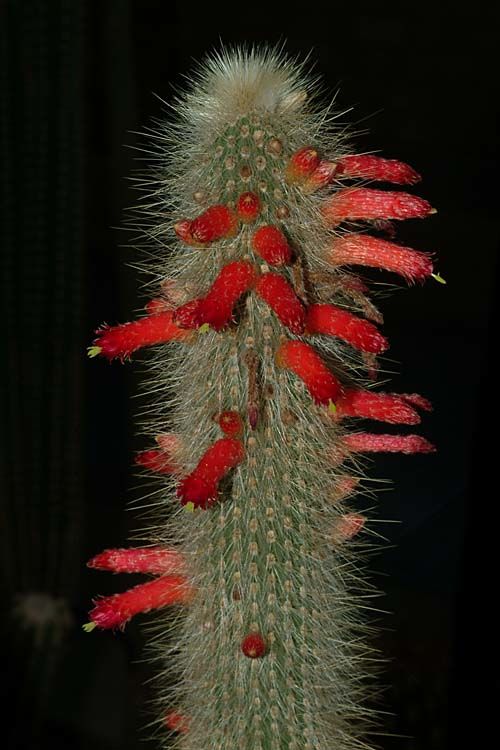 Reference image
Silver Column Cactus
Cleistocactus hyalacanthus is an upright, densely spined columnar cactus in the family Cactaceae. Commonly known as the silver column cactus, this species is highly valued in cultivation for its glistening white spine cover and its contrasting bright reddish-orange tubular flowers that emerge from the sides of the stems 1.
The genus name Cleistocactus derives from the Greek word 'kleistos', meaning closed, referring to the characteristic tubular flowers that rarely open fully. The specific epithet hyalacanthus comes from Latin, translating to 'glassy-spined', a direct reference to the translucent, silvery-white appearance of its dense spines 2.
This species is native to the dry shrublands and high-altitude valleys of western South America, predominantly found in Bolivia and northern Argentina. It typically thrives on rocky slopes and well-draining soils at elevations ranging between 1,500 and 2,500 meters above sea level 1.
Cleistocactus hyalacanthus is a perennial, multi-stemmed succulent subshrub. Individual stems can grow up to 1 meter tall and 5-7 cm in diameter, featuring 15 to 20 shallow ribs. The closely set areoles are packed with 20 to 30 fine, bristly, silver-white spines that envelop the plant. In summer, mature stems produce 3-4 cm long, narrow, tubular pinkish-red flowers adapted for hummingbird pollination 2.
In home cultivation, it is highly resilient. It prefers plenty of bright, indirect sunlight or partial sun. The potting medium must be highly porous and mineral-rich. Water thoroughly during the active spring and summer growth phases, allowing the soil to dry out completely between waterings, and keep almost dry in winter.
Overwatering and poorly drained soils are the primary causes of root rot. Inadequate light results in etiolation, where the stems grow thin, weak, and lose their silvery density. High winter humidity combined with cold temperatures can cause fungal spotting.
Requires bright, filtered sunlight to maintain its dense, bright silver spine coloration.
Water moderately in summer once soil dries, and keep dry during the winter dormancy period.
Requires a highly porous, well-draining mineral mix containing sand, pumice, and grit.
Non-toxic to pets, but the dense, fine spines can cause skin irritation; handle with care.
Very easy to maintain, provided it is not overwatered and is kept dry during the cold season.
Native to the Andean slopes of Bolivia and Northern Argentina, where it thrives in dry, rocky soils under high solar radiation and cool night breezes.
