
Light
Bright Indirect Light
Requires bright, filtered sunlight; benefits from morning sun but needs protection from scorching midday heat.
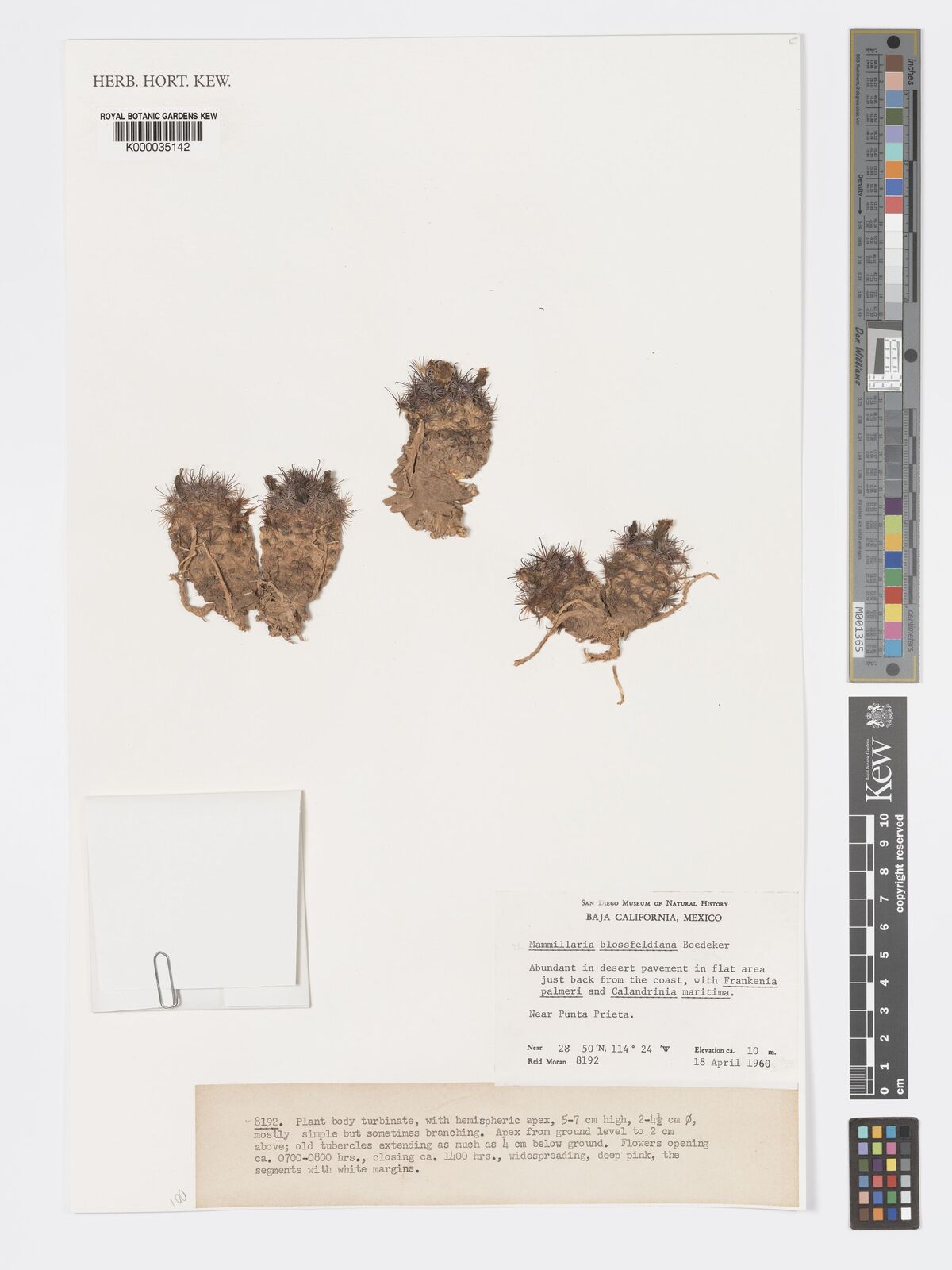 Reference image
Blossfeld's Cochemiea
Cochemiea blossfeldiana (formerly known as Mammillaria blossfeldiana) is a small-growing, cylindrical, perennial succulent subshrub in the family Cactaceae 1. Well-adapted to harsh arid conditions, this species is highly prized among succulent enthusiasts for its stunning, large pink-striped flowers and architectural spination.
The species was first described in 1931 by Friedrich Karl Johann Bödeker under the name Mammillaria blossfeldiana. Recent molecular phylogenetic analyses have reinstated the genus Cochemiea to include this and other hook-spined taxa endemic to Baja California 2. The specific epithet honors Harry Blossfeld, a prominent German plant collector.
Endemic to the Baja California Peninsula of Mexico, Cochemiea blossfeldiana occurs primarily along the coastal desert zones of Baja California and Baja California Sur 3. It thrives in gravelly mineral soils, coastal plains, and rocky hillsides, often subjected to coastal fogs.
Its stems are globose to shortly cylindrical, rarely exceeding 15 cm in height. The stems feature prominent spiraled tubercles, each topped with an areole bearing 15-20 white, needle-like radial spines and 3-4 dark, hooked central spines. The funnelform flowers, appearing in spring and summer, are spectacularly colored with bright pink midstripes and white margins 2.
In cultivation, it requires bright, filtered sunlight with protection from the harshest afternoon sun. It is highly susceptible to rot, requiring an extremely porous mineral substrate and a strict 'soak and dry' watering regimen. Winter watering should be virtually suspended.
Excessive watering and heavy, organic-rich soils are the main causes of mortality, leading to rapid root rot. Keeping the plant in cold, damp conditions during winter will also lead to fungal infections and stem collapse.
Requires bright, filtered sunlight; benefits from morning sun but needs protection from scorching midday heat.
Allow soil to dry out completely between waterings. Suspend watering during the cold winter dormancy.
Extremely gritty, mineral-heavy substrate with high pumice, gravel, and sand content.
Features sharp, hooked central spines that can easily snag skin or clothing. Keep away from pets.
Moderate. Demands careful watering discipline to prevent root rot.
Endemic to the arid coastal plains and rocky slopes of the Baja California Peninsula in Mexico, where it grows in gravelly mineral soils.
