
Light
Direct Sun
Requires full, direct sun for optimal growth, spine development, and spring flowering.
 Reference image
California Fishhook Cactus
Cochemiea dioica (commonly known as the California fishhook cactus) is a perennial, succulent subshrub belonging to the Cactaceae family. Renowned for its distinctive hooked spines and delicate cream-colored blossoms, it is a highly resilient desert species popular among succulent collectors 1.
Originally described within the genus Mammillaria as Mammillaria dioica, recent phylogenetic studies have reassigned this species to Cochemiea. The specific epithet 'dioica' refers to its tendency toward dioecy, meaning individual plants often bear either predominantly male or female flowers, which is relatively rare among cacti 2.
This species is native to the Southwestern United States, particularly southern California, and northwestern Mexico, including the Baja California peninsula and Sonora. It thrives in desert scrub, coastal sage scrub, and rocky slopes at elevations ranging from sea level up to 1,500 meters 1.
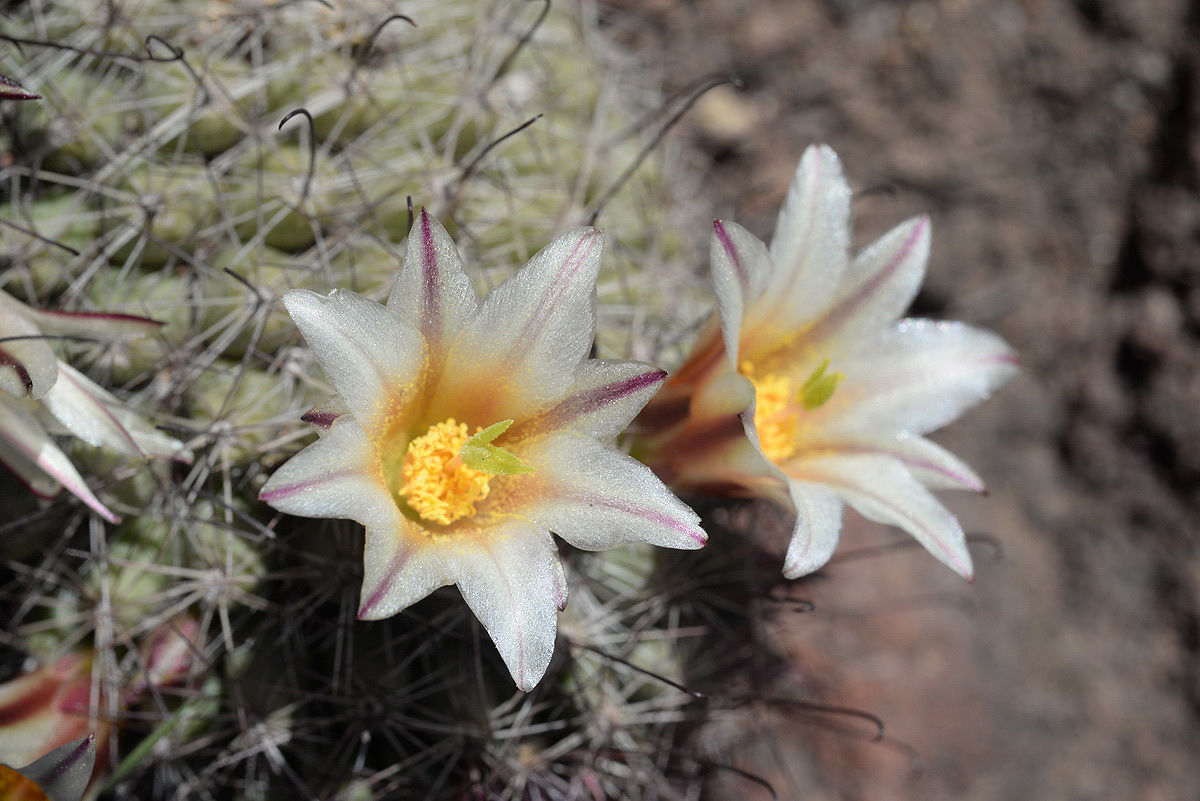
The cactus features cylindrical, bluish-green stems that typically cluster from the base. It can grow up to 25-35 cm tall. The defining feature is the array of spines per areole, highlighted by a central, dark-colored hook. In spring, it produces funnel-shaped cream-yellow flowers, followed by bright red, edible cylindrical fruits 2.
It requires full sun and exceptionally well-drained gravelly or sandy soil. During the active spring and summer growth phases, water only when the substrate is completely dry. Keep dry in winter.
Overwatering and using heavy clay soils are the primary causes of root rot. Inadequate direct sunlight leads to weak, stretched growth (etiolation).
Requires full, direct sun for optimal growth, spine development, and spring flowering.
Water thoroughly only when the soil is bone dry. Suspend watering almost entirely in winter.
A mineral-rich, quick-draining cactus soil containing high proportions of pumice and coarse grit.
The prominent hooked spines can easily snag clothing or skin. Keep out of reach of pets and children.
Very easy to maintain, provided you avoid overwatering and keep the plant in a bright, warm spot.
Naturally distributed across the arid reaches of southern California down into the Baja California peninsula of Mexico, where it populates rocky hillsides and gravelly desert slopes.
