
Light
Direct Sun
Requires at least 6 hours of direct sunlight daily; partial shade will lead to weak, pale growth.
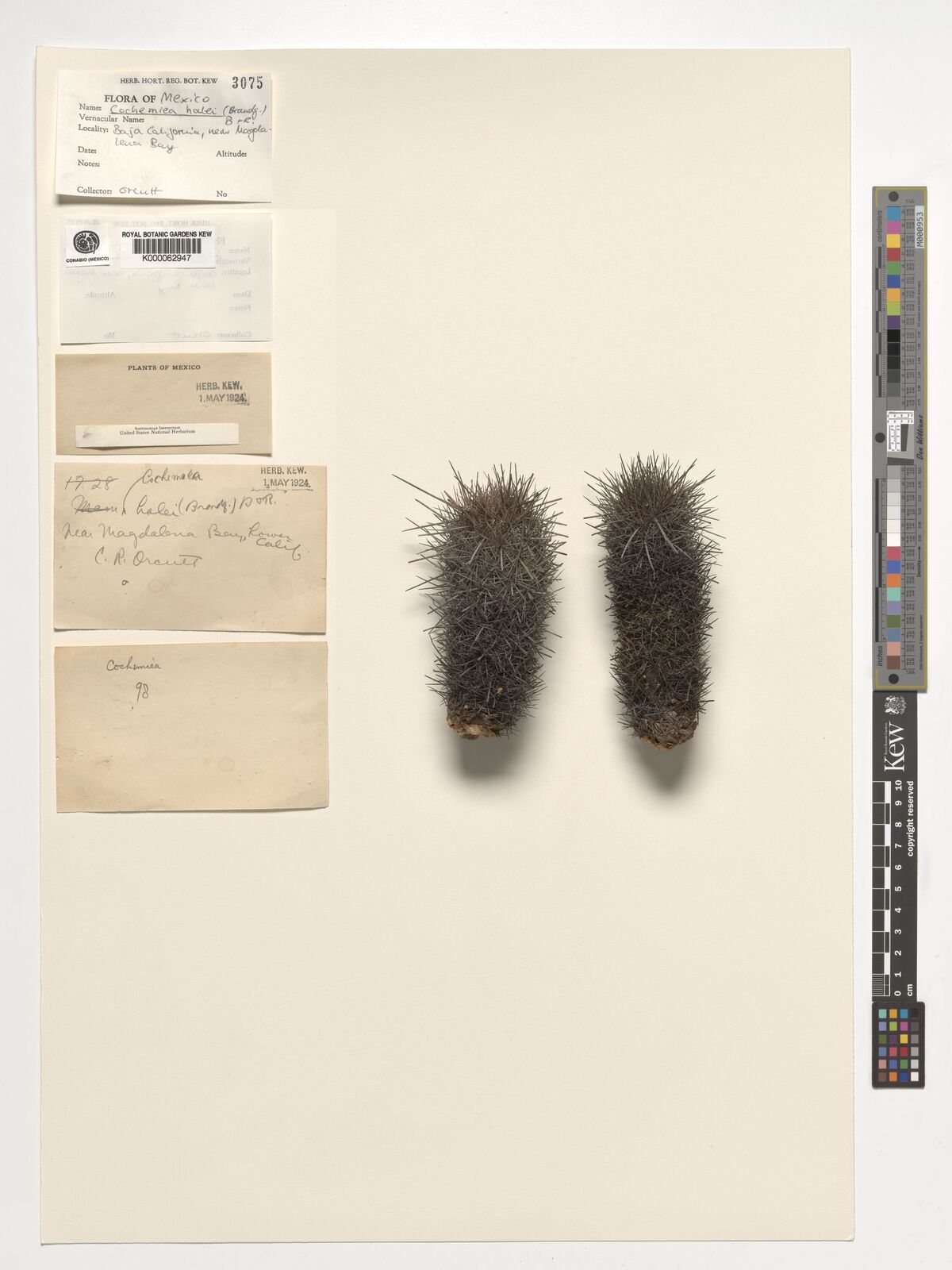 Reference image
Hale's Cochemiea
Cochemiea halei (synonym Mammillaria halei) is a striking, shrubby succulent cactus species endemic to Mexico. Characterized by its clustering growth habit and vibrant red tubular flowers, it is highly prized among cactus collectors for its unique ornamental and structural appeal.
This species was first described in 1889 by the American botanist Townshend Stith Brandegee. The specific epithet honors Josiah Hale, who supported historical scientific expeditions in Baja California 1. Recent phylogenetic research has resurrected the genus Cochemiea, placing this species out of Mammillaria due to distinct morphological and genetic characteristics 2.
Cochemiea halei is native to Mexico, restricted to the islands of Santa Margarita and Magdalena off the coast of Baja California Sur 3. It thrives in desert environments, coastal sandy plains, and rocky volcanic outcrops at low elevations near sea level.
The plant forms dense clumps of cylindrical stems reaching heights of 30 to 50 cm. Stems are covered with prominent tubercles. The areoles bear strong, rigid, yellowish-brown to grayish spines. Its most remarkable feature is the tubular, zygomorphic scarlet-red flower, adapted for pollination by hummingbirds.
In cultivation, it requires full sun exposure to maintain its compact habit and spine color. It demands extremely well-draining, mineral-based soil mixes. Watering should be sparse, conforming to the wet-dry cycle during summer, and ceased in winter. It prefers dry conditions with minimum temperatures not dropping below 5°C.
The most prevalent issue is root rot triggered by overwatering or soil mixes with organic water retention. Lack of bright light leads to etiolation, stretching the stems and weakening the plant's natural pest defenses.
Requires at least 6 hours of direct sunlight daily; partial shade will lead to weak, pale growth.
Water thoroughly only when the soil is completely dry. Suspend watering during the cold winter months.
Needs a very porous soil mix containing plenty of pumice, perlite, and coarse sand.
Equipped with sharp, rigid spines. Handle with thick gloves. Non-toxic to cats and dogs.
Moderate. Easy if watering is strictly controlled, but highly susceptible to rot from excess moisture.
Endemic to the islands of Magdalena and Santa Margarita off the western coast of Baja California Sur, Mexico. It grows primarily in sandy coastal areas and rocky, dry volcanic soils under coastal desert climates.
