
Light
Bright Indirect Light
Thrives in bright, filtered sunlight, requiring protection from scorching direct afternoon sun.
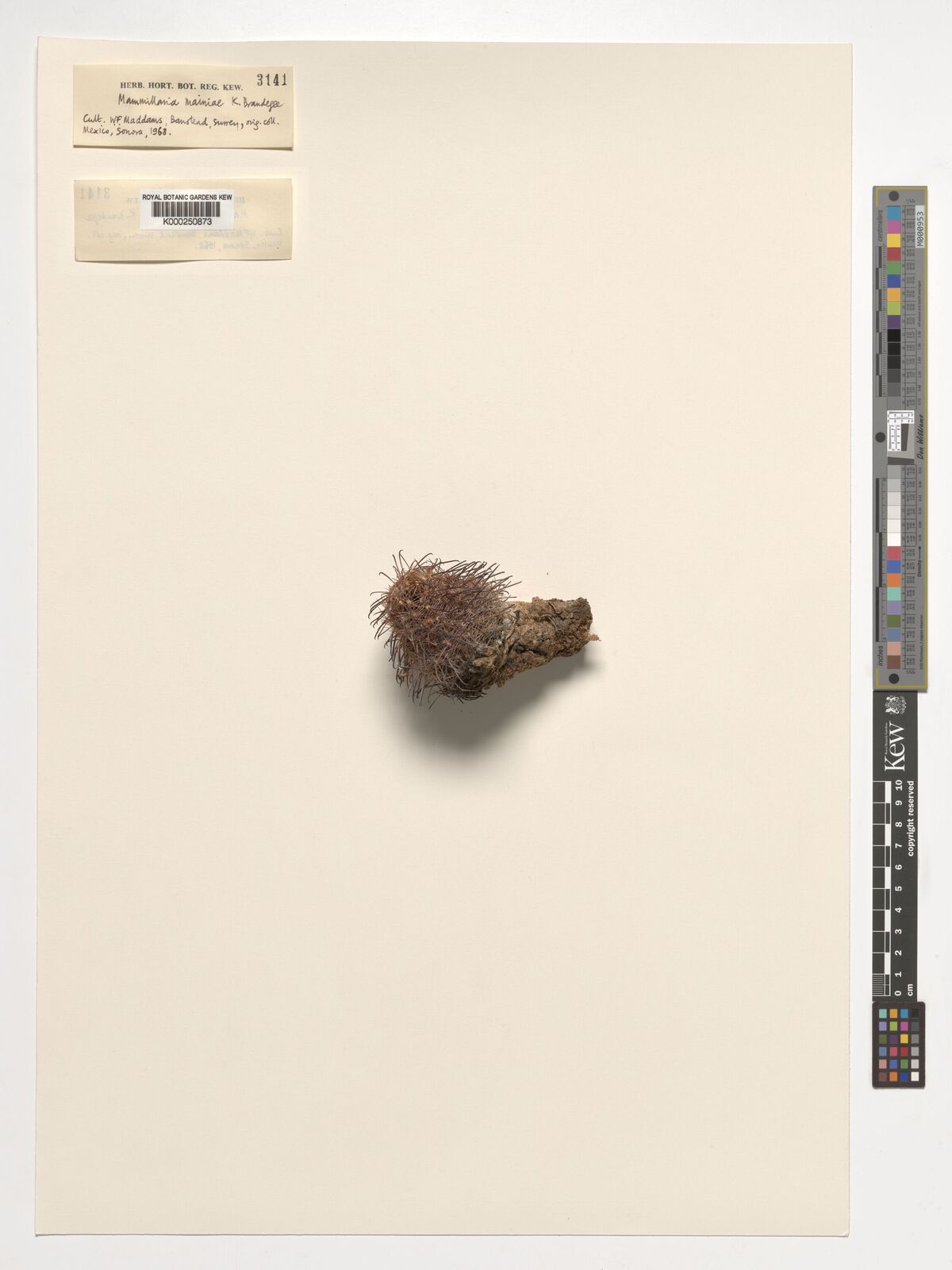 Reference image
Cochemiea mainiae is a highly specialized succulent subshrub belonging to the cactus family (Cactaceae). Revered among cactus enthusiasts, this species is well-adapted to surviving the harsh, arid conditions of North American deserts, showing off characteristic hooked spines and delicate pink-striped blossoms 1.
Originally described as Mammillaria mainiae, recent phylogenetic and morphological studies have transferred this species to the genus Cochemiea 2. The specific epithet "mainiae" honors the original discoverer or collector of the plant. The genus Cochemiea is characterized by its hooked central spines and distinct floral tube morphology, native to the arid zones of northwestern Mexico and the southwestern United States.
This species is naturally distributed across the Sonora desert region, spanning the Mexican states of Sonora (MXNSO), Baja California (MXNBC, MXN_BS), and extending into southern Arizona (ARI) in the United States 1. It thrives on rocky slopes, alluvial plains, and dry shrublands, often growing under the protective canopy of nurse plants or desert shrubs.
The stems of Cochemiea mainiae are globose to short-cylindrical, often clustering from the base with age. The stem surfaces are divided into prominent tubercles. From each areole, stiff spines arise, featuring at least one central spine that is sharply hooked, displaying a reddish-brown to yellowish tint. During the late spring, it produces funnel-shaped flowers with white petals marked by prominent pink or magenta midstripes.
In cultivation, Cochemiea mainiae requires a careful watering hand. It must be potted in a highly porous, mineral-rich substrate containing pumice, coarse sand, and grit 2. Watering should be thorough but infrequent, allowing the potting medium to dry out completely between waterings. During winter dormancy, watering must be suspended almost entirely to prevent root issues.
The most common pitfall is the use of standard peat-based soils that retain moisture for too long, leading to root rot. Keeping the plant in poorly ventilated areas with low light during winter also causes etiolation, weak spine growth, and increased susceptibility to pests.
Thrives in bright, filtered sunlight, requiring protection from scorching direct afternoon sun.
Allow the soil to dry out completely throughout the pot before watering again; keep dry in winter.
Use a high-mineral cactus mix containing coarse sand, pumice, and grit to ensure excellent drainage.
Non-toxic to pets, but the sharp hooked spines pose a physical hazard to curious animals and children.
Moderate care difficulty due to its high sensitivity to overwatering and specific drainage needs.
This cactus inhabits the gravelly slopes and sandy plains of the Sonoran Desert. It frequently grows tucked under desert shrubs, utilizing them as nurse plants to survive the intense heat and dry winds of its native habitat.
