
Light
Direct Sun
Requires full, direct sun for at least 6 hours daily to maintain its shape and promote heavy blooming.
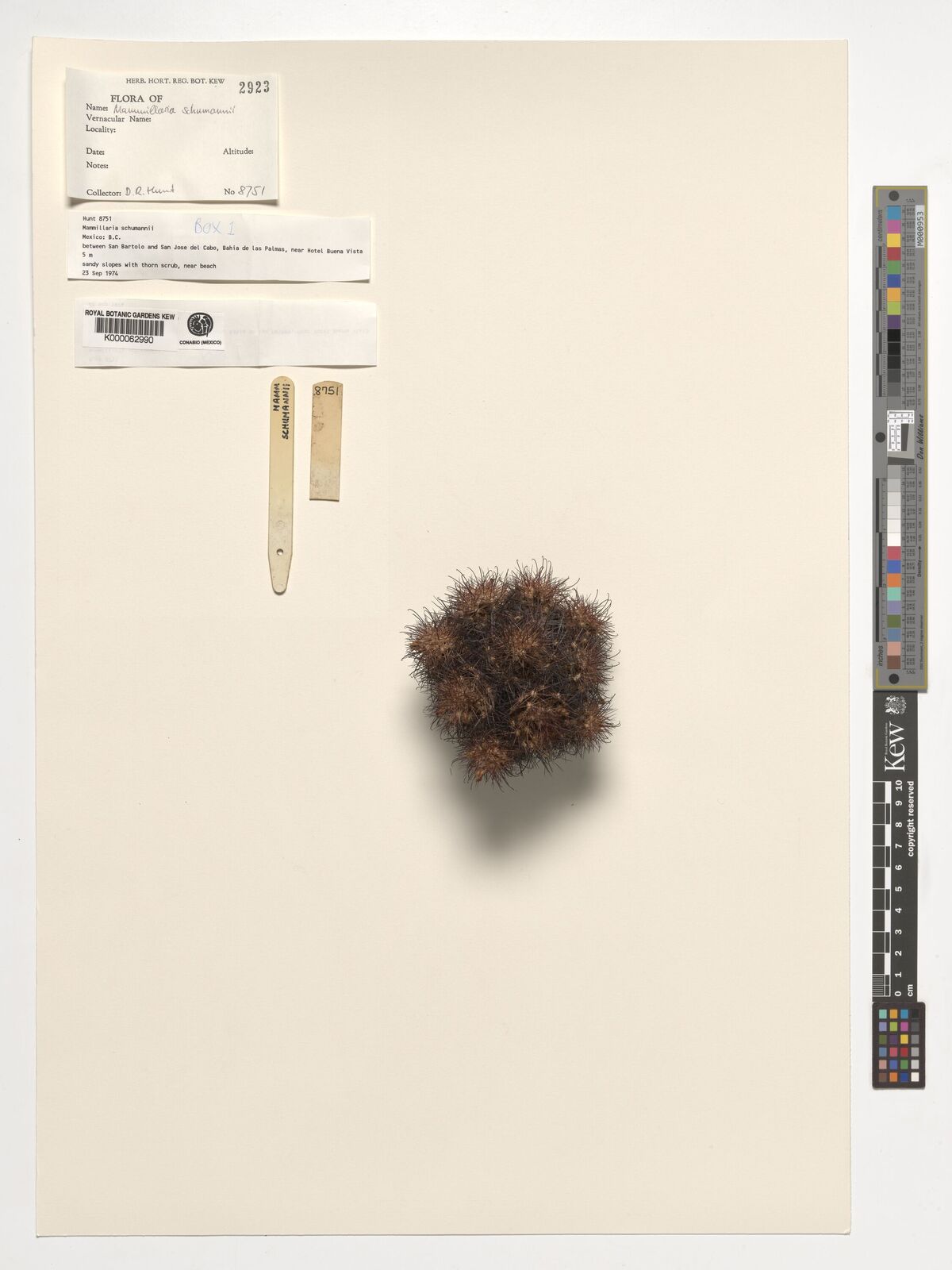 Reference image
Schumann's Cochemiea
Cochemiea schumannii (formerly widely known as Mammillaria schumannii) is a small, clump-forming succulent subshrub belonging to the Cactaceae family. This species is highly prized among collectors for its striking hook-shaped spines and disproportionately large, bell-shaped pink-magenta flowers that appear in summer 1.
Named in honor of the German botanist Karl Schumann, this species was historically classified within the massive genus Mammillaria. Recent molecular and phylogenetic studies have resurrected and expanded the genus Cochemiea, housing this and other closely related Baja California endemics 2.
This species is endemic to Mexico, specifically the southern portion of the Baja California peninsula (Baja California Sur). It thrives at low elevations from sea level up to 200 meters, typically growing on rocky slopes, granitic gravels, and dry shrublands.
The stems are globose to shortly cylindrical, light green to grayish-green, and grow up to 6 cm in height. The tubercles are short and rounded, bearing sharp spines. Each areole features a distinct, strongly hooked central spine. Its magnificent flowers are bright rose-pink, reaching up to 4 cm in diameter.
In cultivation, Cochemiea schumannii demands maximum light and excellent ventilation. It is highly susceptible to rot if overwatered, requiring a strictly porous, mineral-heavy substrate. Water thoroughly only when the soil has dried out completely.
The most prevalent issue is root rot caused by watering during cold, humid winter months or using organic-heavy soil. Lack of direct sunlight leads to etiolation, where the plant stretches and loses its compact shape.
Requires full, direct sun for at least 6 hours daily to maintain its shape and promote heavy blooming.
Water sparingly in summer after the soil is bone dry. Keep almost completely dry in winter.
Extremely porous mineral substrate containing pumice, gravel, and minimal organic matter.
Features sharp, hooked central spines that can easily snag skin or clothing. Keep away from pets.
Requires strict watering discipline due to high sensitivity to excess moisture; moderate difficulty.
Endemic to the arid coastal plains and stony slopes of southern Baja California, Mexico, where it grows in granitic soils alongside desert scrub.
