
Light
Bright Indirect Light
Requires bright indirect light or filtered sun; avoid scorching midday summer sun.
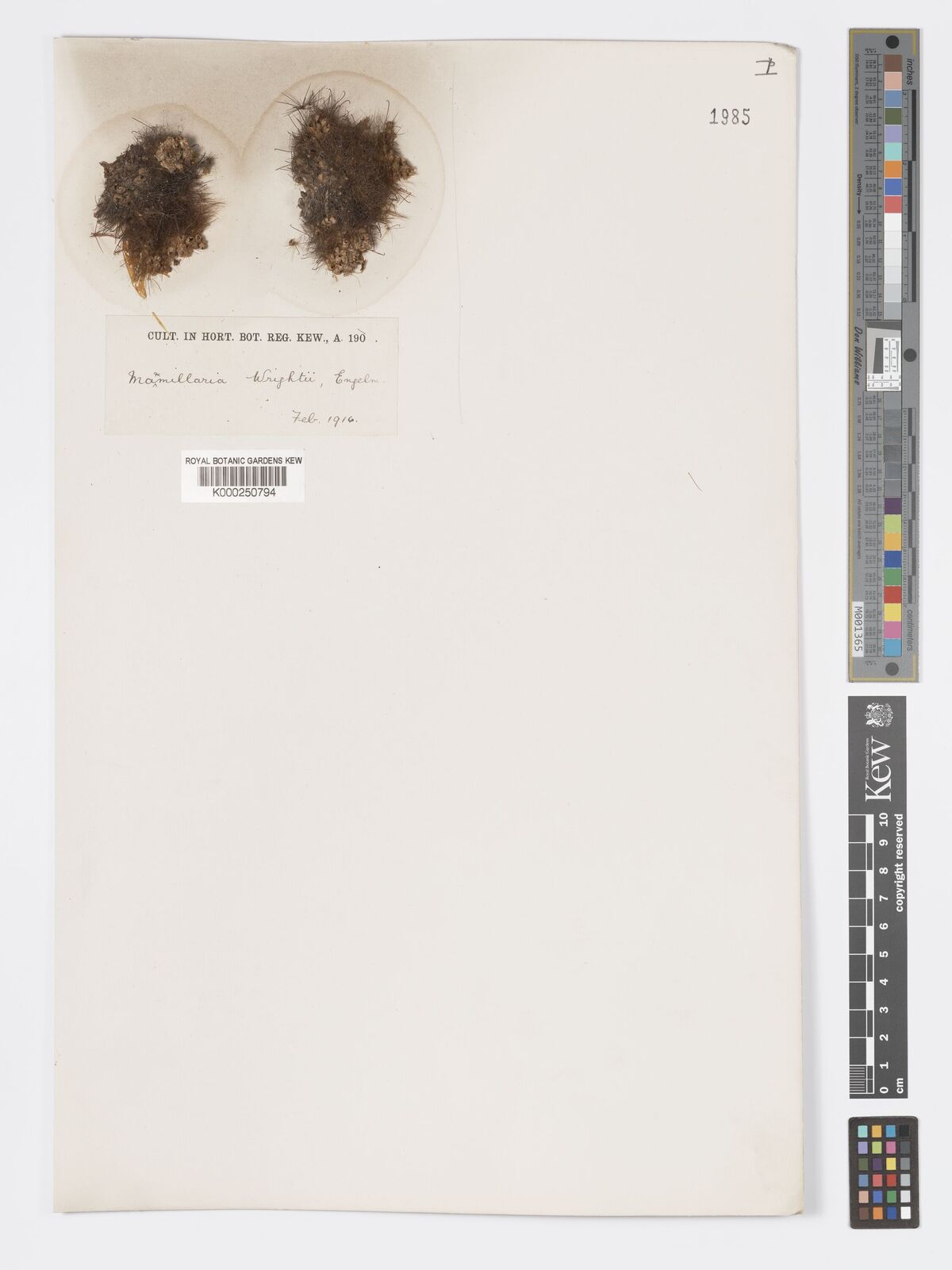 Reference image
Wright's Fishhook Cactus
Cochemiea wrightii (formerly known as Mammillaria wrightii) is a small, typically solitary cactus species within the Cactaceae family, highly prized for its large, showy purple-pink flowers and distinctive hooked central spines.
The species epithet honors Charles Wright, a prominent 19th-century American botanical collector 1. Recent molecular phylogenetic studies have led to the reclassification of this species from the genus Mammillaria into Cochemiea 2.
Native to the southwestern United States (Arizona, New Mexico) and northern Mexico (Sonora, Chihuahua). It typically occurs at elevations of 1000 to 2300 meters, growing in desert grasslands, rocky slopes, and dry shrublands.
The stem is globose to short-cylindric, greyish-green, and grows up to 8 cm in diameter. It features prominent tubercles topped with radial spines and 1-3 hooked, dark central spines. Its magenta flowers are exceptionally large relative to the body size.
In cultivation, it requires an extremely porous, mineral-based substrate. Watering should be thorough but infrequent during the active growing season, and completely suspended during the cold winter months to prevent rot.
Overwatering is the primary cause of failure, quickly leading to basal stem rot. Insufficient light exposure will result in etiolation, causing the compact spherical stem to become weak and unnaturally elongated.
Requires bright indirect light or filtered sun; avoid scorching midday summer sun.
Allow the soil to dry out completely between waterings; keep dry in winter.
Exclusively mineral-based mix with high proportion of pumice, grit, and coarse sand.
Features sharp hooked spines that hook easily into skin or clothing. Non-toxic.
Moderate. Demands strict watering discipline to avoid root loss.
Native to high-elevation desert grasslands and rocky volcanic slopes across Arizona, New Mexico, Sonora, and Chihuahua, often growing nestled under low shrubs.
