
Light
Bright Indirect Light
Requires abundant bright, filtered sunlight to retain its dense golden spine coat and prevent etiolation.
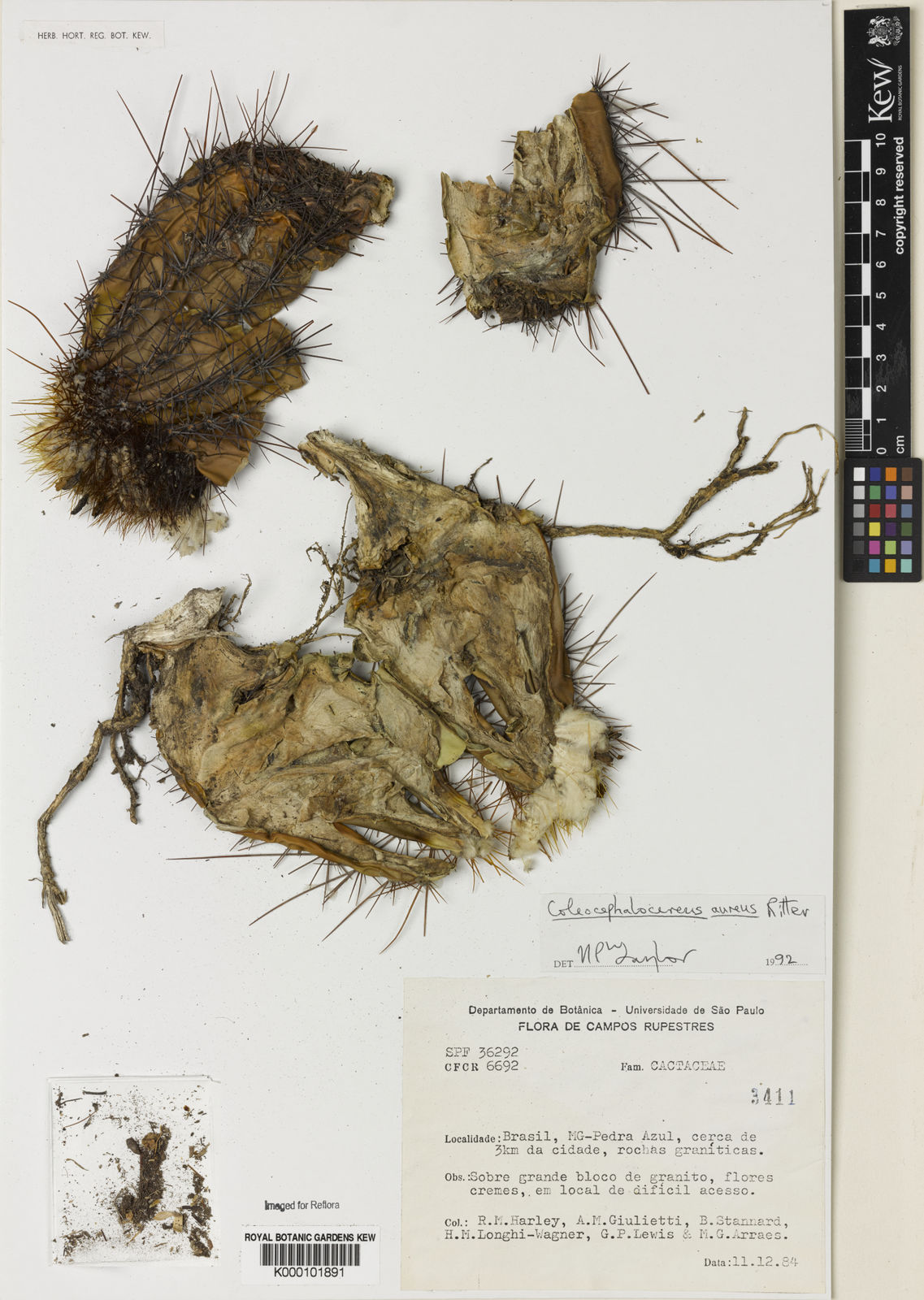 Reference image
Golden Cephalocereus
Coleocephalocereus aureus is a rare and striking columnar cactus within the family Cactaceae. It is highly valued among collectors for its dense golden-yellow spination and the distinct lateral cephalium that develops on mature stems to bear flowers.
Belonging to the genus Coleocephalocereus, this species was first formally described by botanists Friedrich Ritter and Albert Frederik Hendrik Buining 1. The specific epithet aureus is Latin for "golden," directly referring to the bright, lustrous golden-yellow needles that densely cover its ribs 2.
This species is endemic to eastern Brazil, specifically within the state of Minas Gerais 1. It is restricted to seasonally dry tropical biomes, growing primarily in crevices of quartzite and gneiss rock outcrops on steep rocky slopes. Due to habitat loss from agriculture and quarrying, it is classified as Vulnerable (VU) on the IUCN Red List 2.
The plant features cylindrical, erect stems that can clump from the base over time, reaching heights of up to 1 meter. Stems typically present 10 to 15 well-defined ribs. The areoles are closely set, producing abundant, stiff golden-yellow spines. As the stem matures, it develops a lateral woolly cephalium covered with cream-yellow wool and brownish bristles. Nocturnal flowers emerge from this cephalium, presenting pale yellow to greenish-yellow petals.
In cultivation, Coleocephalocereus aureus requires bright, indirect sunlight or partially filtered sun to maintain its golden color and prevent etiolation. It demands a highly porous, mineral-based potting medium with excellent drainage. Water thoroughly during the hot summer months only after the soil is completely dry, and suspend watering almost entirely during winter dormancy.
Overwatering is the primary cause of failure, quickly leading to root and basal stem rot, especially during cooler winter months. Inadequate lighting is another common mistake, which causes the cactus to grow thin, weak stems and lose the characteristic density and brilliance of its golden spines.
Requires abundant bright, filtered sunlight to retain its dense golden spine coat and prevent etiolation.
Water only when the substrate is completely dry. Keep nearly bone-dry during the cold winter months.
Requires a highly porous mineral mix containing pumice, volcanic grit, and coarse sand.
Non-toxic to pets, but the very sharp, dense golden spines can cause physical injury; handle with care.
Moderate difficulty due to specific watering limits and susceptibility to cold-wet rot.
Endemic to the state of Minas Gerais in eastern Brazil, where it grows anchored in the cracks of steep quartzite cliffs and rocky outcrops within seasonally dry tropical zones.
