
Light
Bright Indirect Light
Requires abundant bright, filtered sunlight to maintain its compact growth and produce its unique woolly cephalium.
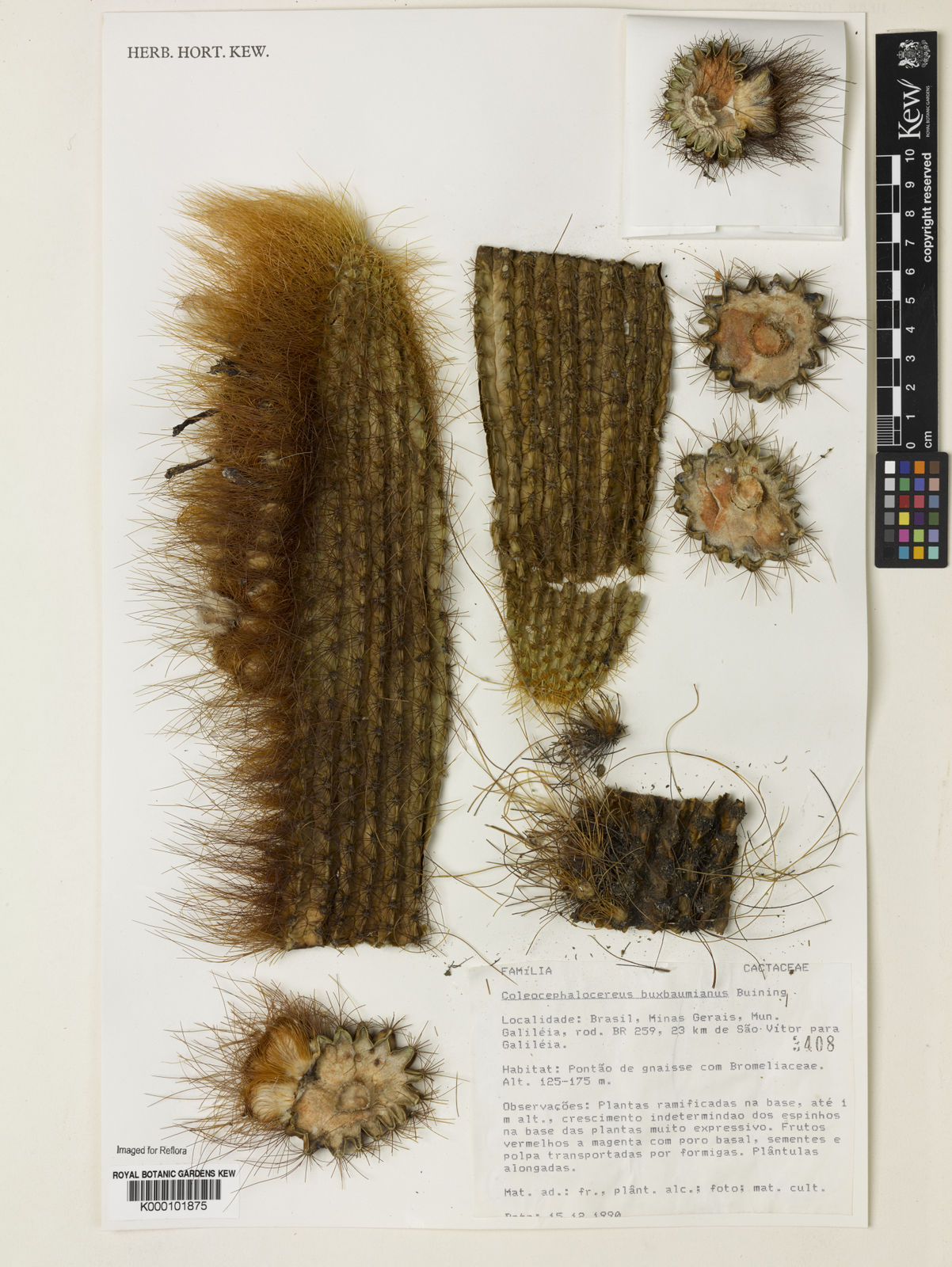 Reference image
Buxbaum's Coleocephalocereus
Coleocephalocereus buxbaumianus is a striking, columnar cactus species belonging to the Cactaceae family. Highly prized by succulent enthusiasts, it is famous for developing a distinct, woolly lateral cephalium (flower zone) along one side of its stem as it reaches maturity 1.
Named in honor of the renowned Austrian botanist Franz Buxbaum, the genus name Coleocephalocereus originates from the Greek words "koleos" (sheath) and "kephale" (head), referencing the protective woolly structure from which the flowers emerge 2.
This species is endemic to eastern and southeastern Brazil, specifically within the states of Minas Gerais and Espírito Santo. It thrives in seasonally dry tropical biomes, growing on rocky outcrops, granite inselbergs, and steep slopes where drainage is instantaneous and sun exposure is intense 1.
The stems are erect, dark green, and can reach up to 1.5 meters in height, often branching from the base. They feature 10 to 18 ribs adorned with brownish spines. Upon reaching maturity, a dense lateral cephalium composed of creamy-white wool and golden-brown bristles develops on one side of the stem. Nocturnal, tubular flowers that are white to yellowish-cream emerge directly from this woolly band 2.
In cultivation, Coleocephalocereus buxbaumianus requires warm conditions and plenty of bright, indirect sunlight to thrive. Because of its susceptibility to root rot, the substrate must be highly mineral and porous. Water should be applied thoroughly only when the soil is completely dry, and temperatures should ideally remain above 10°C during winter dormancy 1.
Overwatering during the cold, dormant winter months is the primary cause of plant loss. Insufficient light exposure will lead to etiolation (pale, stretched growth) and prevent the development of its signature lateral cephalium 2.
Requires abundant bright, filtered sunlight to maintain its compact growth and produce its unique woolly cephalium.
Water moderately during spring and summer; keep almost completely dry in winter to prevent root and stem rot.
Requires a highly porous, mineral-rich substrate containing plenty of pumice, gravel, and coarse sand.
Non-toxic to pets, but possesses sharp spines and bristles. Handle with care and keep away from high-traffic areas.
Moderately easy if overwatering is avoided and winter temperatures are kept warm enough.
Found growing on rocky granite slopes and inselbergs within the seasonally dry tropical regions of eastern Brazil.
