
Light
Bright Indirect Light
Requires abundant bright, filtered sunlight. Protect from intense, scorching midday sun in summer.
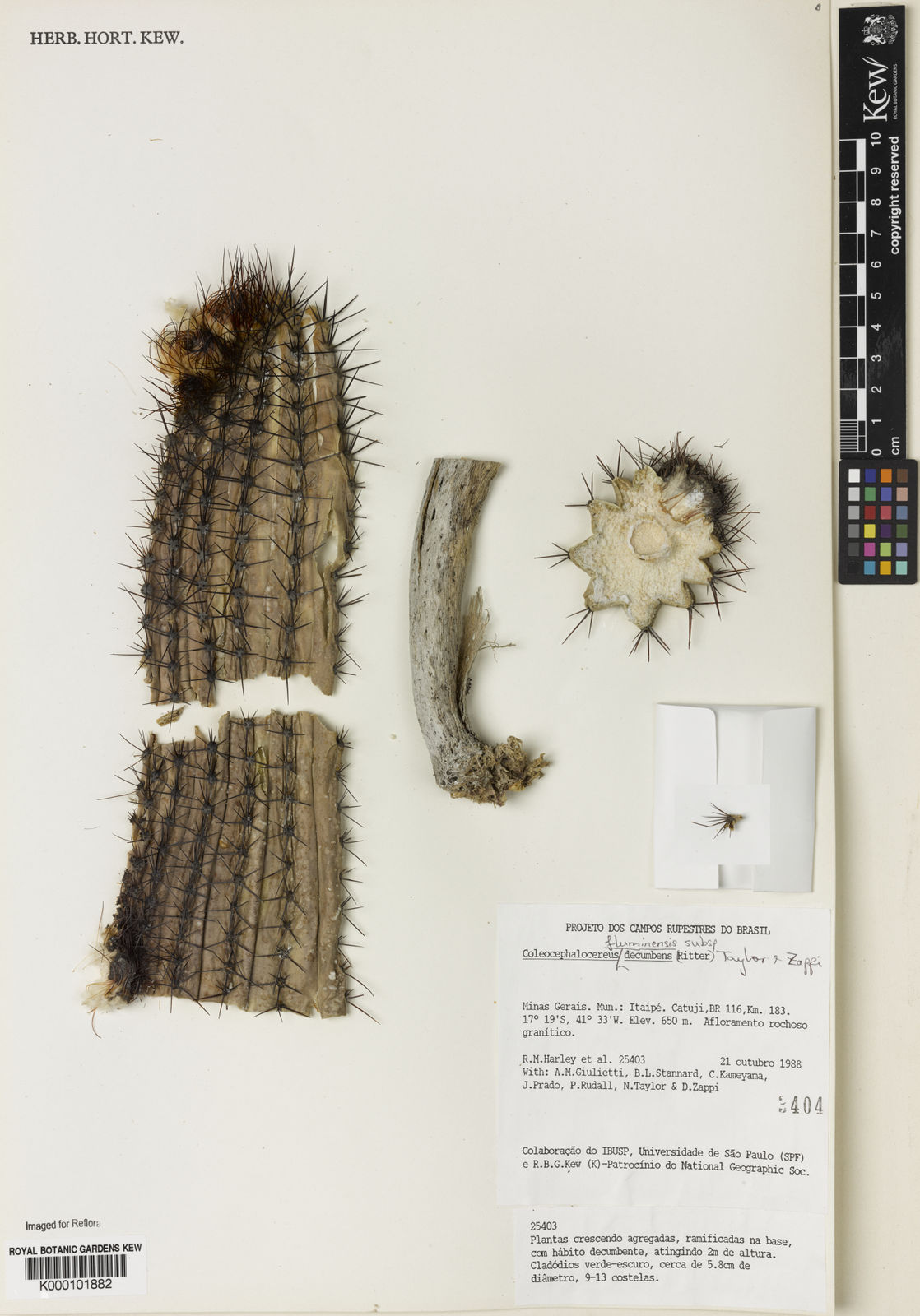 Reference image
Decumbent Head-Cactus
Coleocephalocereus decumbens is a unique and sought-after succulent shrub in the Cactaceae family, known for its prostrate or decumbent growth habit. Unlike many columnar cacti, it sprawls close to the ground and develops a specialized lateral cephalium from which flowers emerge.
Described by botanist Curt Backeberg, the species belongs to the genus Coleocephalocereus. The specific epithet decumbens refers to its characteristic low-growing, trailing stems that recline on the rocky substrates of its native habitat 1.
This species is endemic to eastern Brazil, particularly in the states of Minas Gerais and Bahia 2. It thrives in seasonally dry tropical biomes, growing on rocky outcrops, crystalline quartz fields, and shallow, nutrient-poor soils.
The stems are cylindrical, pale to bright green, with multiple ribs lined with clusters of yellowish-brown spines. As the plant matures, a lateral cephalium—a dense strip of woolly white hairs and bristles—develops along one side of the stem. Small, nocturnal, tubular white or cream-colored flowers bloom from this woolly structure, followed by small red fruits.
In cultivation, it requires an extremely porous, mineral-rich substrate. It prefers bright, indirect sunlight or partially filtered sun. Water thoroughly during the active growing season in spring and summer, allowing the soil to dry out completely between waterings.
Overwatering and poor drainage are the primary causes of failure, quickly leading to root and stem rot. Placing the plant in low-light conditions causes thin, weak growth (etiolation) and prevents the development of the characteristic cephalium.
Requires abundant bright, filtered sunlight. Protect from intense, scorching midday sun in summer.
Water thoroughly only when the soil is 100% dry. Reduce watering to a bare minimum in winter.
Excellent drainage is vital. Use a mineral-based mix with plenty of pumice, gravel, and coarse sand.
Features sharp, rigid spines. Place away from high-traffic areas, children, and curious pets.
Moderate. Needs attentive watering and high-quality drainage to prevent rot.
Native to eastern Brazil, specifically within the rocky outcrops and dry tropical landscapes of Minas Gerais and Bahia, where it clings to quartz-rich soils.
