
Light
Bright Indirect Light
Requires bright, indirect sunlight or filtered sun to maintain its natural shape and spine color.
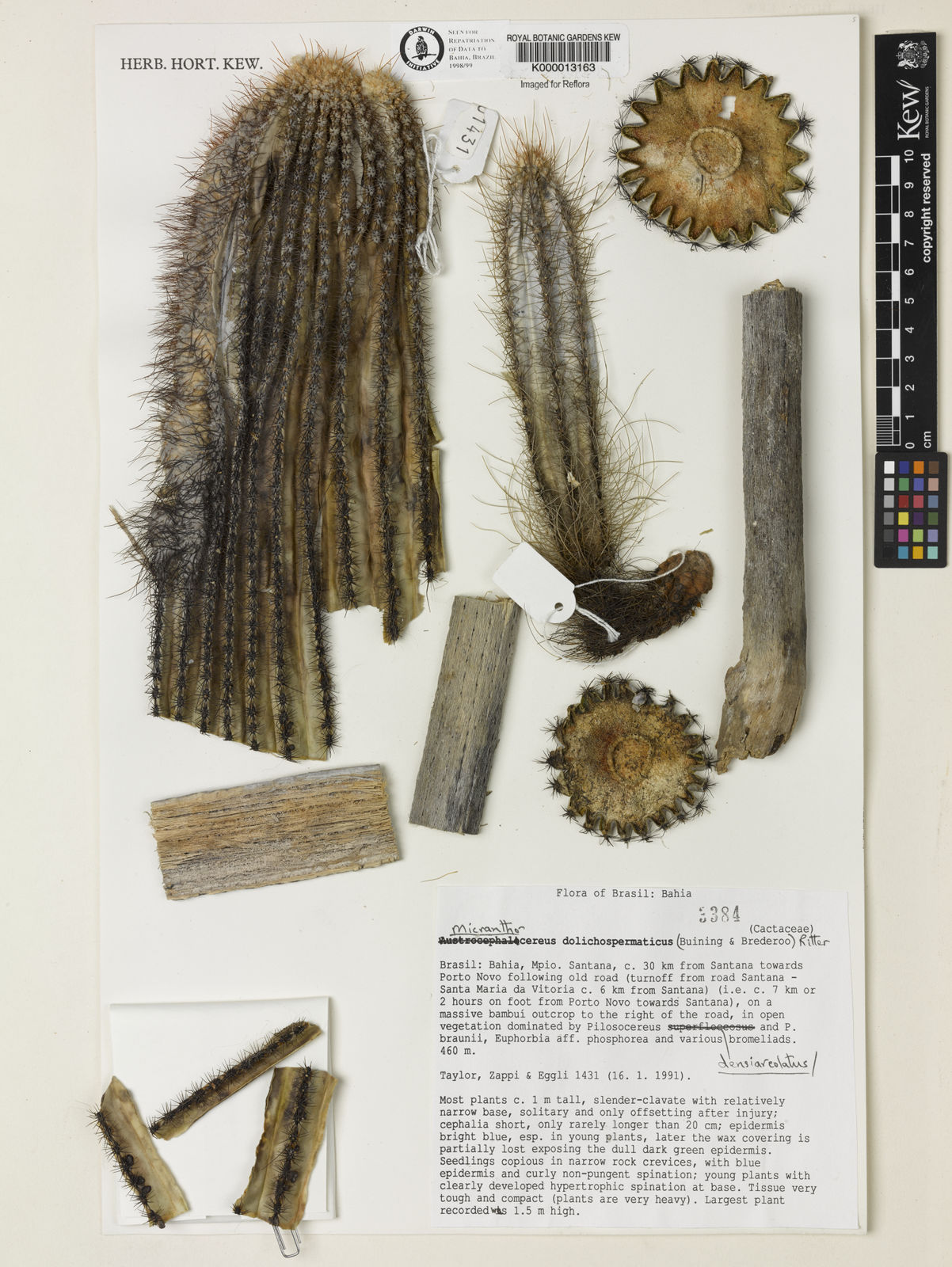 Reference image
Columnar Brazilian Cactus
Coleocephalocereus dolichospermaticus is a rare columnar cactus species native to the arid landscapes of eastern Brazil. It belongs to the family Cactaceae and is highly prized among collectors for its specialized flowering zone, known as a lateral cephalium, which develops on mature specimens 1.
The genus name combines the Greek words koleos (sheath) and kephale (head), referring to the woolly cephalium. The specific epithet dolichospermaticus refers to the unusually elongated shape of its seeds, distinguishing it from close relatives 2.
This succulent subshrub is endemic to Brazil, with populations concentrated in Minas Gerais and adjacent Bahia. It thrives in dry shrublands and rocky outcrops within the semi-arid Caatinga biome, often growing directly in limestone crevices 1.
The plant produces erect, cylindrical stems that can reach up to 1-2 meters in height. Stems are green to glaucous-blue, featuring numerous vertical ribs armed with golden to grayish spines. As it matures, a dense, woolly, bristly lateral cephalium forms along one side of the stem, producing small nocturnal flowers.
In cultivation, it requires a highly porous mineral substrate and excellent drainage. It is sensitive to frost and should be kept dry and cool during winter dormancy. Active growth occurs in summer under bright, indirect light.
Overwatering and rich, organic soils are the most common causes of failure, leading to root rot. Insufficient light results in etiolation, where the column grows thin, weak, and loses its characteristic bluish hue.
Requires bright, indirect sunlight or filtered sun to maintain its natural shape and spine color.
Water thoroughly only when the soil is dry. Reduce watering to a bare minimum in winter.
Use a porous, mineral-rich cactus mix with high amounts of pumice, coarse sand, and perlite.
Equipped with sharp spines; keep out of reach of curious pets and children.
Requires moderate care due to its sensitivity to cold moisture and specialized soil needs.
Native to the rocky limestone outcrops of the semi-arid Caatinga region in eastern Brazil.
