
Light
Direct Sun
Thrives in direct, unfiltered sunlight.
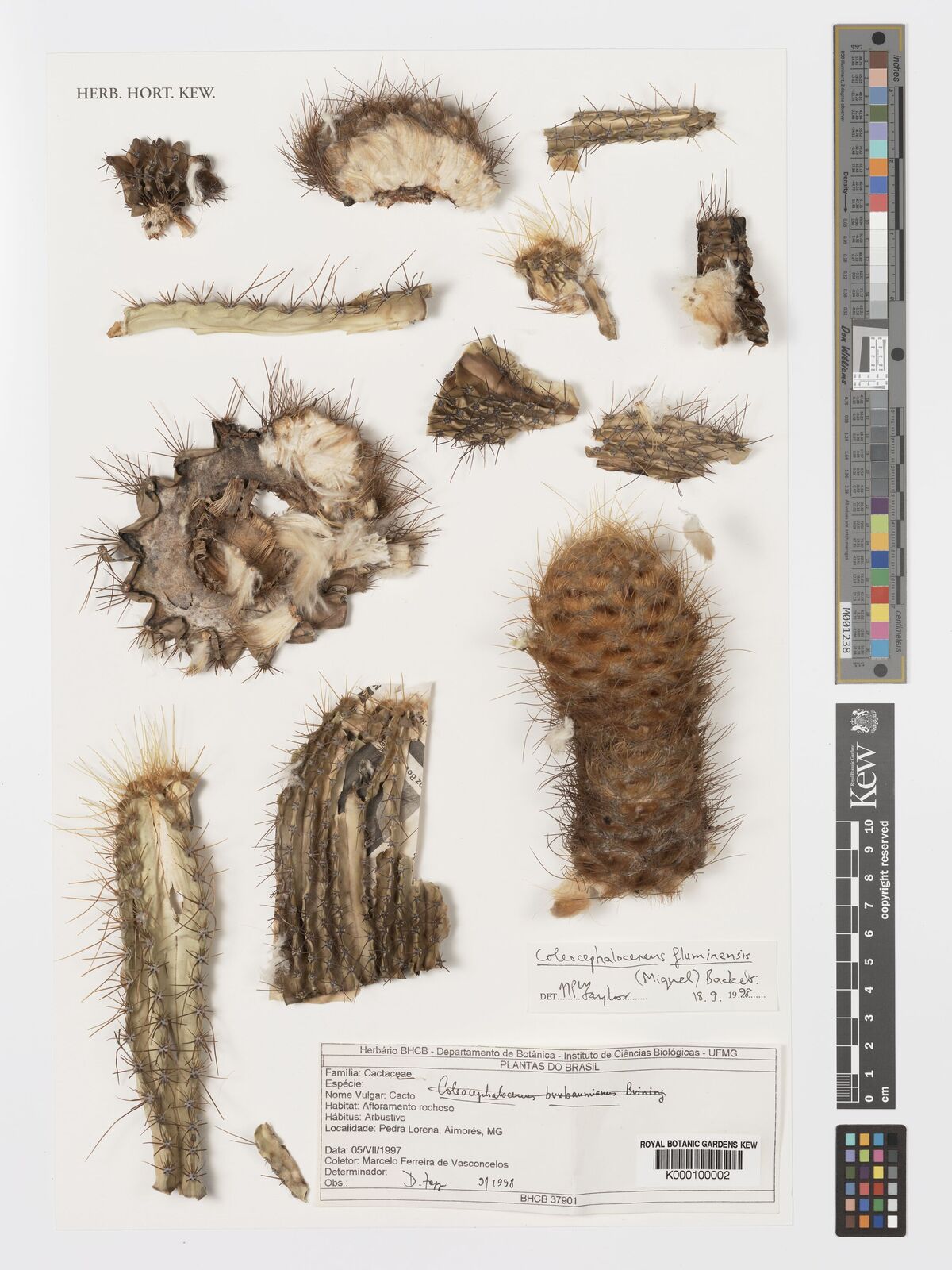 Reference image
Fluminensis Columnar Cactus
Coleocephalocereus fluminensis is a unique columnar cactus species native to the coastal regions of Brazil. Belonging to the family Cactaceae, it is widely appreciated among enthusiasts for its dramatic habit of forming a lateral cephalium—a specialized woolly and bristly flowering structure—along one side of its mature stems.
The species was initially described by Albert Löfgren under the name Cereus fluminensis before being reassigned to the genus Coleocephalocereus by Curt Backeberg 1. The specific epithet "fluminensis" derives from the Latin word referring to things from Rio de Janeiro 2.
This cactus is endemic to southeastern Brazil, spanning across Espírito Santo, Rio de Janeiro, Minas Gerais, and São Paulo 3. It thrives in seasonally dry tropical biomes, typically anchoring to steep granitic outcrops (inselbergs) and rocky coastal cliffs of the Atlantic Forest domain 2.
It forms semi-erect or decumbent dark green stems that can grow 1 to 2 meters long, branching mainly from the base. Stems have 5 to 17 prominent ribs. Upon reaching maturity, a continuous golden-yellow to whitish woolly cephalium with brownish bristles develops along one side of the stem. The nocturnal, white to pinkish-white tubular flowers emerge from this cephalium, followed by small, decorative red berry-like fruits.
This species demands full sun exposure and an extremely porous substrate. It is best grown in a mineral-heavy potting mix containing high amounts of pumice, coarse sand, and perlite. Water thoroughly when the soil is completely dry during the growing season, and restrict watering significantly in winter. It lacks frost tolerance and should be overwintered above 8°C.
The most prevalent errors include overwatering, using heavy organic soils with poor drainage, and placing the plant in low-light environments. Excess moisture quickly triggers root rot, whereas inadequate light results in thin, weak, and etiolated growth.
Thrives in direct, unfiltered sunlight.
Water only after the substrate has dried out completely.
Highly porous, mineral-based cactus soil with excellent drainage.
Features sharp spines and stiff bristles; non-toxic but handle with thick gloves.
Requires moderate care, mainly concerning winter protection and strict watering control.
Indigenous to the steep coastal granite outcrops and inselbergs within the seasonally dry tropical zones of Rio de Janeiro, São Paulo, and surrounding areas.
