
Light
Bright Indirect Light
Prefers bright, indirect or filtered sunlight. Avoid intense, scorching midday sun during peak summer.
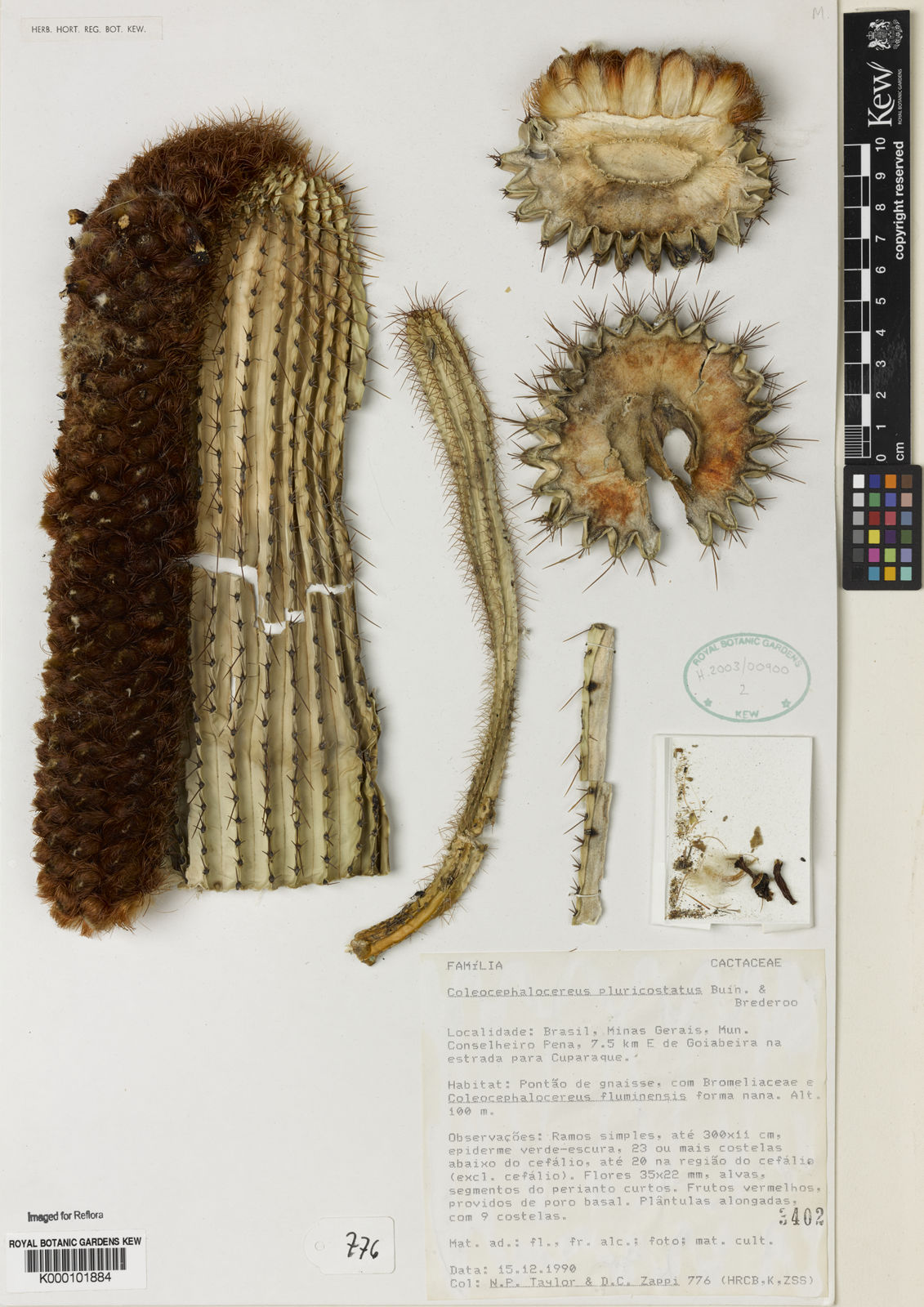 Reference image
Many-Ribbed Cephalium Cactus
Coleocephalocereus pluricostatus is a rare, column-forming succulent shrub or tree belonging to the Cactaceae family, native to the seasonally dry tropical zones of Brazil. It is highly valued among collectors for its numerous ribs and the striking lateral cephalium it develops as it matures, from which flowers emerge 1.
The genus name Coleocephalocereus is derived from the Greek words 'koleos' (sheath) and 'kephale' (head), referring to the woolly cephalium. The specific epithet 'pluricostatus' indicates the high number of ribs present on its stems. This species occupies a unique position within the tribe Cereeae, showing close relationships with other woolly-headed South American columnar cacti 2.
This species is endemic to southeastern Brazil, notably within the states of Minas Gerais, Espírito Santo, and Rio de Janeiro. It thrives on inselbergs—isolated granite and gneiss dome-like hills—and in dry, rocky deciduous forests 1. Due to quarrying and agricultural expansion, its natural populations are threatened, earning it a Vulnerable (VU) status on the IUCN Red List.
The plant grows upright, reaching up to 3 meters in height with stems featuring 15 to 25 dense vertical ribs. The woolly lateral cephalium develops on one side of the stem, exhibiting yellowish to brownish wool and bristles. It bears small, nocturnal white or cream-colored flowers that arise from this cephalium, followed by small fleshy red fruits.
In cultivation, it requires bright, filtered light to mimic its natural understory or rocky ledge habitat. It needs very porous, mineral-heavy substrate with minimal organic material. Watering should be thorough but infrequent, allowing the substrate to dry out entirely between applications. Winter minimum temperatures should be kept above 10°C.
Overwatering is the primary cause of failure, quickly leading to root rot due to the plant's sensitivity to stagnant moisture. Insufficient light can cause etiolation (stretching) and weak spine development, while exposure to freezing temperatures can cause irreversible tissue death.
Prefers bright, indirect or filtered sunlight. Avoid intense, scorching midday sun during peak summer.
Let the soil dry out entirely between waterings. Reduce watering drastically to a minimum during winter.
Requires excellent drainage. Use a mix heavily amended with pumice, perlite, and coarse sand.
Equipped with sharp spines that can cause injury; keep away from children and pets.
Moderately demanding; successful cultivation relies on avoiding overwatering and providing warm winters.
Native to the granite inselbergs and dry tropical forests of Minas Gerais, Espírito Santo, and Rio de Janeiro in Brazil.
