
Light
Bright Indirect Light
Requires bright, indirect sunlight or filtered light; protect from intense midday sun.
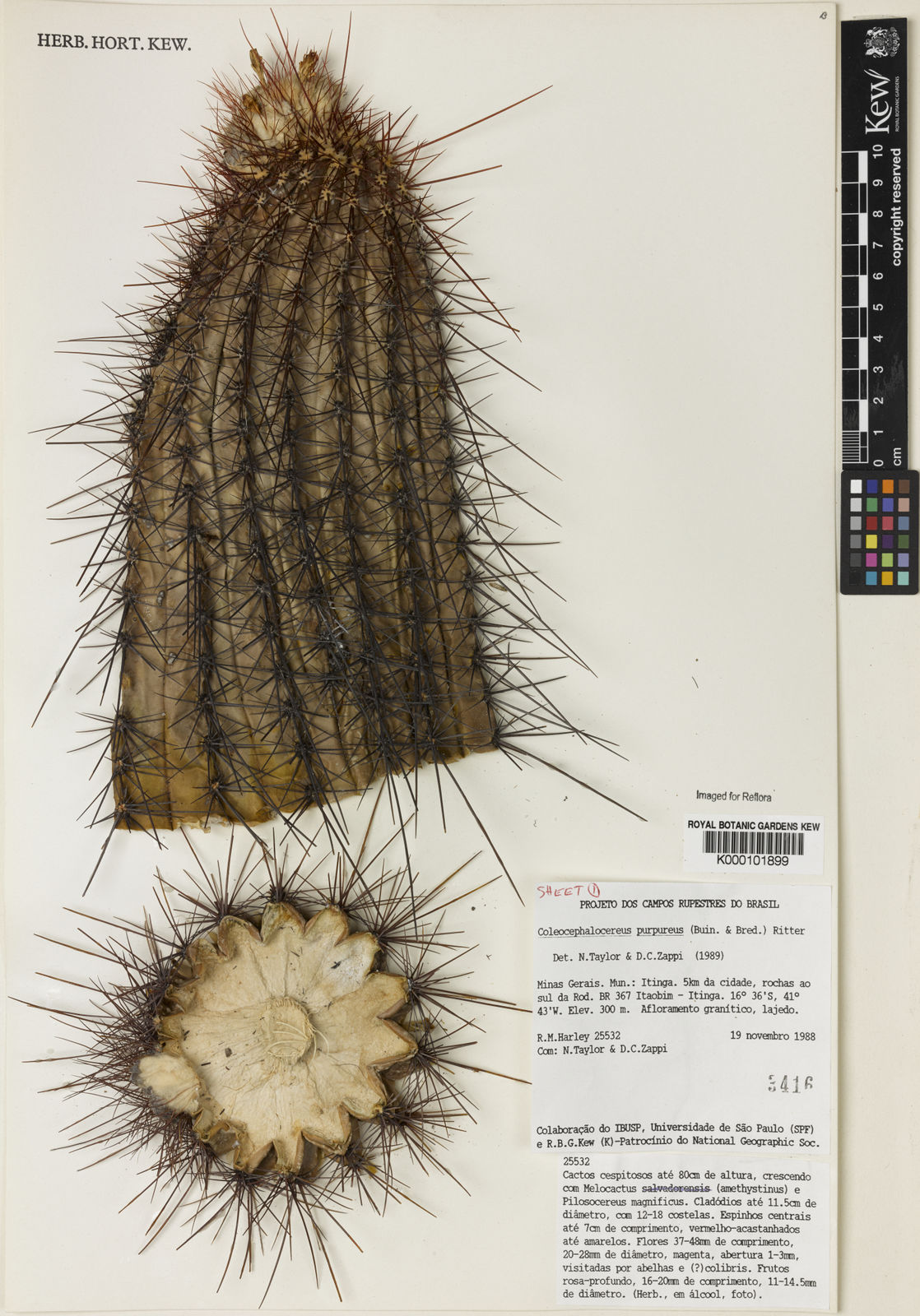 Reference image
Purple Cephalocereus
Coleocephalocereus purpureus is a rare, columnar cactus belonging to the Cactaceae family, renowned for its highly specialized lateral cephalium and restricted natural range 1. Endemic to the seasonally dry tropical environments of Brazil, this critically endangered succulent is a prized collector's plant.
Belonging to the genus Coleocephalocereus, this species is characterized by its woolly flowering zone (cephalium). The specific epithet 'purpureus' refers to the distinct purplish-pink wool and bristles that ornament its fertile lateral zone, separating it from typical green cacti 2.
This species is native to eastern Brazil, specifically within the state of Minas Gerais. It grows primarily on granitic and gneissic rock outcrops (inselbergs) within seasonally dry tropical biomes. Due to agricultural expansion, its natural populations are severely fragmented and under threat 1.
It forms upright, cylindrical green stems that can grow up to 1 meter tall. As the plant matures, it develops a prominent, woolly lateral cephalium on one side of the stem, from which tubular, purplish-pink nocturnal flowers emerge, followed by small red fruits.
In cultivation, Coleocephalocereus purpureus requires exceptionally well-draining mineral soil with high pumice content. It prefers bright, indirect light or filtered sun. Water thoroughly during the growing season only when the soil has dried out completely, and keep almost dry in winter.
Overwatering and using heavy, organic-rich soil mixes are the primary causes of failure, quickly leading to root rot. Additionally, exposing the plant to temperatures below 10°C in damp conditions will trigger physical collapse.
Requires bright, indirect sunlight or filtered light; protect from intense midday sun.
Allow the potting mix to dry out entirely between waterings; keep dry during winter months.
Coarse, nutrient-poor mineral soil enriched with pumice, perlite, and fine gravel.
Non-toxic, but possesses sharp spines and bristles that can cause injury; handle with care.
Moderately difficult due to strict moisture control and sensitivity to cold, damp winter conditions.
Native to the eastern regions of Brazil, specifically Minas Gerais, where it colonizes rocky granite outcrops and specialized dry tropical microclimates.
