
Light
Full Sun
Requires full, direct sun; insufficient light causes weak, stretched growth.
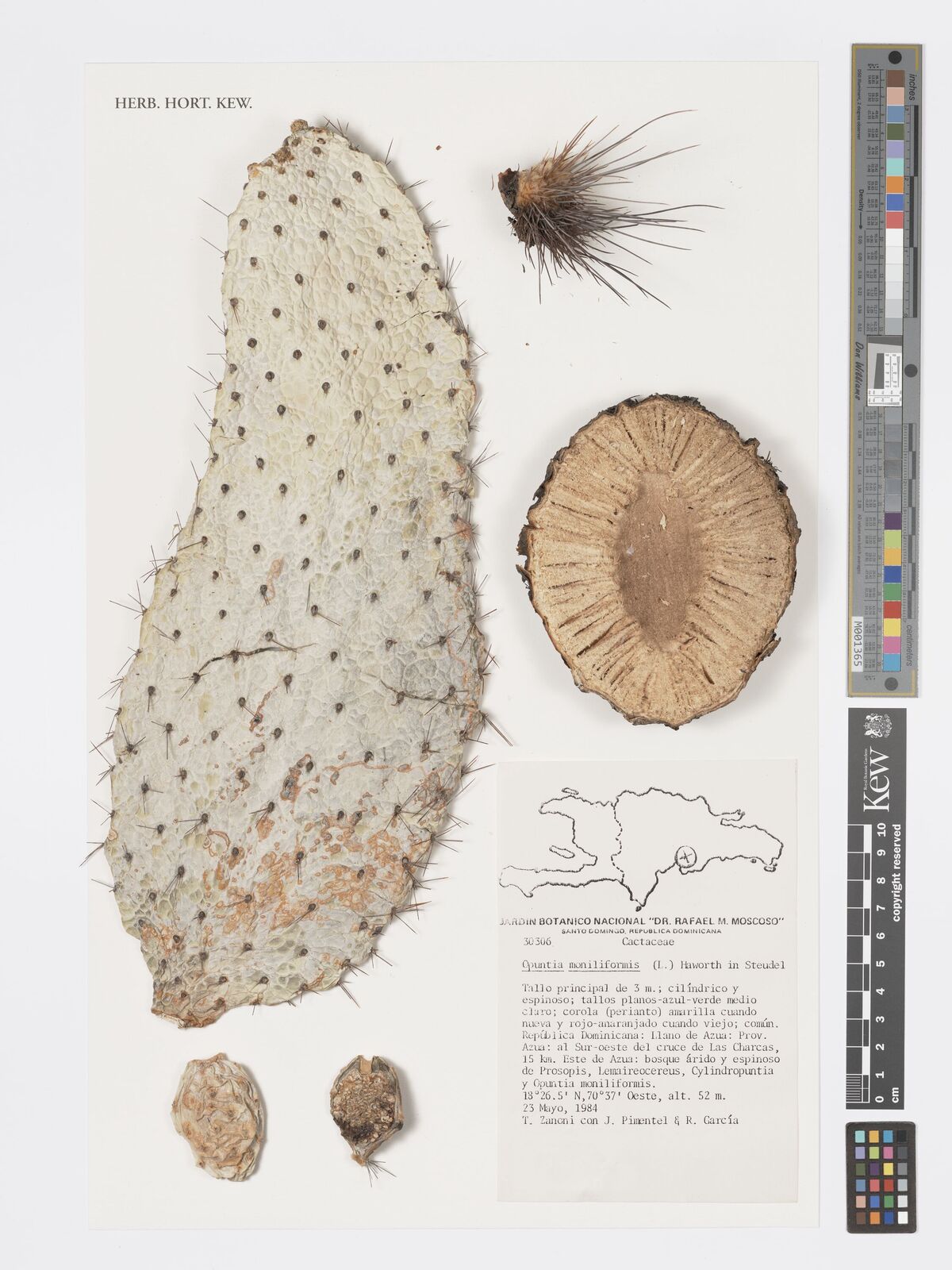 Reference image
Necklace Prickly Pear
Consolea moniliformis is one of the most striking arborescent members of the Cactaceae family. Originating from the dry scrub forests of the Caribbean, this species eventually develops a thick, woody trunk, acquiring a miniature tree-like form. It is highly sought after by succulent collectors for its sculptural posture and uniquely segmented branches 1.
Originally described by Linnaeus as Cactus moniliformis, the species was later transferred to the genus Consolea within the subfamily Opuntioideae. Synonyms include Opuntia moniliformis. The specific epithet 'moniliformis' translates to 'necklace-shaped' in Latin, referencing how the segments arrange themselves like a string of beads 2.
This species is native to the Caribbean islands, including Cuba, Haiti, the Dominican Republic, and Puerto Rico. It naturally thrives in seasonally dry tropical forests, coastal cliffs, and limestone soils. It exhibits excellent tolerance to drought and high salinity 1.
In the wild, Consolea moniliformis is a succulent tree that can reach heights of 4 to 5 meters. The trunk is cylindrical, becoming heavily spined and bark-like with age. The segments forming the branches are flattened, glossy green, and irregularly jointed. Young segments bear yellowish spines, followed by vibrant orange or red flowers 12.
For indoor and greenhouse cultivation, south-facing windows with plenty of direct sunlight are ideal. It requires highly porous, mineral-rich cactus soil. Watering should be done only when the soil is completely dry during the active growing season, and reduced to a bare minimum in winter 2.
The most frequent cultivation errors include overwatering and using pots with poor drainage, which rapidly leads to root and stem rot. Additionally, low light levels cause etiolation, resulting in weak, stretched growth.
Requires full, direct sun; insufficient light causes weak, stretched growth.
Allow soil to dry out completely between waterings. Minimize in winter.
Mineral-rich, coarse mix with plenty of pumice, perlite, and coarse sand.
Non-toxic, but features sharp spines and glochids that can cause skin irritation.
Very easy to care for, provided they are not overwatered and receive ample light.
Naturally distributed across the Caribbean islands, this species thrives in arid tropical forests, coastal bluffs, and rocky limestone terrains, highly adapted to prolonged dry seasons.
