
Light
Full Sun
Requires full, direct sun to maintain its natural waxy color and robust spines.
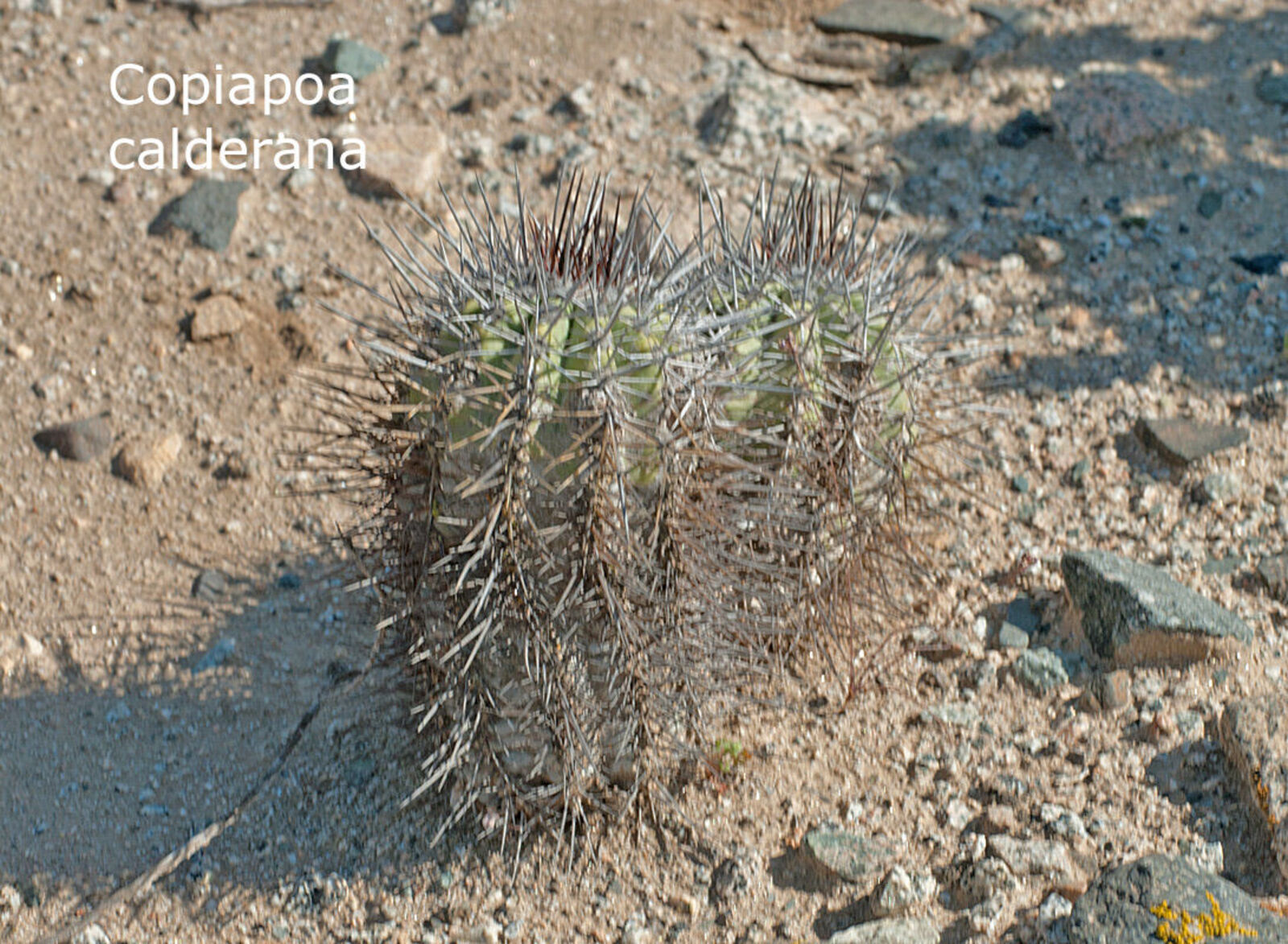 Reference image
Caldera Copiapoa
Copiapoa calderana is a slow-growing, highly sought-after succulent subshrub native to the hyper-arid coastal deserts of northern Chile 1. Belonging to the Cactaceae family, this species is highly adapted to extreme drought and is prized by collectors for its attractive grayish-green globose stems.
This species was formally described by the German botanist Friedrich Ritter 2. The genus name Copiapoa refers to the province of Copiapó in Chile, while the specific epithet calderana refers directly to the coastal town of Caldera, near which the type specimen was discovered.
Copiapoa calderana is endemic to the coastal hills of the Atacama Desert in Chile, particularly around Caldera 1. In this hyper-arid environment where rainfall is virtually non-existent, the plants rely heavily on the dense coastal fog, locally known as "Camanchaca," which rolls in from the Pacific Ocean 2.
This cactus typically grows solitary or forms small clumps over time. The globose to cylindrical stem is gray-green or bluish-green, often protected by a waxy coating that reduces transpiration. It features well-defined ribs with rigid, sharp central and radial spines that start black or dark brown and weather to gray. Yellow, funnel-shaped flowers emerge from the woolly crown in summer.
In cultivation, it requires an extremely porous, mineral-rich substrate consisting mostly of pumice, gravel, and volcanic rock. It must receive maximum sunlight to retain its compact shape and intense spine color. Watering should be highly restricted and confined strictly to the warm growing season.
Overwatering and the use of organic potting mixes are the primary causes of failure, quickly leading to root rot 1. Inadequate light exposure leads to etiolation, causing the natural spherical stem to stretch and weaken.
Requires full, direct sun to maintain its natural waxy color and robust spines.
Water only when the soil is 100% dry during summer; keep entirely dry in winter.
Requires a purely mineral mix with excellent drainage and zero peat.
Armed with very sharp spines. Keep away from pets and curious children.
Moderate; requires strict watering discipline and specialized gritty soil.
Native to the coastal slopes of the Atacama Desert in Chile, primarily near Caldera, where it survives in one of the world's driest climates by absorbing moisture from coastal Pacific fog.
