
Light
Full Sun
Requires at least 6 hours of direct sunlight daily to maintain its dense spination and compact shape.
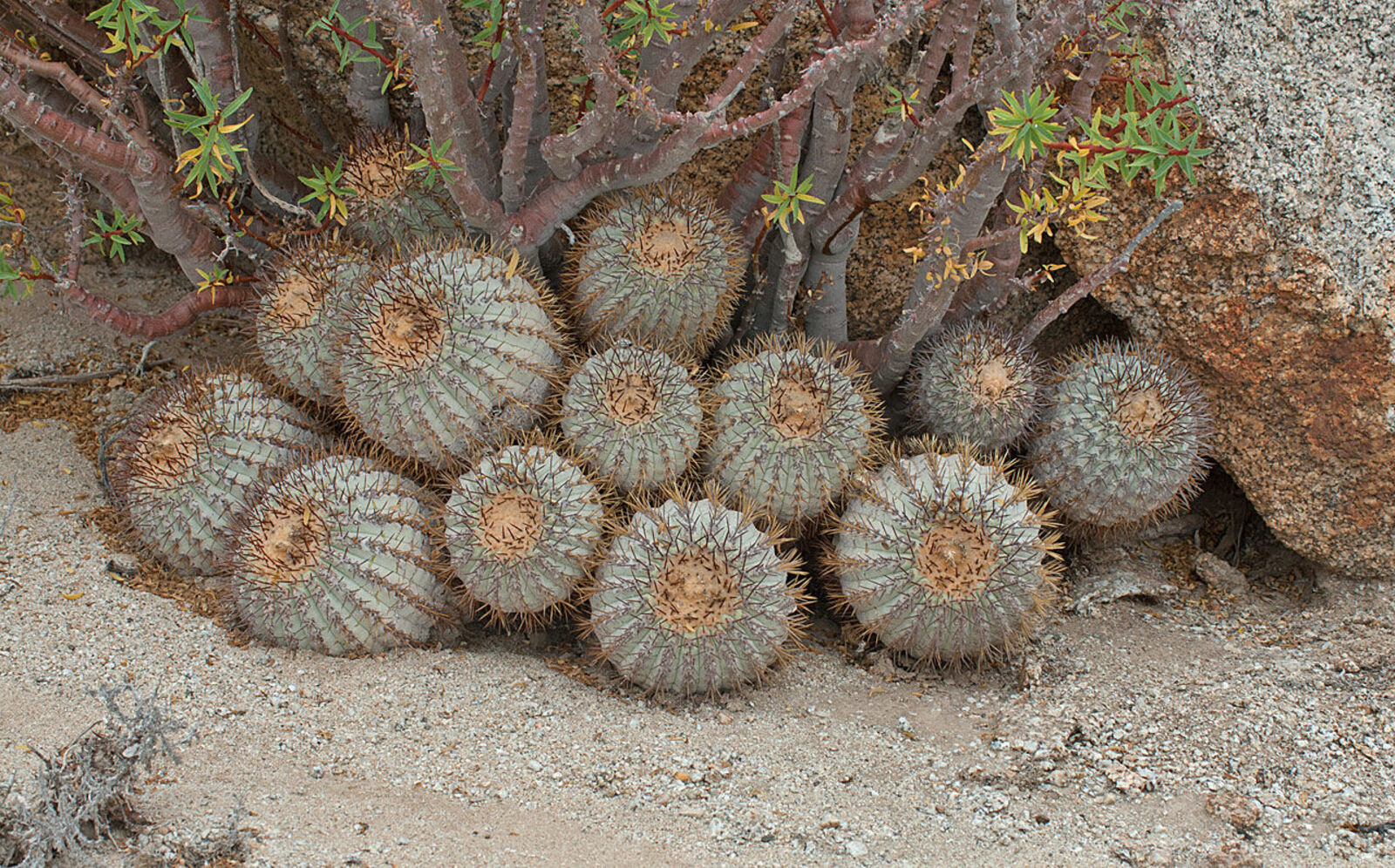 Reference image
Yellow-spined Copiapoa
Copiapoa longistaminea is a highly prized cactus species belonging to the family Cactaceae, adapted to the extreme hyper-arid conditions of the Atacama Desert. Known for its clumping habit and dense yellow-to-brown spines, it is a flagship species in specialty succulent collections 1.
The genus Copiapoa is named after the province of Copiapó in northern Chile, where these cacti are strictly endemic. The specific epithet longistaminea refers to the notably long stamens found within its yellow flowers 2. It was officially described by the German botanist Friedrich Ritter.
This species is native to a narrow coastal strip of northern Chile, spanning the Antofagasta and Atacama regions 1. Inhabiting coastal cliffs and dry shrublands, it survives in a habitat with virtually no rainfall, relying almost exclusively on the coastal fog locally known as Camanchaca 2.
It forms dense, multi-headed clumps (succulent subshrub) that can reach up to a meter in diameter over several decades. The individual stems are globose to cylindrical, grey-green, and topped with robust yellow-brown spines. In summer, bright yellow, diurnal flowers emerge from the woolly crown 1.
In cultivation, mimicking its dry habitat is crucial. It requires an extremely mineral-dominant potting medium consisting of pumice, lava rock, and coarse sand. Adequate ventilation and full sun are mandatory for keeping the plant compact and preserving its intense spination.
The most frequent mistake is using standard organic potting soils and overwatering, which rapidly leads to root rot. Insufficient light exposure causes the stems to stretch unnaturally (etiolate) and lose their characteristic compact form.
Requires at least 6 hours of direct sunlight daily to maintain its dense spination and compact shape.
Water bi-weekly during summer; keep completely dry and cold during winter dormancy.
Use a mix of 80% pumice, lava gravel, and coarse grit. Absolutely avoid standard peat soils.
Non-toxic, but the sharp, rigid spines can cause physical injury. Handle with thick leather gloves.
Moderate to hard. Requires strict watering discipline and very high light levels to prevent rot.
Endemic to the hyper-arid coastal cliffs of northern Chile. This species is naturally sustained by the dense sea fogs sweeping inland from the Pacific Ocean, allowing it to survive years without direct rainfall.
