
Light
Full Sun
Requires full sun to maintain its chalky blue-grey protective wax and compact shape.
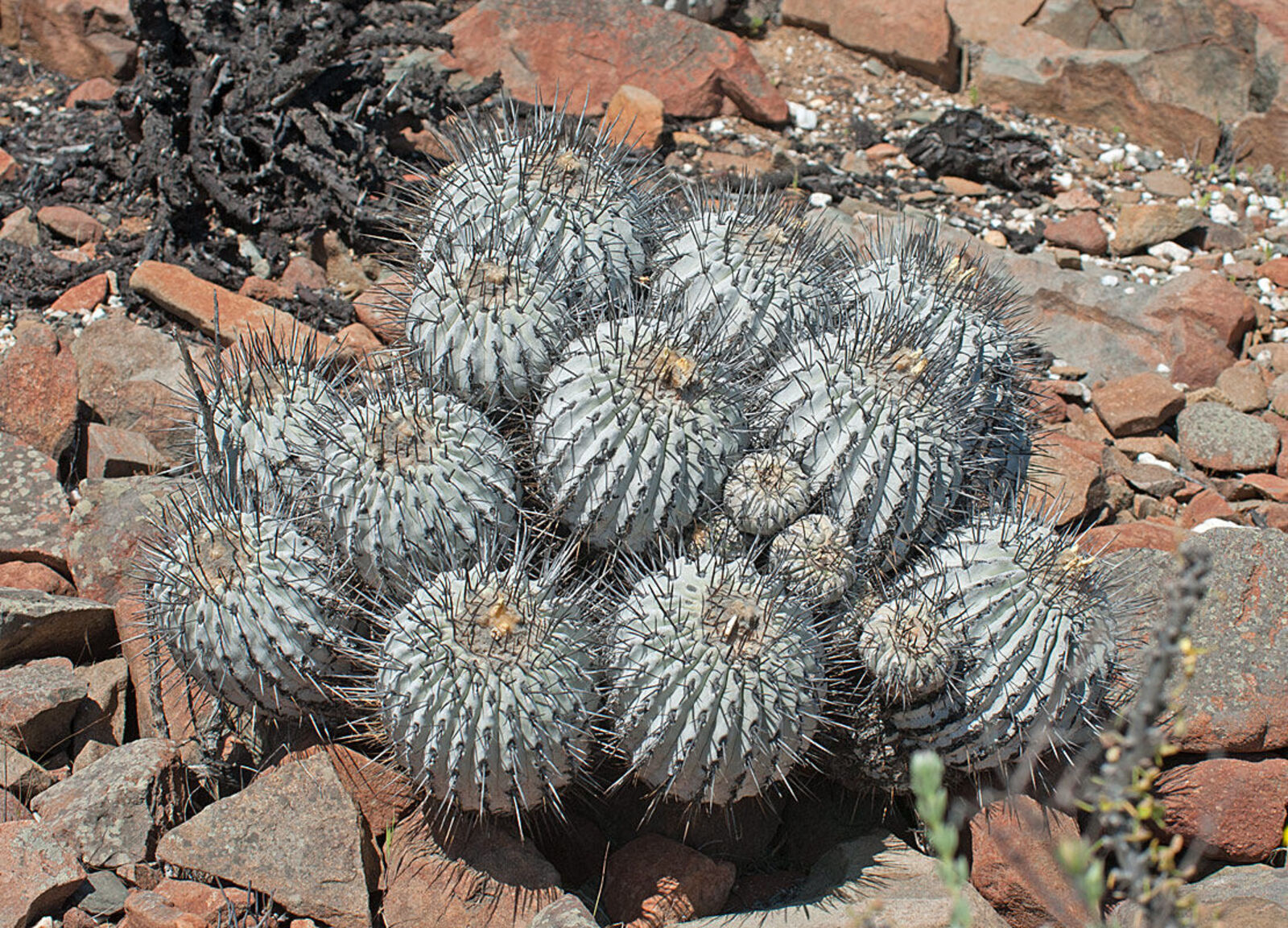 Reference image
Mallet Copiapoa
Copiapoa malletiana is an extraordinary, slow-growing succulent subshrub endemic to the hyper-arid Atacama Desert of Chile. Highly prized by cactus enthusiasts for its glaucous, chalky-blue stem coloration and fierce spination, this species is a master of survival in one of the harshest environments on Earth 1.
Belonging to the genus Copiapoa within the Cactaceae family, the genus name pays homage to the Copiapó province in northern Chile. Taxonomically, it is closely aligned with the Copiapoa carrizalensis complex but displays unique morphological traits, such as distinct rib structures and spine configurations that distinguish it in habitat studies 2.
This species is restricted to coastal areas of the Atacama Desert, primarily between Huasco and Carrizal Bajo. In this desert biome, annual rainfall is practically zero. The survival of Copiapoa malletiana relies heavily on the dense coastal fog, locally known as 'Camanchaca', which rolls inland from the Pacific Ocean and condenses on the plant's surface 1.
It features globose to short cylindrical stems that cluster from the base with age. The epidermis is covered in a characteristic waxy, glaucous-blue coating that protects it from intense solar radiation. Sharp, dark grey to black spines emerge from woolly areoles. During the growing season, pale yellow, funnel-shaped flowers appear at the apex.
In cultivation, it demands maximum light exposure, excellent air circulation, and a strict watering schedule. The potting medium must be predominantly mineral-based to facilitate immediate drainage 2.
Overwatering is the primary cause of failure, quickly leading to root rot. Keeping the plant in stagnant air or inadequate light causes etiolation, stripping the cactus of its natural compact form and blue wax coating.
Requires full sun to maintain its chalky blue-grey protective wax and compact shape.
Water only when the substrate is fully dry. Keep bone-dry in winter to prevent root rot.
Requires an extremely free-draining mix, consisting of 80% pumice, gravel, and coarse sand.
Armed with very sharp and rigid spines. Handle carefully with thick gloves and keep away from pets.
Moderate to hard due to its extreme sensitivity to overwatering and slow growth rate.
Native to the coastal terraces of northern Chile, where it survives in rocky soils receiving almost all of its moisture from maritime morning fog rather than rainfall.
