
Light
Full Sun
Requires full, direct sun to maintain its chalky epidermal wax and dark spines.
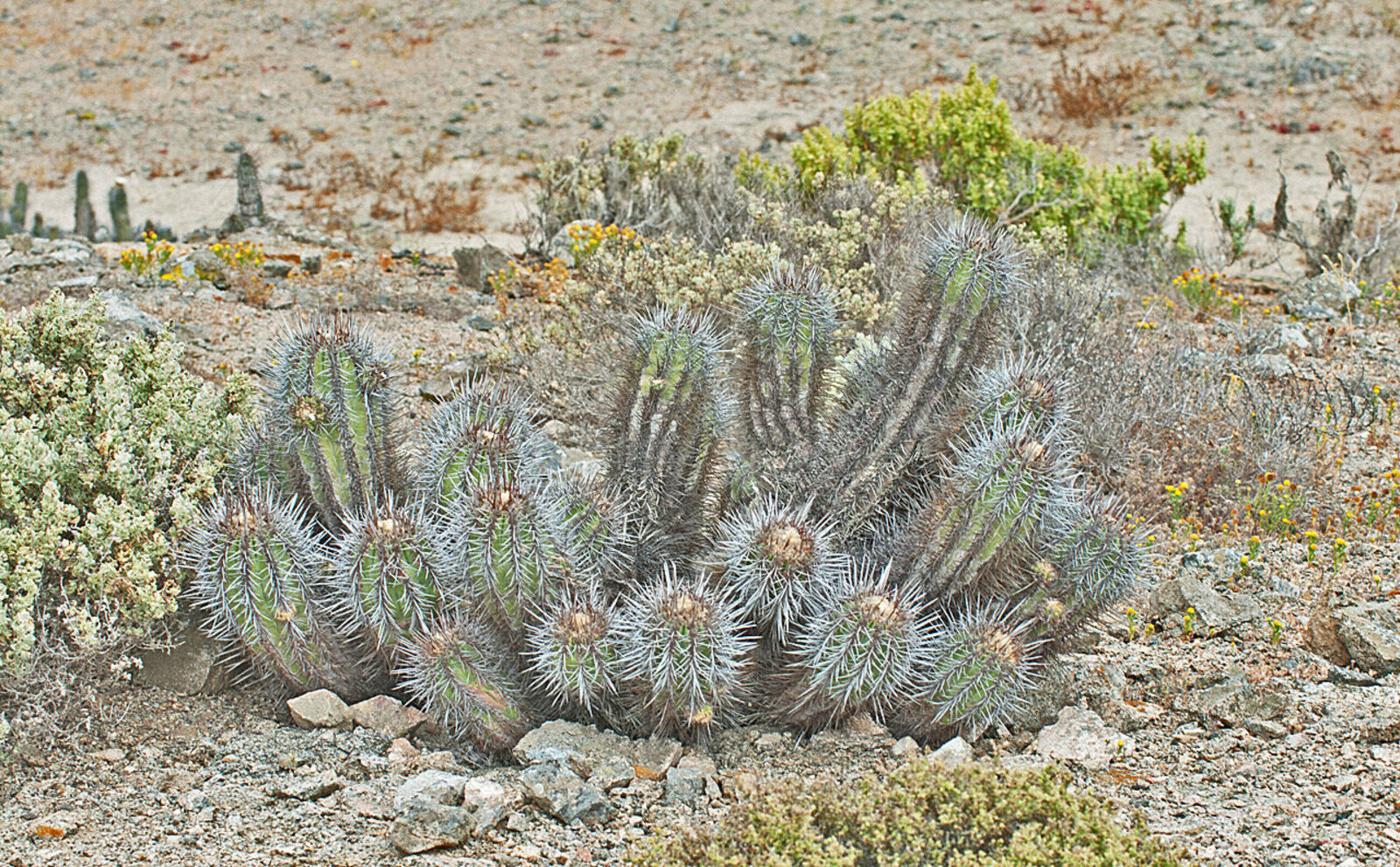 Reference image
Coast Copiapoa (Copiapoa marginata)
Copiapoa marginata is a remarkable cactus species in the family Cactaceae, endemic to the hyper-arid coastal cliffs of northern Chile. Superbly adapted to the extreme environment of the Atacama Desert, this succulent subshrub is highly prized by collectors for its globose to cylindrical gray-green stems and striking black spines 1.
The species was first described by Salm-Dyck in 1845 as Echinocactus marginatus and later reassigned to the genus Copiapoa by Britton & Rose in 1922 2. The specific epithet "marginata" refers to the distinct, prominent margins of the stem ribs.
This cactus is native to the coastal hills of the Antofagasta and Atacama regions of Chile 3. It grows on rocky slopes where rainfall is virtually non-existent. Survival depends heavily on the dense coastal fog, locally known as "Camanchaca," which condenses on the plant's surface and provides essential moisture.
Copiapoa marginata forms clumps of cylindrical stems branching from the base over time. Stems are covered with a waxy, chalky, greyish-blue bloom. It typically features 12 to 15 ribs. The areoles are woolly when young, bearing stiff, straight, dark brown to blackish spines. The apex produces funnel-shaped, pale yellow flowers.
In cultivation, this species requires an extremely porous, mineral-dominant soil mix. Water should be applied moderately during the warm summer months and withheld completely during winter. Bright, direct sunlight is crucial to maintain its signature glaucous skin and strong spine coloration 2.
The most frequent mistake is overwatering combined with organic-heavy soils, which inevitably causes root rot. Lack of adequate sunlight leads to etiolation, causing the stems to lose their compact shape and protective waxy coating.
Requires full, direct sun to maintain its chalky epidermal wax and dark spines.
Water only when the substrate is completely dry in summer; keep bone-dry during winter.
Highly porous, mineral-based substrate consisting mainly of pumice, lava rock, and coarse sand.
Non-toxic, but sharp, stiff spines can cause physical injury; keep away from pets.
Moderate; requires strict watering discipline and maximum sunlight exposure.
Occurs along the arid coastal cliffs of northern Chile, particularly around Antofagasta and Atacama. It thrives on rocky, ocean-facing slopes, relying on heavy morning fogs as its primary water source in an otherwise hyper-arid desert.
