
Light
Full Sun
Requires full, direct sunlight. Inadequate light leads to stretching and weakening of spines.
 Reference image
Rock Copiapoa
Copiapoa rupestris is a highly resilient and visually striking succulent subshrub belonging to the Cactaceae family, native to the hyper-arid coastal zones of Chile. Adapted to thrive in the harsh conditions of the Atacama Desert, this cactus is highly prized by collectors for its beautiful body texture and dense spination.
Within the genus Copiapoa of the Cactaceae family, this species is scientifically designated as Copiapoa rupestris. The specific epithet "rupestris" derives from Latin, meaning "living among rocks," which directly references its preferred natural habitat on steep, rocky cliffs and gravelly slopes 1.
The native range of this species is restricted to the coastal desert areas of northern Chile, particularly around the Antofagasta and Atacama regions 2. In this hyper-arid environment, rainfall is extremely rare. The plants survive by absorbing moisture from the dense, daily coastal fog known as "Camanchaca."
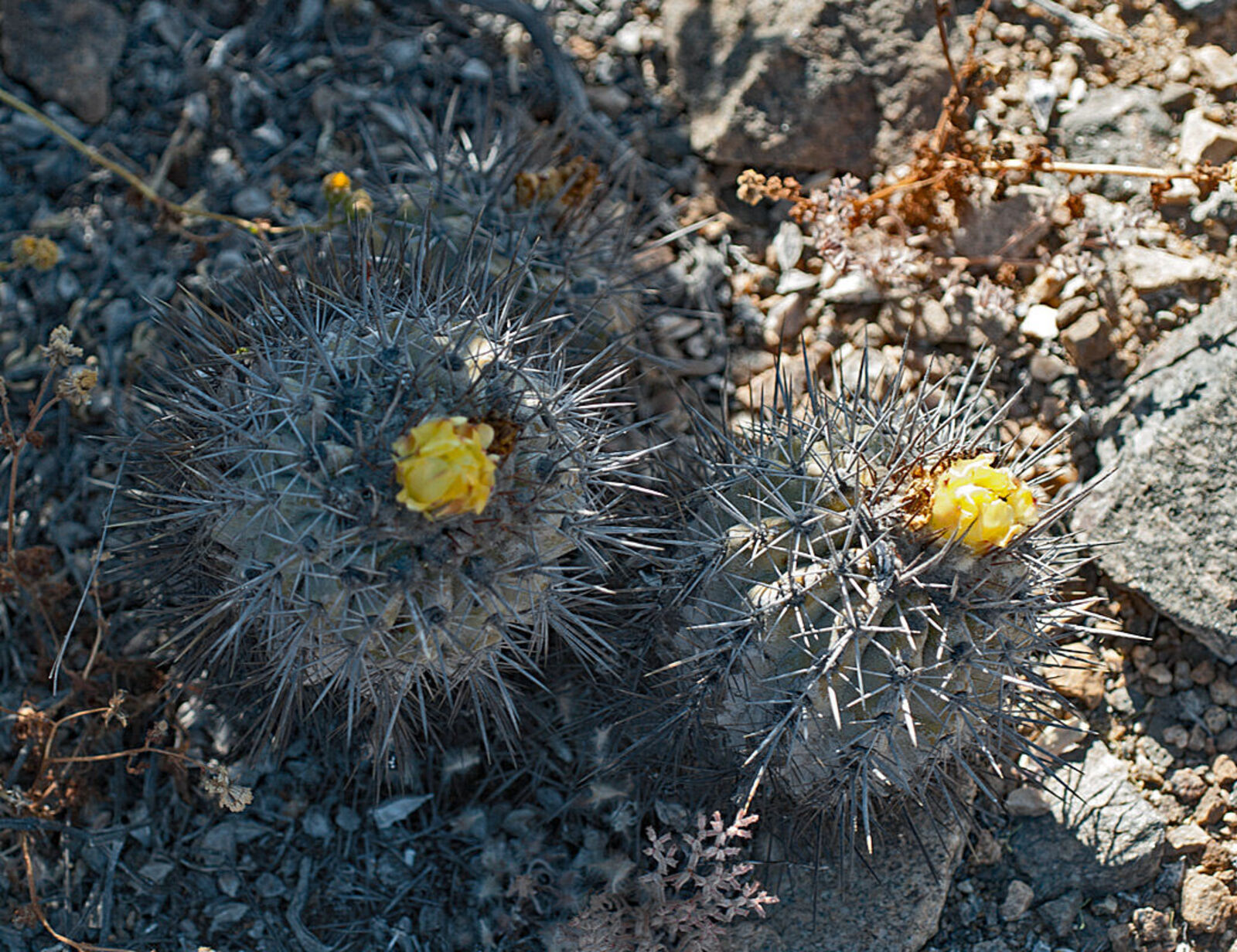
Copiapoa rupestris forms spherical to short cylindrical stems that offset from the base over time to create dense clumps. The epidermis ranges from dull green to bronze-grey. It features prominent ribs armed with robust, sharp, dark brown to black spines that fade to grey with age. Funnel-shaped, bright yellow flowers appear at the woolly apex.
In cultivation, it requires maximum direct sunlight and exceptional drainage. Watering must be sparse, performed only when the soil is completely dry, and withheld almost entirely during the cold winter months to prevent rot and encourage spring flowering.
The most frequent error is overwatering combined with poor ventilation, which rapidly causes root rot. Placing the plant in low-light conditions results in etiolation, where the stem stretches unnaturally and loses its compact form.
Requires full, direct sunlight. Inadequate light leads to stretching and weakening of spines.
Water only when the substrate is bone dry. Keep dry in winter.
Requires a highly mineral, fast-draining mix containing pumice, grit, and sand.
Equipped with very sharp, stiff spines. Handle with thick leather gloves and keep away from pets.
Moderate. Easy if underwatered, but highly susceptible to rot from excess humidity.
Endemic to the coastal cliffs of the Atacama Desert in northern Chile, where it relies heavily on dense ocean fogs for its moisture needs.
