
Light
Full Sun
Requires full sun and high UV exposure to maintain compact growth and dense spines.
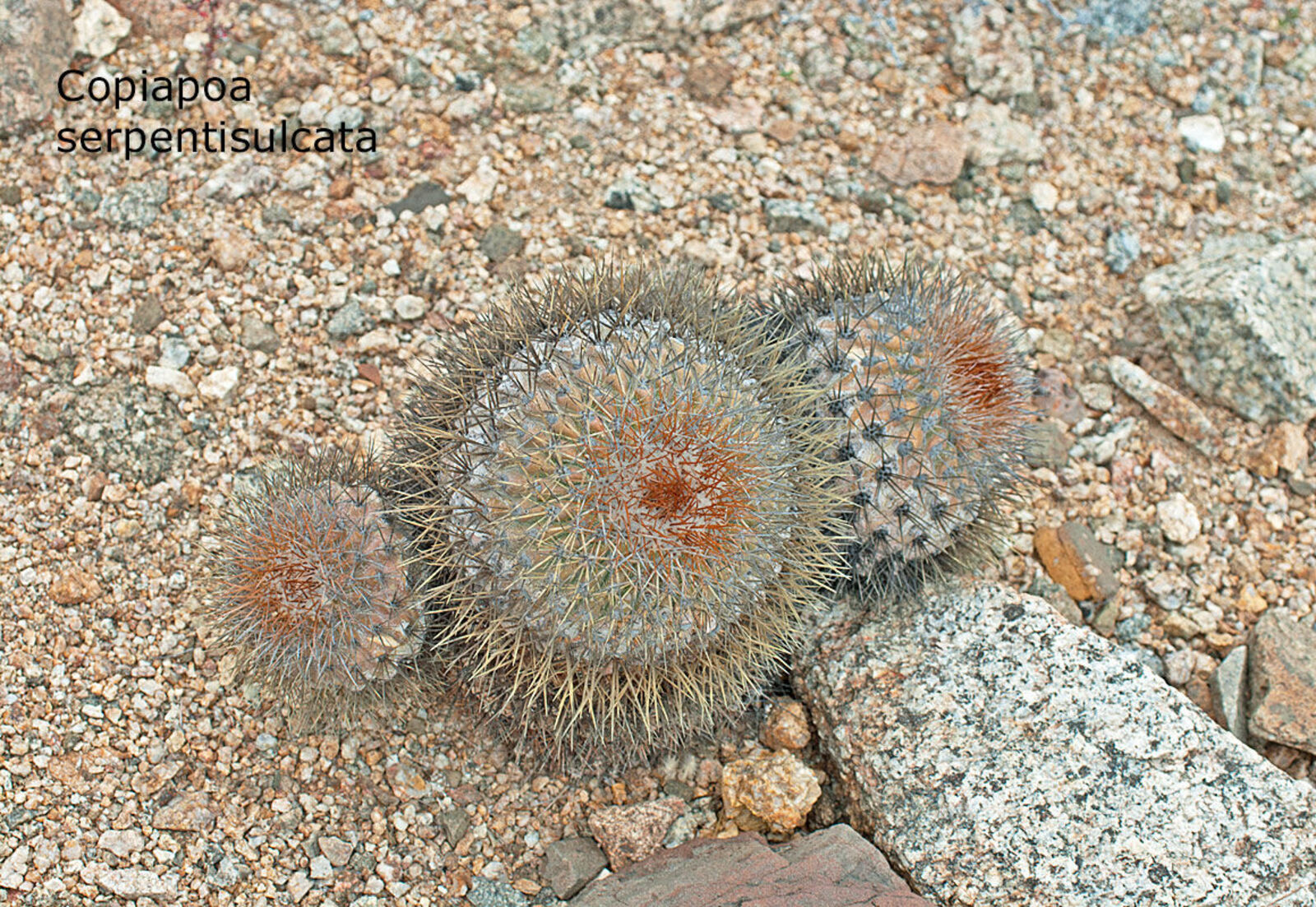 Reference image
Snake-grooved Copiapoa
Copiapoa serpentisulcata is a highly specialized cactus species belonging to the family Cactaceae, perfectly adapted to the hyper-arid coastal environments of the Atacama Desert 1. It is valued by succulent enthusiasts for its distinct wavy ribs and attractive golden-brown spination.
The specific epithet 'serpentisulcata' is derived from Latin, meaning 'serpentine-furrowed' or 'snake-grooved,' referring to the characteristic wavy or undulating pattern of its ribs 2. It belongs to the genus Copiapoa, which is renowned for its extreme drought tolerance.
This species is endemic to northern Chile, particularly restricted to the coastal hills of the Antofagasta region near Taltal 1. It grows on steep, rocky cliffs and gravelly slopes where rainfall is virtually non-existent, surviving almost exclusively on moisture condensed from coastal fogs, locally known as 'camanchaca'.
The stems are globose to short cylindrical, clustering over time from the base. The epidermis color ranges from grayish-green to bronzy-tan. It features distinct, wavy, spiraled ribs. The apex is covered with yellowish-brown wool from which strong, needle-like spines emerge. The flowers are funnelform, bright yellow, and open at the stem tips during summer.
In cultivation, it requires maximum sunlight exposure and exceptional air movement to thrive. Mimicking its natural fog habitat by misting the plant in the early morning can be beneficial. Water should be applied only when the mineral-rich substrate is completely dry, and kept completely dry during winter dormancy 2.
The most prevalent issue is overwatering combined with poorly draining soil, which rapidly leads to root rot. Lack of sufficient direct sunlight causes etiolation, wherein the plant stretches unnaturally and loses its compact, characteristic shape.
Requires full sun and high UV exposure to maintain compact growth and dense spines.
Allow soil to dry out completely between waterings. Keep dry in winter.
Extremely mineral-rich, porous mix consisting mostly of pumice, lava rock, and coarse sand.
Equipped with sharp, rigid spines. Handle with thick leather gloves and keep away from pets.
Moderate difficulty due to its extreme sensitivity to overwatering and high light demands.
Endemic to the hyper-arid coastal cliffs of the Atacama Desert, where it relies on ocean fog as its primary source of hydration.
