
Light
Full Sun
Requires full, unfiltered sun all day long to maintain its tight spine growth.
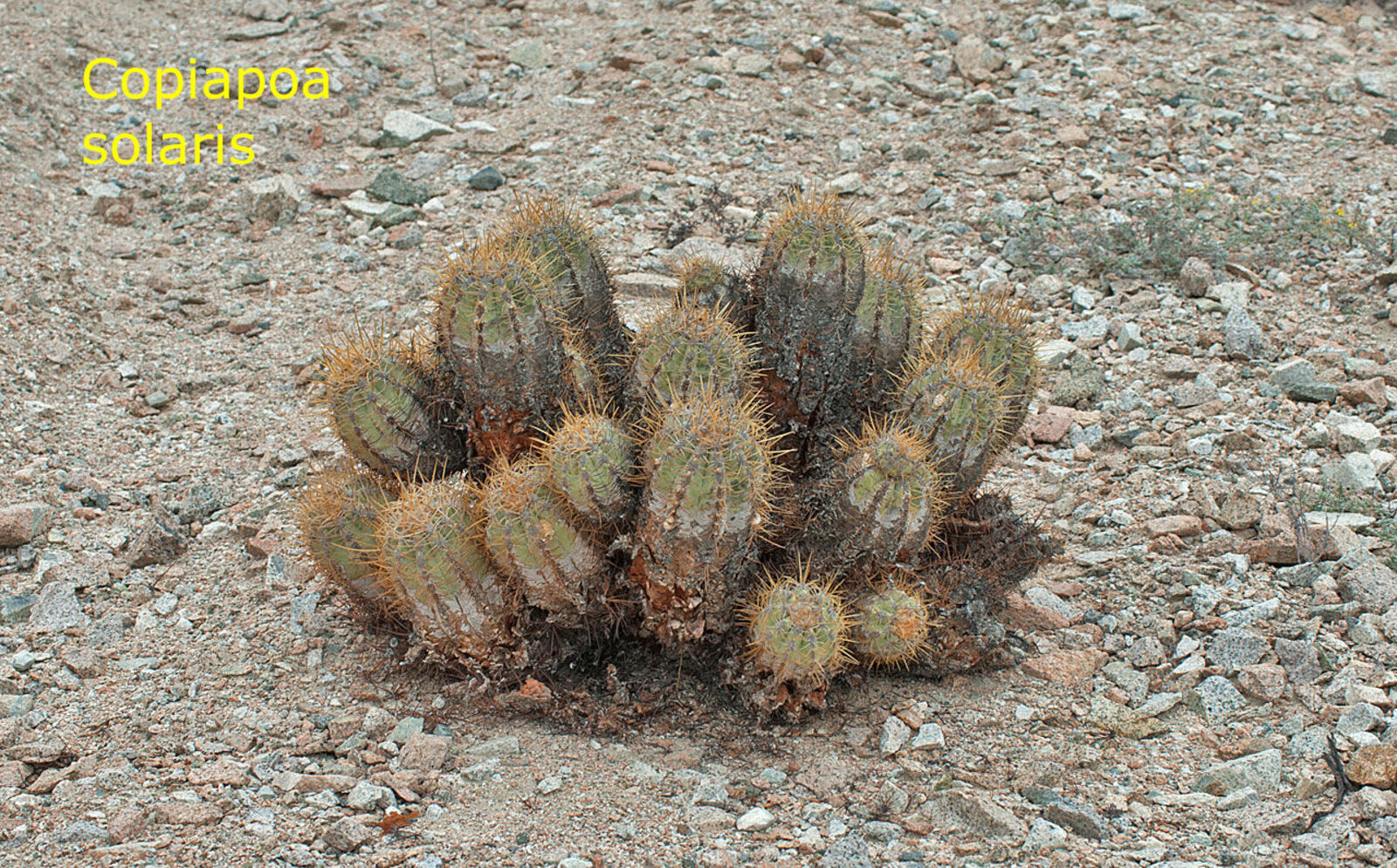 Reference image
Solar Copiapoa
Copiapoa solaris is a rare and highly sought-after cactus species, famous among succulent enthusiasts for its rugged, ancient appearance and extreme survival adaptations 1. Native to the hyper-arid coastal cliffs of the Atacama Desert, it is a true slow-growing collector's plant.
Belonging to the family Cactaceae and the genus Copiapoa, the specific epithet solaris refers to the sun-baked environment it populates. It is also historically known under the synonym Pilocopiapoa solaris 2.
This species is restricted to a narrow coastal strip in northern Chile, particularly around the Antofagasta region. It thrives on steep, rocky desert slopes where rainfall is virtually non-existent. The plants survive solely by absorbing moisture from the dense Pacific coastal fog, known locally as 'camanchaca' 1.
Copiapoa solaris forms impressive, dense mounds composed of dozens of individual globose to short cylindrical stems. The stems are heavily armored with thick, rigid, yellowish-brown to ash-grey spines. Yellow, funnel-shaped flowers emerge from the heavily woolly apical growing point under optimal conditions 2.
It is widely considered one of the most difficult cacti to grow in cultivation. It demands intense direct sunlight, outstanding ventilation, and an entirely mineral substrate. Water must be applied with extreme caution.
Overwatering is the primary cause of failure; even a slight excess of moisture in the soil can trigger fatal root rot. Poor air circulation and plastic pots that retain moisture must be strictly avoided.
Requires full, unfiltered sun all day long to maintain its tight spine growth.
Water at most once every 25 days in summer; keep completely dry in winter.
Strictly mineral soil mix with zero organic matter or peat is required.
Armed with very sharp, stiff spines. Handle with heavy-duty protective gloves.
Recommended strictly for expert growers due to extreme rot sensitivity.
Found exclusively in the coastal mountains of the Chilean Atacama Desert. It grows on barren, rocky terraces where it depends on the daily cycle of dense coastal fog to meet its moisture requirements.
