
Light
Full Sun
Requires at least 6 hours of direct sunlight daily.
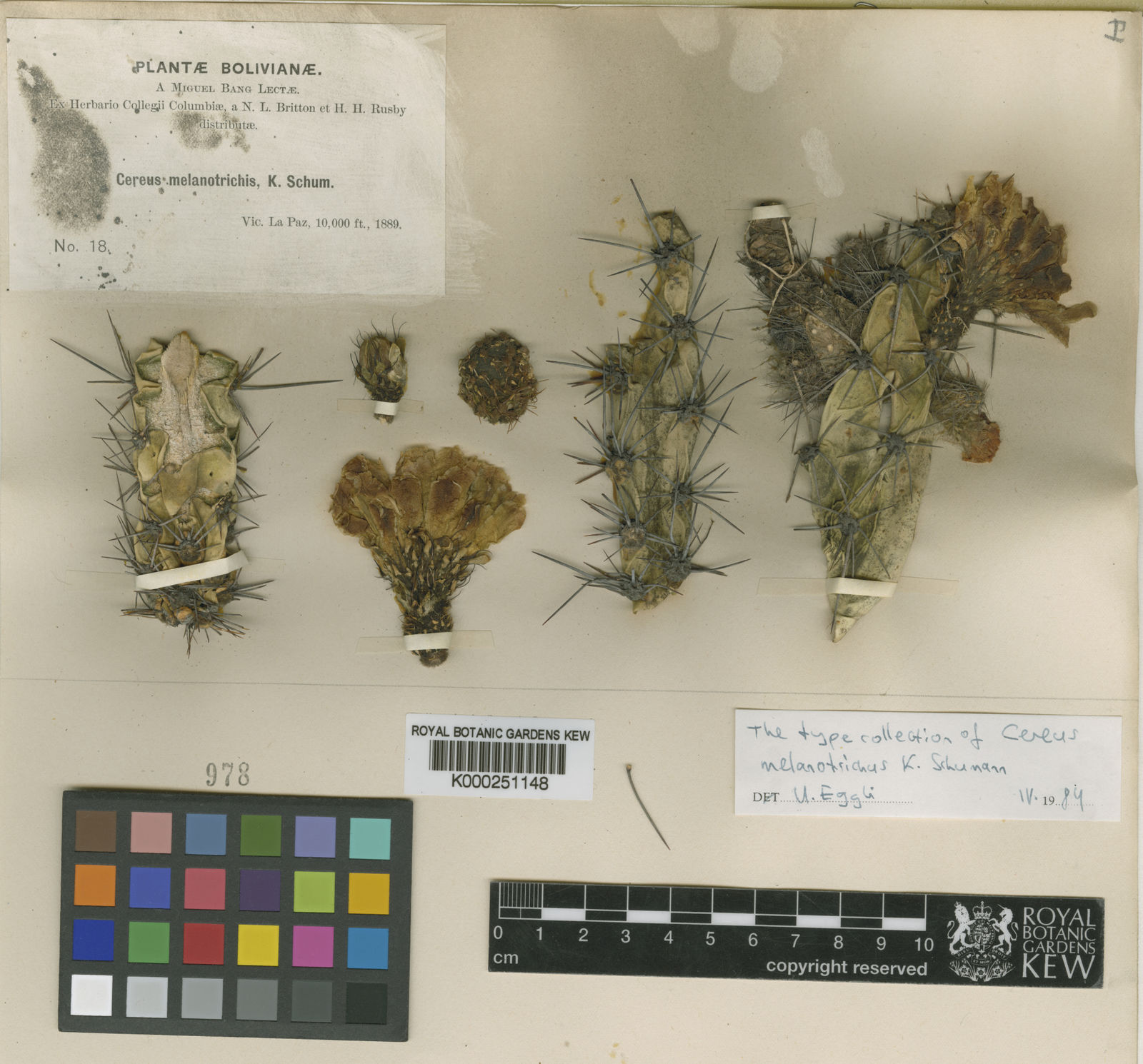 Reference image
Black-spined Corryocactus
Corryocactus melanotrichus is a distinctive yet lesser-known member of the family Cactaceae. Native to the arid valleys of Bolivia, this species is recognized for its columnar growth habit and striking spination 1. It thrives naturally in dry shrublands and rocky slopes.
The species was established under the genus Corryocactus. The specific epithet "melanotrichus" translates from Greek/Latin roots as "black-haired", referencing the dark trichomes found on the flower areoles 2. The genus itself honors T. A. Corry, a prominent railway engineer in the Andes.
This cactus is native to South America, specifically endemic to the dry inter-Andean valleys of Bolivia at elevations ranging from 1500 to 3000 meters 1. It inhabits steep, rocky slopes within desert or dry shrubland biomes where sunlight is intense and moisture is sparse.
It features a shrubby to semi-columnar habit, often branching from the base. The stems are light to greyish green, divided into prominent ribs. The areoles bear strong, rigid spines that vary from yellowish-brown to dark black. Its funnel-shaped flowers are typically yellow to orange-yellow 2.
When cultivated indoors or in greenhouses, it demands full, direct sunlight to maintain its compact shape and strong spines. A highly porous, mineral-rich substrate with excellent drainage is mandatory. Watering should only occur when the soil is completely dry, and kept nearly dry in winter 1.
The most prevalent issue is root rot triggered by overwatering or poorly draining, clay-heavy soils. Additionally, inadequate light leads to etiolation, causing the stems to grow thin, weak, and pale.
Requires at least 6 hours of direct sunlight daily.
Water only when the soil is bone dry.
Highly porous cactus and sand mix.
Handle with gloves due to sharp spines; non-toxic to pets.
Easy to care for as long as watering is kept minimal.
Naturally distributed across the arid Andean valleys and high-altitude dry shrublands of Bolivia.
