
Light
Bright Indirect Light
Requires at least 6 hours of bright indirect or filtered direct sunlight daily.
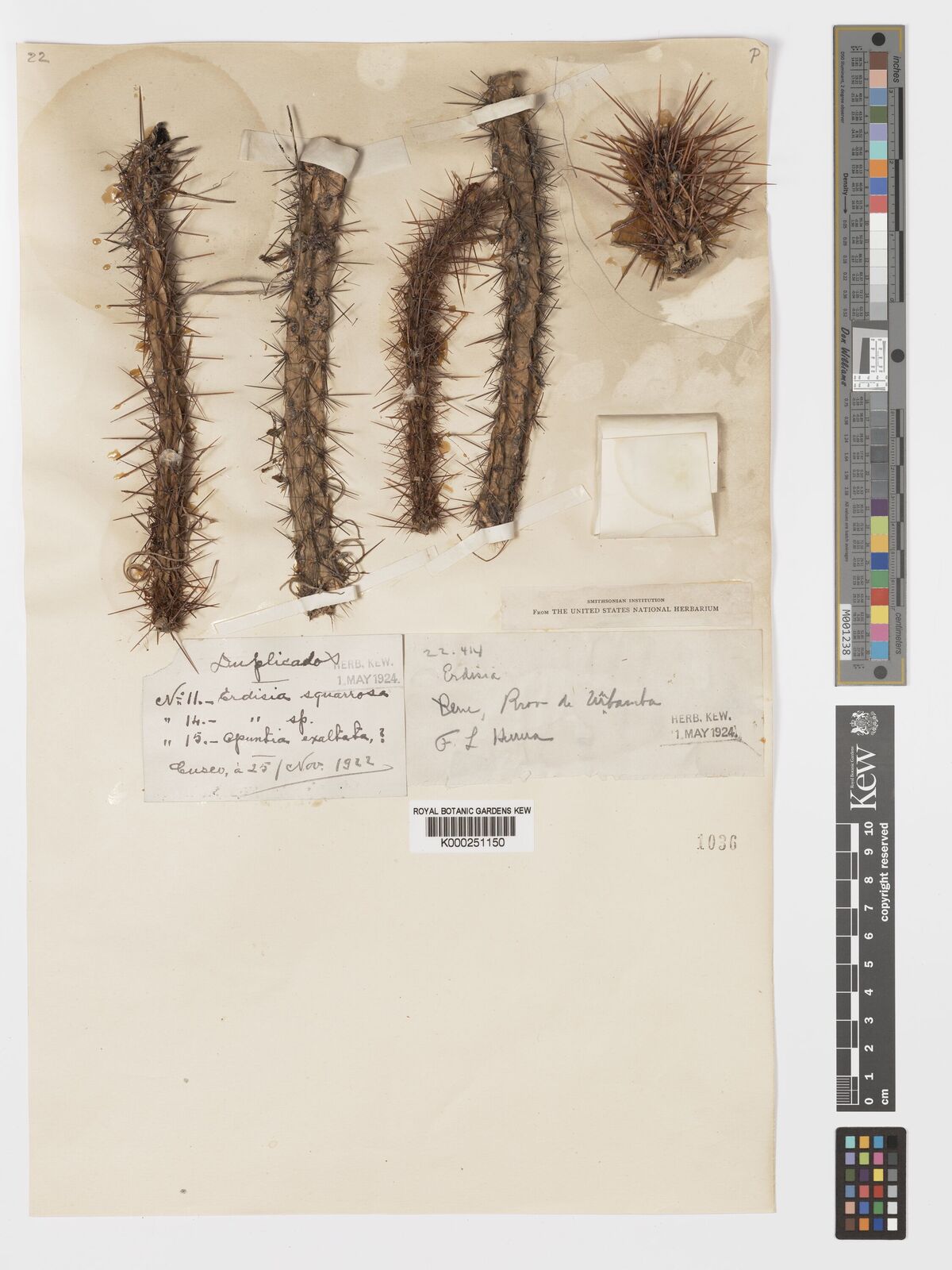 Reference image
Squarrose Corryocactus
Corryocactus squarrosus is a rare, columnar to shrubby cactus species belonging to the family Cactaceae, native to the arid high-altitude regions of Peru 1. It is highly prized among succulent collectors for its rigid spination and distinct growth habit.
The species was classified under the genus Corryocactus, named in honor of T. A. Corry, an engineer who aided botanical exploration in the Andes 2. The specific epithet 'squarrosus' comes from Latin, meaning 'rough, scurfy, or spreading at right angles,' describing the stiff, outward-pointing spines that emerge from its ribs.
Native to Western South America, particularly the arid valleys of Peru, this cactus thrives on rocky slopes 1. It is well-adapted to dry shrublands and desert biomes, where it experiences intense solar radiation, low annual rainfall, and dramatic temperature drops at night.
The stems are green to dull green, divided into distinct, vertical ribs. The areoles bear strong, sharp spines ranging in color from grey to brown, which spread out at wild angles. During the active growing season in late spring and summer, it produces funnel-shaped, brightly colored flowers near the stem tips.
In cultivation, it requires a very bright position with partial to full sun exposure and extremely well-draining soil. Watering should be deep but infrequent, allowing the soil to dry out completely between sessions. During winter, it should be kept dry and cool 2.
Overwatering is the primary cause of failure, quickly leading to root rot. Keeping the plant in poorly lit indoor areas causes etiolation, where stems stretch and weaken.
Requires at least 6 hours of bright indirect or filtered direct sunlight daily.
Water thoroughly only when the soil is completely dry. Keep dry in winter.
Requires a gritty, highly porous cactus mix with pumice or perlite.
Features very sharp spines; handle with care and keep away from pets and kids.
Moderately easy if watering is strictly controlled and bright light is provided.
Naturally distributed across the high-elevation dry valleys and steep rocky hillsides of western Peru, adapted to extreme desert and dry shrubland climates.
