
Light
Full Sun
Requires full sun and intense light to maintain its compact, cushion-like growth form.
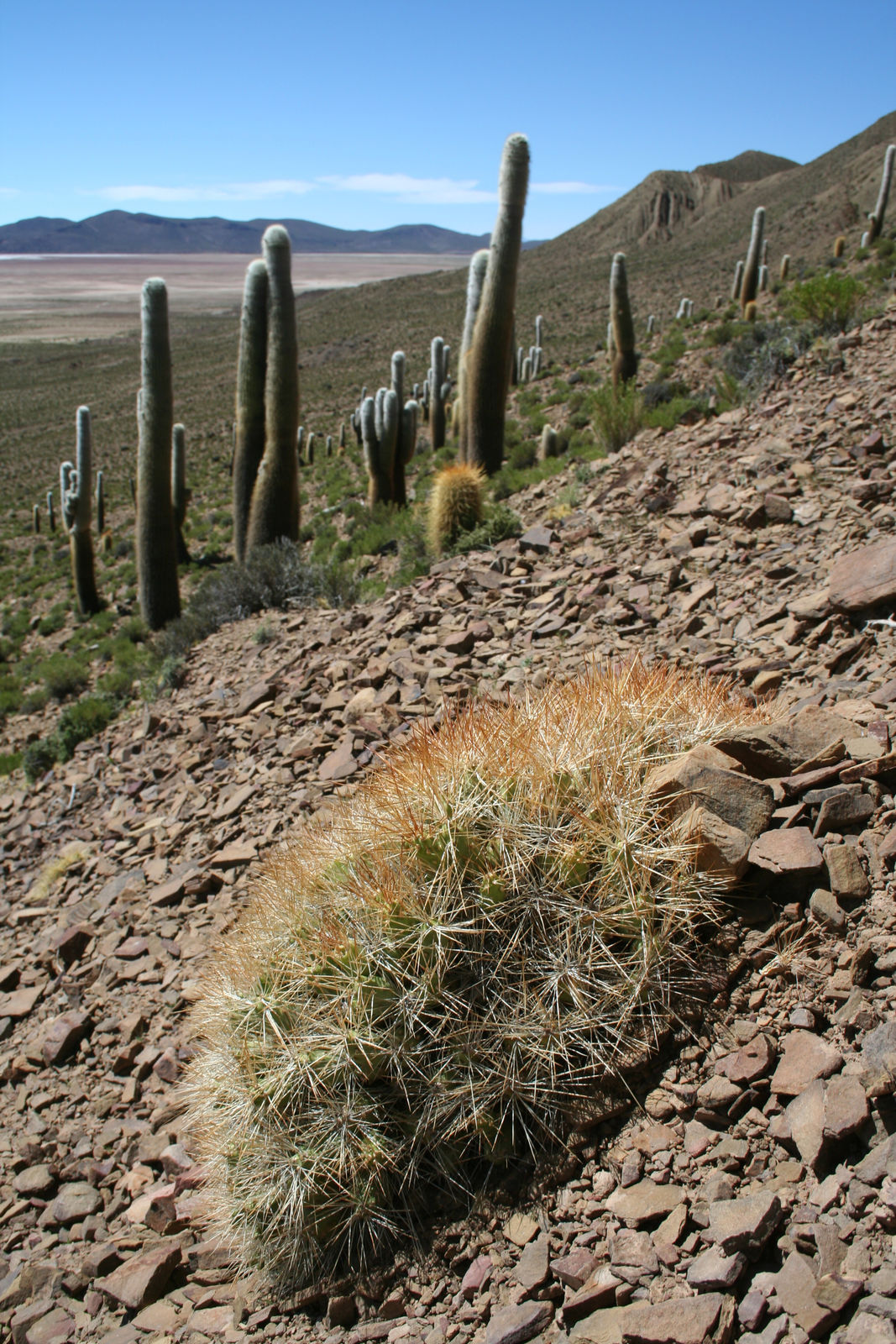 Reference image
Andean Cushion Cactus
Cumulopuntia pentlandii is a low-growing, cushion-forming succulent subshrub belonging to the family Cactaceae. It is native to the harsh, high-altitude environments of the Andes, where it forms dense, defensive mounds 1.
Originally described under the genus Opuntia, the species was later classified into the genus Cumulopuntia. The specific epithet 'pentlandii' honors Joseph Barclay Pentland, an Irish geographer and naturalist. Common synonyms include Tephrocactus pentlandii and Maihueniopsis pentlandii 2.
This resilient cactus is native to western South America, specifically high-altitude regions of Bolivia, Peru, Chile, and northwestern Argentina. It thrives at elevations between 3,000 and 4,500 meters in arid shrublands, rocky slopes, and puna grasslands 1.
The plant grows in compact clumps resembling low cushions. Individual stem segments are globose to ovoid, light green to grayish-green. Areoles can bear needle-like spines ranging from yellow to brown, though spineless populations exist. The flowers are striking, usually vivid yellow, orange, or reddish, blooming at the tips of the stems during summer 2.
In cultivation, Cumulopuntia pentlandii requires exceptional drainage and maximum sunlight. It is remarkably cold-hardy, surviving temperatures down to -10°C, provided the substrate remains absolutely dry during the winter resting phase 1.
Overwatering and placing the plant in heavy, organic soils are the most common causes of root rot. Lack of adequate airflow and insufficient light in winter will lead to weak, stretched growth (etiolation).
Requires full sun and intense light to maintain its compact, cushion-like growth form.
Water only when the soil is dry during the growing season; keep bone dry in winter.
Highly mineral substrate containing pumice, coarse sand, and minimal organic matter.
Features small, irritating glochids (micro-spines) that easily detach and can harm pets.
Moderate. It requires strict dry periods in winter to prevent root damage.
Found naturally in the high-altitude Andean puna, growing on gravelly, wind-swept slopes and dry shrublands.
