
Light
Full Sun
Requires full, direct sun; at least 6-8 hours of intense sunlight daily.
 Reference image
Teddy Bear Cholla
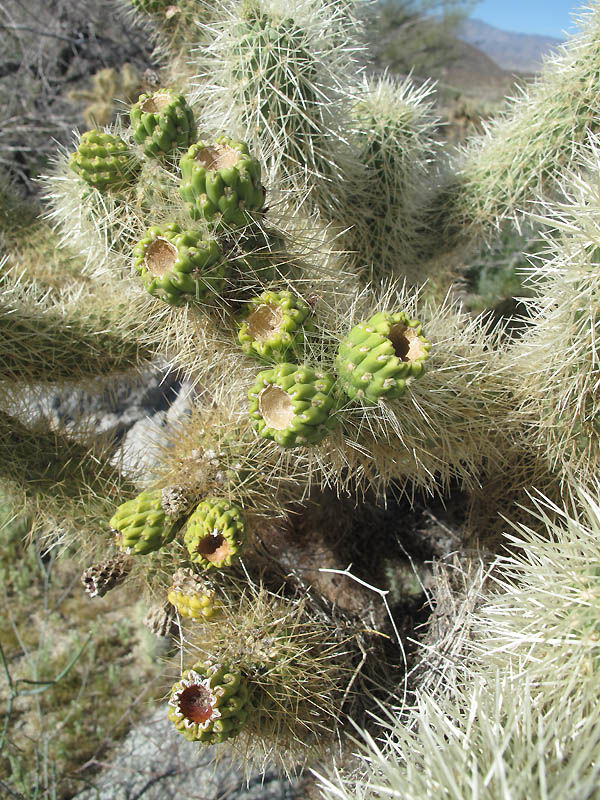
Cylindropuntia bigelovii, commonly known as the "Teddy Bear Cholla," is an iconic desert cactus known for its deceptive fuzzy appearance, which is actually composed of a dense matrix of incredibly sharp, barbed spines 1.
Belonging to the family Cactaceae and the genus Cylindropuntia, this species was first described by George Engelmann. The specific epithet honors the botanist John Milton Bigelow. It is famous for its easily detached segments, giving it the nickname "jumping cholla."
This species is native to the Southwestern United States (California, Arizona, Nevada) and Northwestern Mexico (Sonora, Baja California) 2. It thrives in extreme desert conditions, particularly on rocky slopes, alluvial fans, and gravelly flats.
This succulent shrub typically grows 1 to 2.5 meters tall, featuring a dark central trunk with numerous silver-yellow, spine-covered joints. The dense spines reflect sunlight, protecting the plant from intense heat. It produces pale green-yellow flowers, sometimes tinged with purple, in late spring.
Hardly suitable for standard indoor cultivation due to its safety hazards and extreme light requirements, it can be grown in xeric gardens or specialized greenhouses. It requires minimal water and maximum direct sunlight.
Overwatering, placing the plant in dim light, and using heavy clay soils are fatal. Attempting to handle the plant without proper tools can lead to painful skin attachments of the barbed segments.
Requires full, direct sun; at least 6-8 hours of intense sunlight daily.
Allow soil to dry out completely. Virtually no watering during winter dormancy.
Highly porous, mineral-heavy, gravelly cactus mix with excellent drainage.
Extremely dangerous. Spines are heavily barbed, easily detach, and are highly painful to remove. Toxic to pets.
Hard to manage safely due to extreme spine hazard, though culturally low-maintenance.
Found abundantly in the Mojave and Sonoran deserts, colonizing dry, rocky slopes and gravelly plains.
