
Cylindropuntia caribaea

Caribbean Cholla

Overview

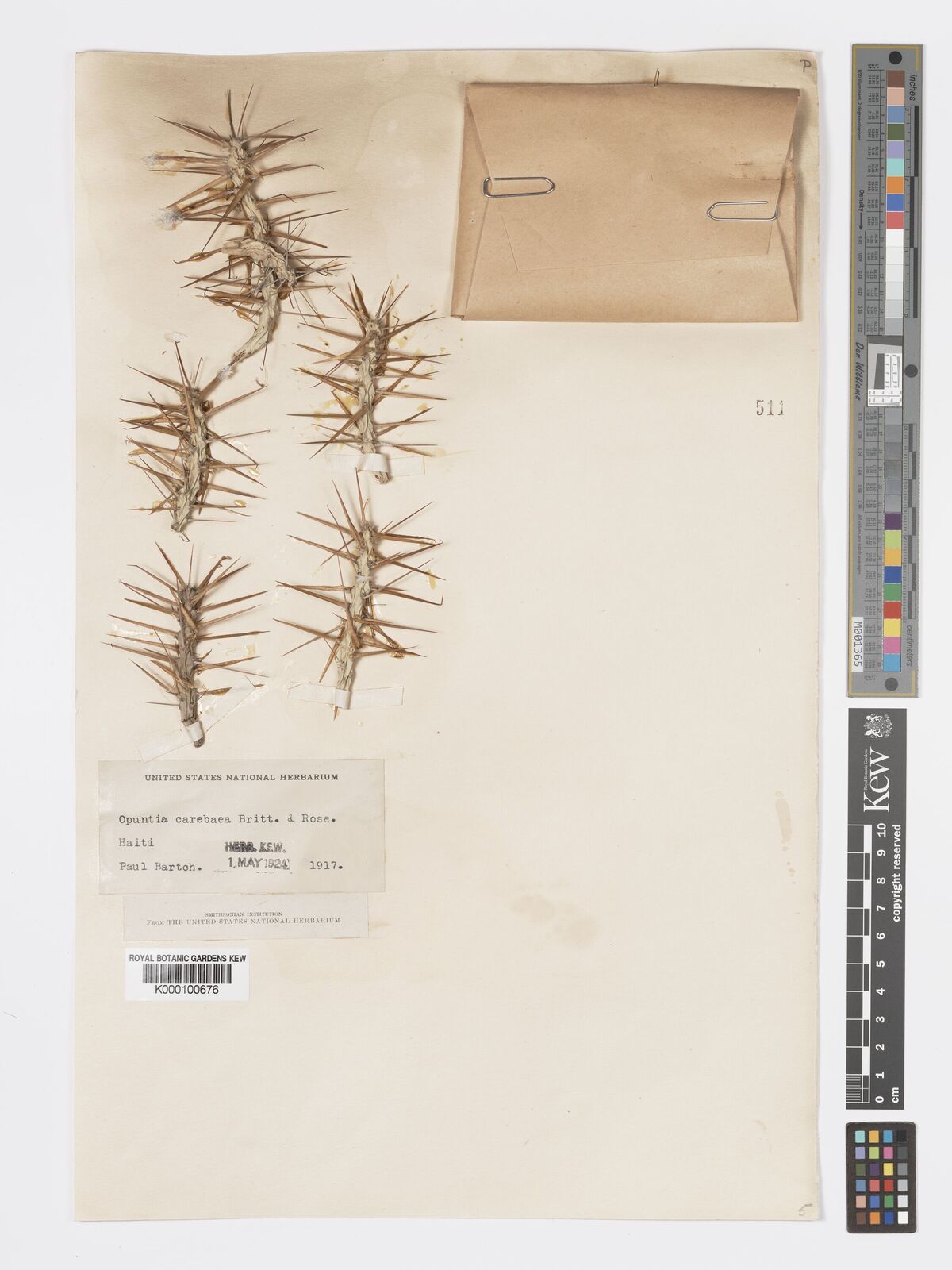
Cylindropuntia caribaea, commonly known as the Caribbean Cholla, is a shrubby, heavily spined cactus species belonging to the family Cactaceae. Known for its persistent and sharp spines, it is a resilient species ideal for xeriscaping 1.

Taxonomy and Naming

The species was formally classified by botanists Nathaniel Lord Britton and Joseph Nelson Rose. The genus name Cylindropuntia refers to its cylindrical stem segments, distinguishing it from flat-padded Opuntias, while caribaea denotes its native Caribbean distribution 2.

Distribution and Habitat

This cactus is native to the Caribbean region, including Haiti, the Dominican Republic, Colombia, and Venezuela. It thrives in seasonally dry tropical biomes, coastal scrublands, and sandy, low-elevation dry forests 1.

Appearance

Growing as a succulent shrub up to 1.5 meters tall, it features cylindrical green joints with prominent tubercles. The areoles bear formidable, yellowish-brown spines covered in paper-like sheaths. It produces small, pale yellow-green flowers followed by dry, spiny fruits.

Cultivation and Care

It requires full sun exposure to maintain its compact, robust growth. Watering must be sparse, allowing the soil medium to dry out completely between sessions. During winter, it enters dormancy and requires dry conditions.

Common Cultivation Errors

Overwatering and poorly draining soil are the leading causes of root rot. Lack of sufficient direct sunlight results in weak, elongated stem segments 2.

Bibliography

References

  1. Plants of the World Online (POWO), Royal Botanic Gardens, Kew.
  2. IUCN Red List of Threatened Species - Cylindropuntia caribaea.
Light

Full Sun

Requires full sun. Place in the brightest south-facing window or outdoors in direct sunlight.
Watering

12-30 Days

Water only when the substrate is 100% dry. Reduce watering to a bare minimum in winter.

Soil

Excellently draining, sandy and gravelly cactus potting mix

Needs an extremely porous mix of pumice, coarse sand, and potting soil.

Safety

Risky for Pets

Highly dangerous to pets and children due to very sharp, easily detached barbed spines.

Difficulty

Easy

Very easy to care for if kept dry and sunny, but physically difficult to handle during repotting.

Native Habitat

Caribbean, Colombia, Venezuela

Originally distributed across the dry coastal regions and island ecosystems of the Caribbean, extending into the arid lowlands of northern South America in Colombia and Venezuela.

Frequently Asked Questions

Is Caribbean Cholla toxic to pets?
While not chemically highly toxic, its extremely sharp, barbed spines and glochids pose a severe mechanical hazard to pets' mouths, paws, and eyes.
How often should I water it in a pot?
Water roughly every 12 days in summer only after the soil has dried out completely. In winter, reduce watering to once a month or withhold entirely.
What kind of pot and soil should I use?
Use unglazed clay pots with drainage holes and a highly porous substrate containing 50% pumice, gravel, and coarse sand mixed with minimal organic soil.
Will this cactus bloom indoors?
It is very difficult to get blooms indoors. It requires full outdoor sun and natural temperature fluctuations during spring to produce flowers.
How fast does it grow?
It has a moderate growth rate compared to other cacti. With adequate sun and warmth, it can produce several centimeters of new stem segments annually.
Is it cold hardy during winter?
It can tolerate brief drops to -2°C (28°F) if kept completely dry, but it should be protected from hard frosts and kept indoors in winter.
What should I do if the spines get stuck in my skin?
Use tweezers for larger spines, or apply adhesive tape over the tiny, irritating glochids and pull it off to remove them effectively.
Does it shed leaves?
It does not have true leaves; photosynthesis occurs in the stems. Tiny, vestigial leaves on new growth are temporary and shed naturally very quickly.
Why is my cactus stem turning soft?
Softening or darkening of the stem is a classic sign of root rot from overwatering. Stop watering immediately and propagate healthy stem tips if possible.
How is it propagated?
It is easily propagated by taking stem segment cuttings in spring or summer, letting the cut end callus for a few days, and then planting in sandy soil.