
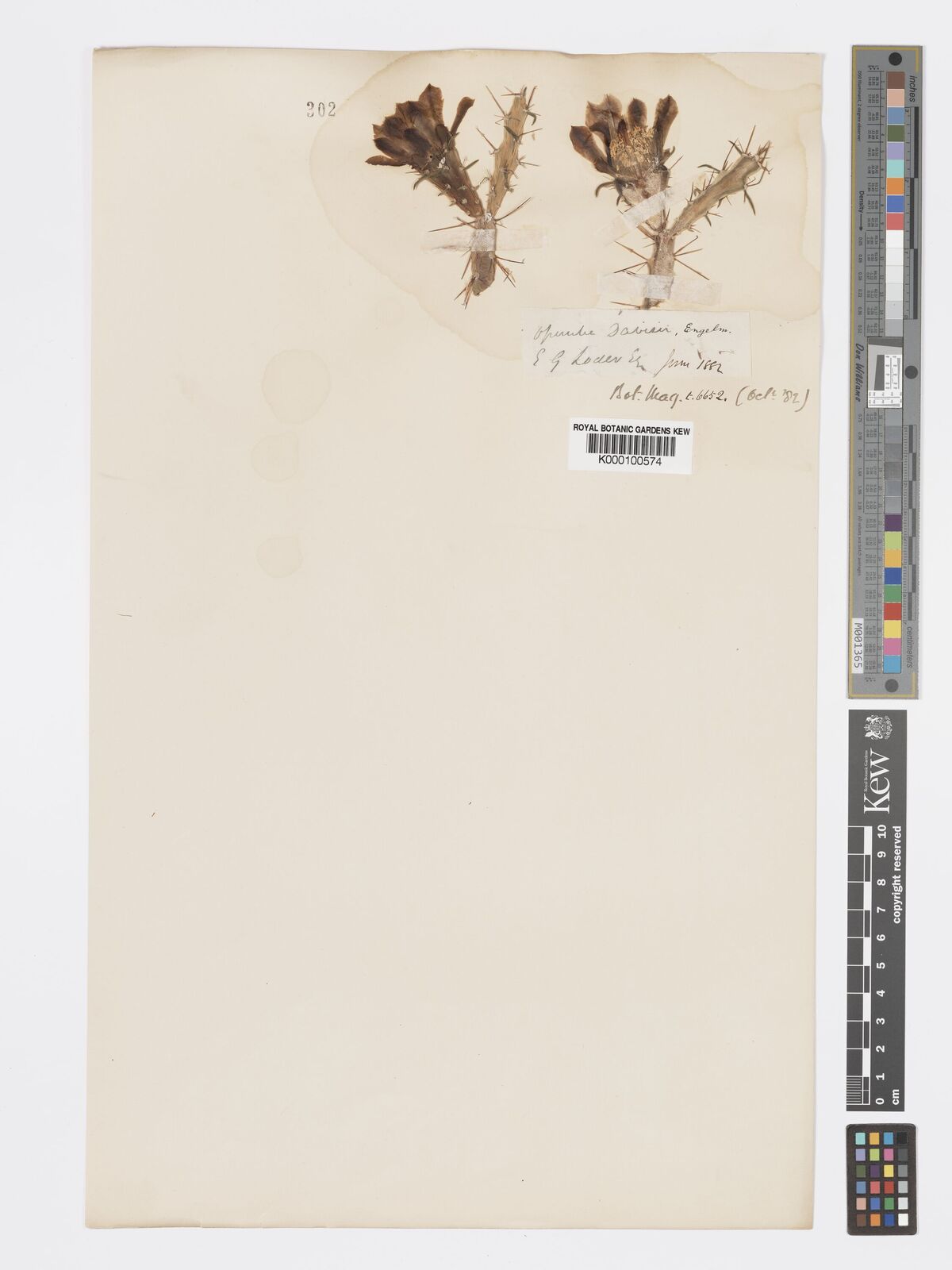
Cylindropuntia davisii

Davis' Cholla

Overview

Cylindropuntia davisii, commonly known as Davis' Cholla, is a highly drought-tolerant succulent shrub belonging to the Cactaceae family 1. Renowned for its densely spiny stems and golden appearance, this species is a classic representative of desert flora.

Classification and Naming

Originally described by George Engelmann, the scientific name is Cylindropuntia davisii (Engelm.) F.M.Knuth. The genus name Cylindropuntia refers to the cylindrical shape of its jointed stems 1.

Distribution and Habitat

Native to the south-central United States, its range spans Texas, New Mexico, and Oklahoma 2. It thrives in sandy desert flats, limestone hills, and dry shrublands under full sun exposure.

Appearance

This low-growing shrubby cactus typically reaches heights of 30-60 cm. The bronze-green cylindrical stems are heavily covered with yellowish-brown spines encased in papery, reflective sheaths, giving the plant a luminous golden glow. It produces greenish-yellow flowers in late spring to early summer 2.

Cultivation

It requires full sun and excellent air circulation, making it ideal for outdoor rock gardens or xeriscaping. It is extremely sensitive to overwatering; the mineral-rich soil must dry out completely between waterings. It exhibits impressive frost tolerance, surviving sub-zero winter temperatures when kept dry.

Common Mistakes

Lack of direct sunlight leads to weak, etiolated growth. Overwatering or planting in heavy, clay-rich soil rapidly causes root and stem rot.

Bibliography

References

  1. Plants of the World Online (POWO). Royal Botanic Gardens, Kew. URL: http://www.plantsoftheworldonline.org
  2. GBIF Secretariat (2023). Cylindropuntia davisii. GBIF Backbone Taxonomy. URL: https://www.gbif.org
Light

Full Sun

Full direct sun; requires at least 6 hours of direct sunlight daily.
Watering

12-30 Days

Allow soil to dry out completely. Do not water during cold winter months.

Soil

Well-drained, sandy and gravelly cactus mineral mix

Coarse sand, pumice, and gravel-rich cactus mix with minimal organic matter.

Safety

Risky for Pets

Armed with sharp, barbed spines that attach easily to skin and clothing. Keep away from pets.

Difficulty

Moderate

Easy outdoors with negligible care, but highly prone to rot in low-light, wet conditions.

Native Habitat

South-Central USA (Texas, New Mexico, Oklahoma)

Grows naturally in sandy flats, limestone slopes, and semi-arid grasslands across Texas, New Mexico, and parts of Oklahoma.

Frequently Asked Questions

Can Cylindropuntia davisii be grown in pots?
Yes, but the pot must have excellent drainage holes and contain mineral-rich soil. It also needs a location with full, direct sun all day.
How often should I water this cactus?
Water roughly every 12 days in summer only after the soil has completely dried out. In winter, suspend watering almost entirely.
Is Davis' Cholla cold hardy?
Yes, it is highly frost-resistant down to -15°C (5°F) provided the soil remains completely dry. Wet winter cold can cause rot.
Is it toxic to pets?
While not chemically toxic, its extremely sharp, barbed spines pose a severe physical hazard to pets and humans.
Is it suitable for indoor cultivation?
Generally no. Due to its high light and ventilation requirements, it will stretch and weaken indoors unless placed in an extremely sunny south-facing window.
What is the best soil mix?
A porous cactus mix containing pumice, lava rock, coarse sand, and a minimal amount of peat moss works best.
When and what color does it bloom?
It blooms in early summer, producing yellowish-green or bronze-tinted flowers at the tips of the cylindrical stems.
How fast does it grow?
It has a slow to moderate growth rate, developing new cylindrical joints each year under optimal warm and sunny conditions.
Why do its spines look golden yellow?
The spines are covered in papery, translucent sheaths that reflect sunlight, creating a characteristic golden glow.
What are the signs of rot and how can it be saved?
Softening and darkening of the stem indicate rot. Cut away the healthy upper joints, let them dry for a week, and replant to root.