
Light
Full Sun
Requires full, direct sun. Indoors, it will suffer without a high-powered grow light or south window.
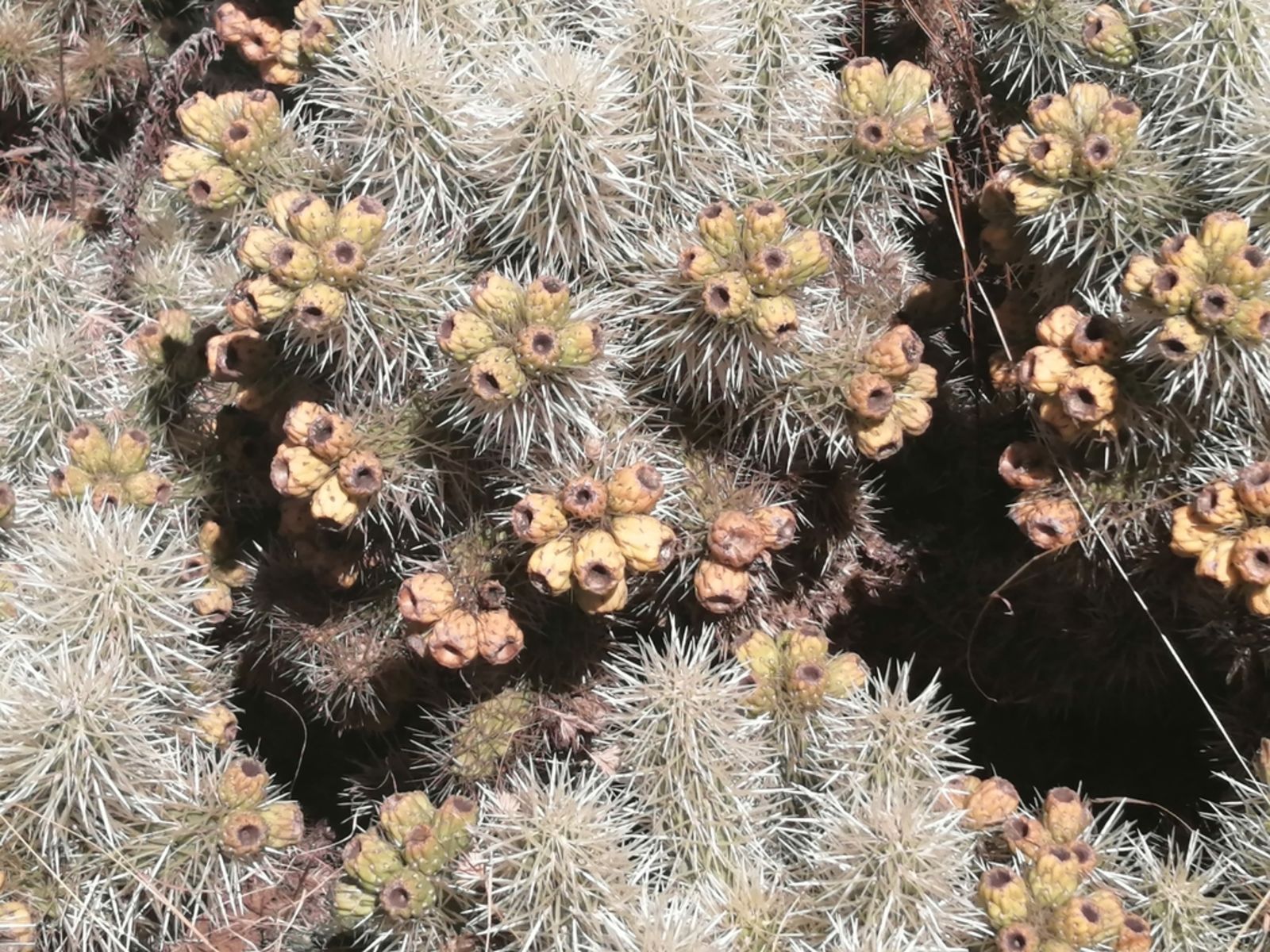 Reference image
Pale Cholla
Cylindropuntia pallida, commonly known as Pale Cholla or Hudson Pear, is a heavily armed, shrubby succulent cactus belonging to the Cactaceae family 1. It is well-known for its aggressive growth and vicious spines.
The species belongs to the genus Cylindropuntia, characterized by cylindrical jointed stems. In various taxonomic treatments, it has been closely linked or synonymized with Cylindropuntia rosea 2. The specific epithet 'pallida' refers to its pale, whitish-yellow spines.
Native to the arid and semi-arid regions of Mexico (specifically states like Coahuila and Tamaulipas). However, due to its resilience, it has introduced populations in Australia, southern Africa, and parts of Europe, where it often behaves as a noxious weed 1.
This species forms a branched shrub up to 1.5 meters tall. Its segments are cylindrical, grey-green, and detach easily when brushed. The areoles bear fierce, barbed, papery-sheathed spines. It produces attractive pink to magenta flowers during late spring 2.
Due to its hazardous spines, it is rarely kept as a houseplant and is best suited for secure outdoor rock gardens. It requires maximum sunlight and exceptionally well-draining mineral substrate.
Overwatering is the primary cause of failure, leading to root rot. Keeping the plant in low-light indoor areas will cause weak, etiolated growth. Handling without proper thick leather protection is highly discouraged 1.
Requires full, direct sun. Indoors, it will suffer without a high-powered grow light or south window.
Allow the substrate to dry out entirely between waterings. Water sparingly in summer, none in winter.
A highly porous mix containing grit, pumice, and coarse sand with very little organic matter.
Warning! Equipped with dangerously sharp, barbed spines that cause painful wounds. Keep away from pets.
Hard to manage due to severe mechanical hazards and strict light demands.
Native to the dry shrublands of Northern Mexico. It has successfully naturalized and become invasive in several dry regions of Australia and South Africa.
