
Light
Full Sun
Requires full, direct sun. South-facing windows, balconies, or open garden beds are ideal.
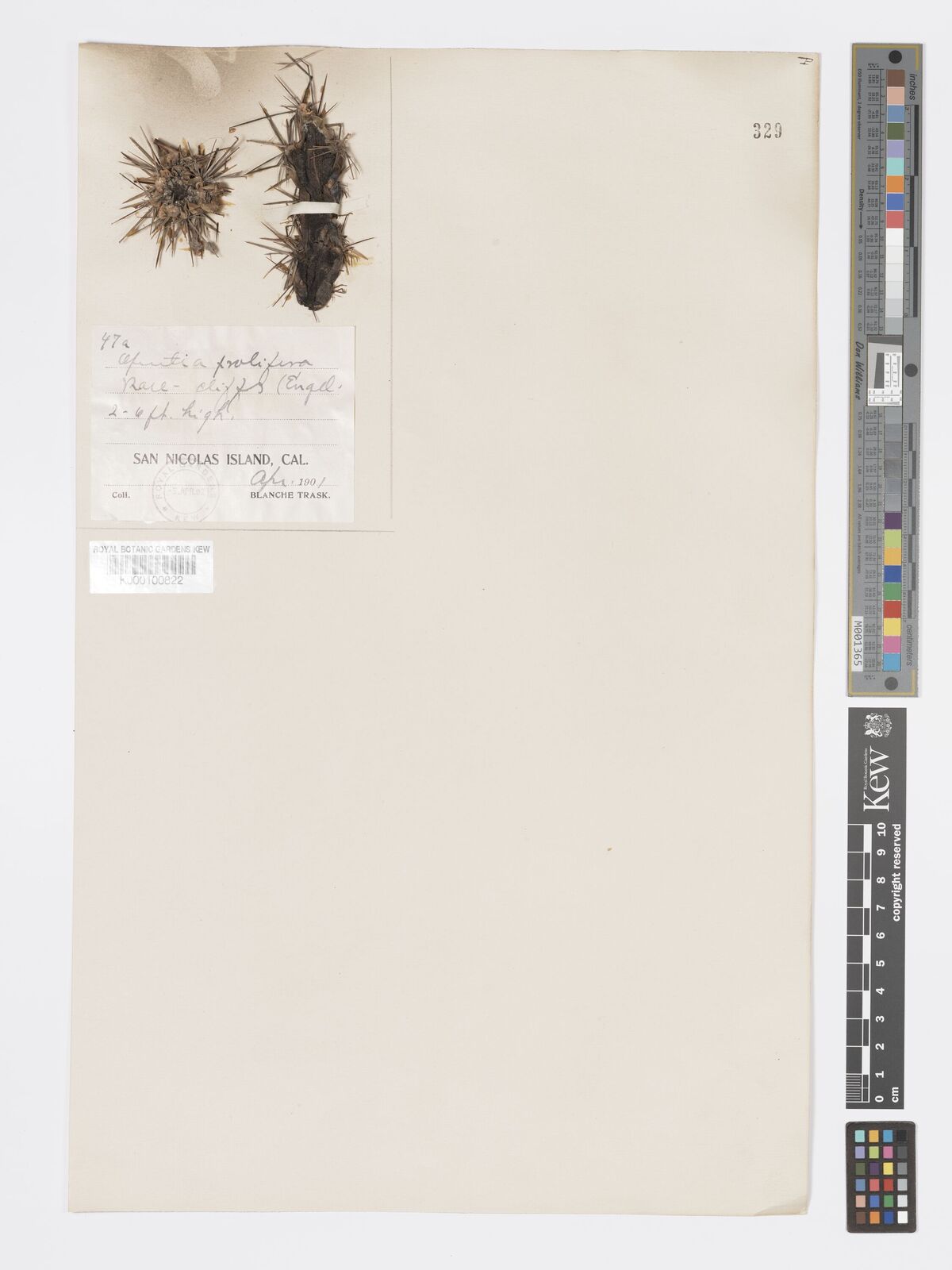 Reference image
Coastal Cholla
Cylindropuntia prolifera, commonly known as the coastal cholla, is a robust, shrubby succulent native to the maritime desert scrub of western North America. It is characterized by its heavily armed, segmented branches and peculiar, proliferating chains of fruit.
Originally described as Opuntia prolifera by George Engelmann in 1852, the species was later classified under the genus Cylindropuntia to group cylindrical-jointed chollas 1. The specific epithet prolifera refers to the plant's unique growth habit where new flowers and subsequent fruits grow directly out of the existing fruits from previous seasons, forming long hanging chains 2.
This species is native to the coastal bluffs, hillsides, and dry canyons of Southern California (United States) and Baja California (Mexico), including adjacent channel islands. It thrives in sandy, well-draining soils of Mediterranean-type semi-arid climates, often near coastal sage scrub communities 1.
Coastal cholla forms a highly branched, woody-stemmed shrub reaching heights of 1 to 2.5 meters. The cylindrical stem segments are fleshy, grey-green, and carry prominent tubercles. Areoles bear 1 to 2 cm long, yellowish-brown spines sheathed in papery covers, along with tiny, irritating glochids. It produces dark red to purple-magenta flowers in late spring, followed by green, spineless, often sterile fruits.
In cultivation, it requires maximum sunlight exposure and exceptionally well-draining soil. It is highly drought-tolerant, suited for xeriscaping or outdoor containers in dry climates. Watering should be sparse, letting the substrate dry completely between applications. It has limited frost tolerance, withstanding temperatures down to -5°C if kept dry.
Overwatering is the primary cause of failure, quickly leading to root rot. Insufficient sunlight causes pale, weakened, and stretched segment growth (etiolation).
Requires full, direct sun. South-facing windows, balconies, or open garden beds are ideal.
Water sparingly during spring and summer; keep almost completely dry in winter.
Excellent drainage is vital. Use a mix heavy in pumice, gravel, and coarse sand.
The barbed spines and tiny glochids can easily lodge in skin or pet fur, causing painful irritation.
Very easy for beginners, provided they avoid overwatering and handle the plant with care.
Naturally distributed along the arid coastal strip and offshore islands, thriving in maritime desert scrub environments with sandy and gravelly soils.
