
Light
Full Sun
South-facing windows providing at least 6 hours of direct sunlight are ideal.
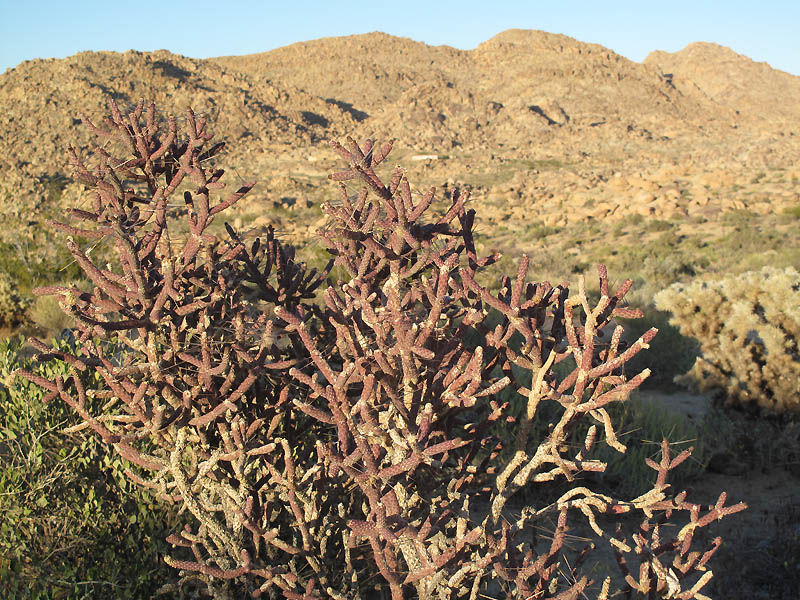 Reference image
Diamond Cholla
Cylindropuntia ramosissima, commonly known as the diamond cholla or branched pencil cholla, is a highly drought-tolerant, shrubby cactus species belonging to the family Cactaceae 1. It is well-known for its intricate branching and distinctively patterned cylindrical joints.
Originally described by George Engelmann as Opuntia ramosissima, it was later transferred to the genus Cylindropuntia to separate the cylindrical-jointed opuntioids from flat-padded prickly pears 2. The specific epithet ramosissima translates from Latin as "most branched," emphasizing its highly ramified growth habit.
The species is native to the Mojave and Colorado deserts of the Southwestern United States (California, Nevada, Arizona) and Northwestern Mexico (Sonora, Baja California) 1. It thrives in gravelly, sandy, and calcareous soils on dry slopes and desert flats at elevations up to 1,500 meters.
Growing as an erect, intricately branched shrub up to 2 meters tall, it features slender, grey-green cylindrical joints measuring only 0.5 to 1 cm in diameter. The stems are covered in unique, flat-topped, diamond-shaped tubercles. Areoles bear small yellow glochids and typically 1 or 2 long, sharp spines encased in papery, tan sheaths 2. The flowers are relatively small, exhibiting greenish-yellow, bronze, or pinkish hues.
In cultivation, this cactus requires minimal attention. It demands full sun exposure and an exceptionally well-draining, mineral-dominant soil mix. Watering should be sparse, performed only when the substrate is dry, and reduced to virtually zero during winter.
Overwatering and inadequate sunlight are the primary causes of failure. Excess moisture quickly leads to root rot, while low light levels result in weak, etiolated growth. Using heavy, organic-rich soils that retain moisture is also detrimental.
South-facing windows providing at least 6 hours of direct sunlight are ideal.
Water only when the soil is completely dry, and withhold water almost entirely in winter.
Use sandy, pumice, and perlite-heavy cactus mixes that offer superb drainage.
WARNING: Possesses very sharp spines and hazardous microscopic barbed glochids that easily embed in skin.
Very easy to maintain due to high drought tolerance, but handling and repotting are difficult due to spines.
Grows naturally in the arid, gravelly, and sandy flats of the Mojave and Colorado deserts.
