
Light
Full Sun
Requires full, direct sun for at least 6-8 hours daily.
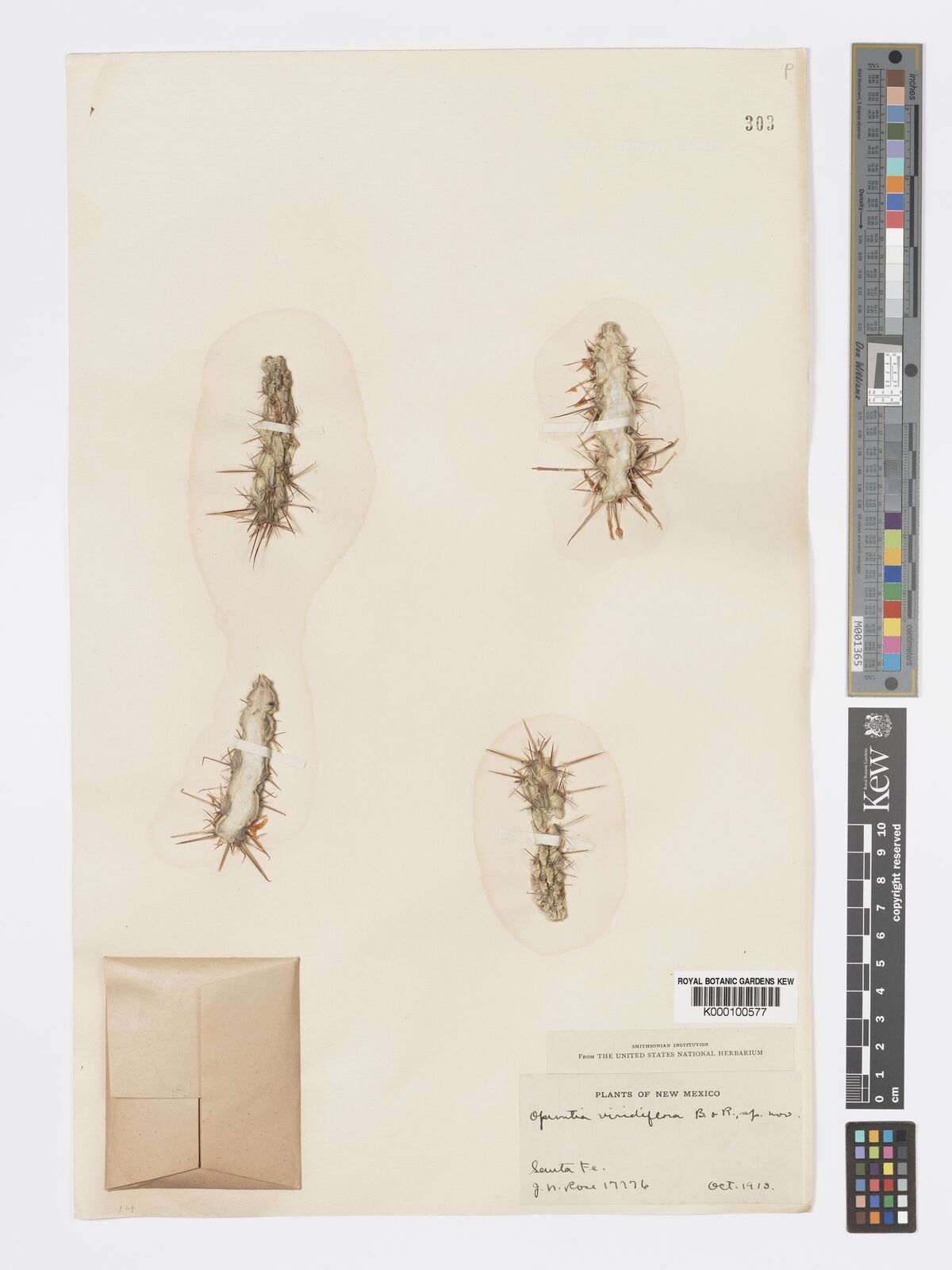 Reference image
Santa Fe Cholla
Cylindropuntia × viridiflora, commonly known as the Santa Fe cholla, is a rare, naturally occurring hybrid succulent shrub in the cactus family (Cactaceae). Known for its extreme cold hardiness, it forms an intricately branched shrub suited for xeric gardens.
This taxon represents a natural hybrid between Cylindropuntia imbricata and Cylindropuntia whipplei 1. The specific epithet 'viridiflora' translates to 'green-flowered', pointing directly to the distinct yellowish-green hue of its blossoms.
Native to the Southwestern United States, including New Mexico, Colorado, Utah, and Arizona, this plant is found in desert grasslands and pinyon-juniper woodlands 2. It thrives at moderate to high elevations, typically between 1,500 and 2,200 meters, under rocky and dry conditions.
It is a woody-stemmed succulent shrub growing up to 1.2 meters high. The cylindrical, jointed stems are grey-green, displaying prominent tubercles. The spines are sheathed and range from yellow to brown. Its most striking feature is the copper-green or yellowish-bronze flowers that bloom in late spring.
In cultivation, it demands exceptional drainage and maximum sunlight. It is incredibly cold-tolerant, surviving sub-zero winter temperatures, provided the soil remains completely dry 1. Perfect for rock gardens and xeriscaping.
Watering during winter or planting in heavy, clay-rich soil will cause rapid root rot. Indoor cultivation often fails due to inadequate sunlight, which leads to weak, elongated growth.
Requires full, direct sun for at least 6-8 hours daily.
Strictly soak-and-dry. Keep completely dry throughout winter.
Pure mineral soil mix with pumice, coarse sand, and fine gravel.
Equipped with sharp spines and tiny, barbed glochids that easily penetrate skin; toxic to pets due to physical injury risk.
Easy in outdoor rock gardens, but difficult indoors due to high light and low humidity demands.
Naturally distributed across the arid, high-altitude shrublands and pinon-juniper zones of New Mexico, Arizona, Colorado, and Utah.
