
Light
Full Sun
Requires full, direct sun for robust spine development and flowering.
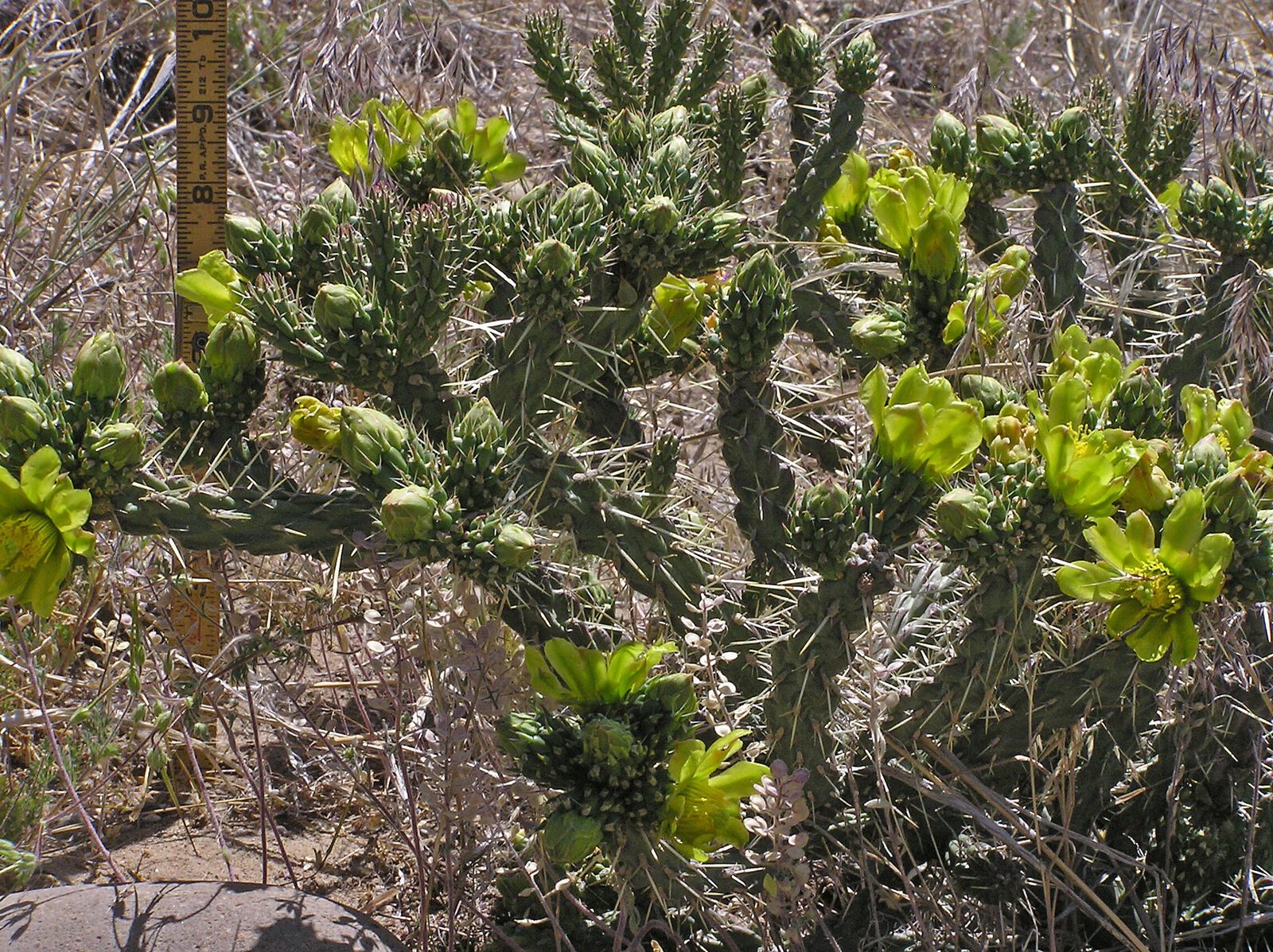 Reference image
Whipple Cholla
Cylindropuntia whipplei, commonly known as Whipple Cholla, is an exceptionally cold-hardy, shrubby cylindrical cactus belonging to the family Cactaceae. Known for its dense armature of shimmering spines, it is a prominent feature of high-desert xeriscapes 1.
Named in honor of Lieutenant Amiel Weeks Whipple, a railroad surveyor and explorer, the species was formally classified under the genus Cylindropuntia. Its common names include Whipple's Cholla and Valley Cholla 2.
This species is native to the southwestern United States, spanning Colorado, Utah, Arizona, New Mexico, and Nevada 1. It thrives at elevations ranging from 900 to 2,400 meters, typically found in dry grasslands, desert shrublands, and juniper-pinyon woodlands 3.
Whipple Cholla forms a low, densely branched shrub up to 1.5 meters tall. Its green to yellow-green stems are cylindrical and segmented, covered in prominent tubercles. The spines are covered with papery, silver-white or pale yellow sheaths that reflect intense sunlight. Chartreuse to yellow-green flowers bloom in early summer, followed by yellow, fleshy, persistent fruits 3.
This cactus requires full sun exposure and exceedingly well-drained, mineral-heavy soils. It is remarkably frost-hardy, surviving temperatures down to -25°C if kept dry. Watering should be sparse in summer and withheld almost entirely in winter 2.
The most prevalent error is overwatering or using compacted, clay-rich soil, which inevitably leads to root rot. Insufficient sunlight results in weak, etiolated stem segments and sparse spine growth 1.
Requires full, direct sun for robust spine development and flowering.
Allow soil to dry out completely. Suspend watering almost entirely in winter.
Exclusively gritty, mineral-based cactus mix containing pumice, sand, and gravel.
Equipped with sharp spines and micro-barbed glochids. Handle only with heavy-duty tongs or thick leather gloves.
Very hardy against cold and drought, but highly susceptible to overwatering.
Widely distributed across the high deserts of the Southwestern United States, particularly abundant in the Colorado Plateau regions of Arizona, Utah, and western Colorado.
