
Light
Bright Indirect Light
Requires bright, filtered sunlight; protect from intense midday summer sun.
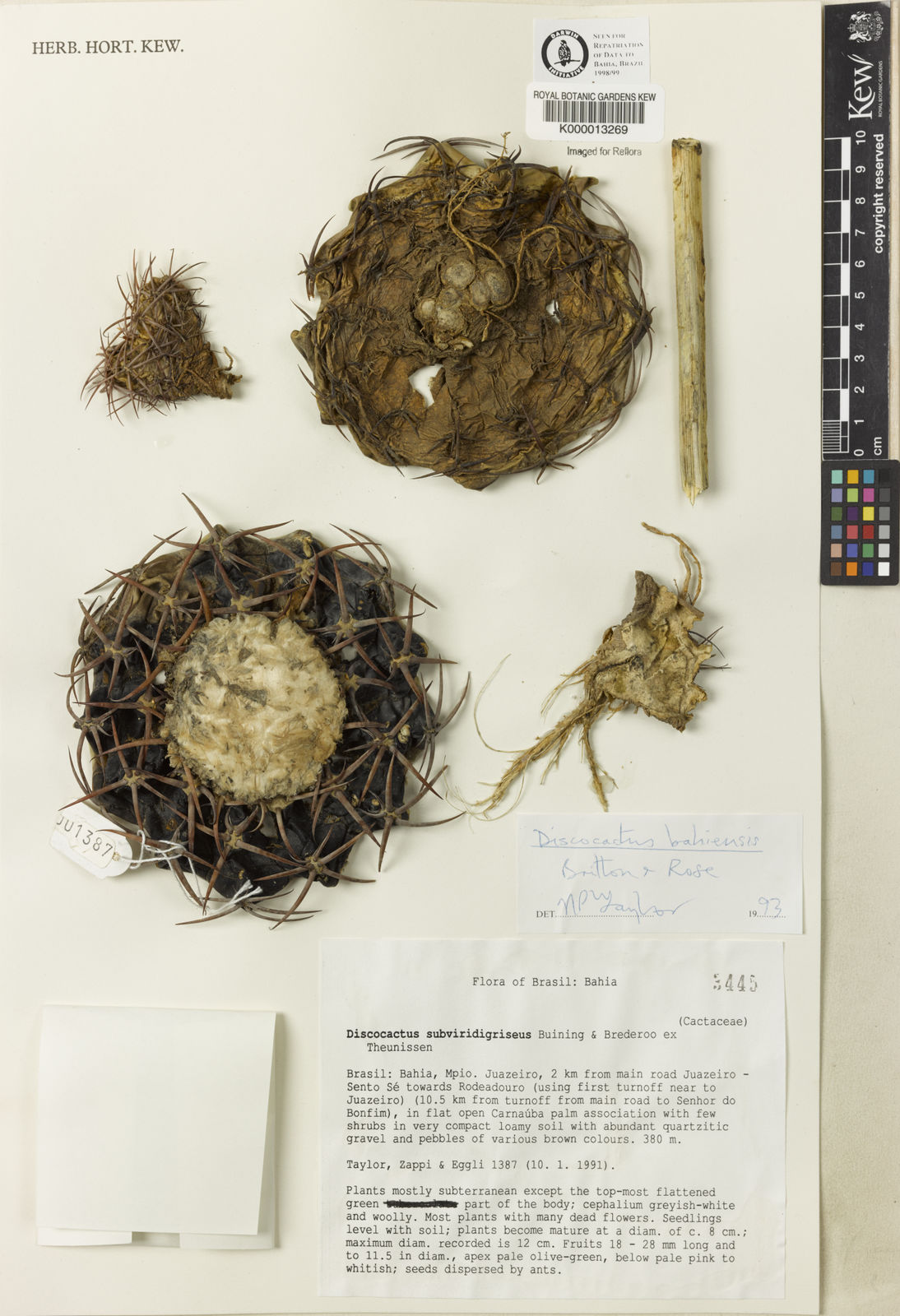 Reference image
Bahia Discocactus
Discocactus bahiensis is a highly sought-after, disk-shaped cactus species belonging to the family Cactaceae. It is classified as Vulnerable due to agricultural expansion and habitat destruction in its wild range 1.
The species was formally described by botanists Albert Buining and Arnold Brederoo 2. The genus name Discocactus derives from the Greek word 'diskos', referencing its flattened, disc-like silhouette, while the specific epithet bahiensis denotes its primary native state of Bahia in Brazil.
This succulent subshrub is endemic to northeastern Brazil, thriving in the seasonally dry tropical Caatinga biome 1. It grows in quartzitic stony gravel, sandy soils, and cracks of rocky outcrops, where it is exposed to harsh winds and high solar radiation.
The stem is solitary, globose-depressed, reaching up to 15 cm in diameter, and possesses 10 to 15 distinct ribs. The spines are strong, curved, and yellowish-brown. As the plant reaches maturity, it develops a prominent apical cephalium covered with white wool and dark bristles. From this cephalium, nocturnal, heavily scented white flowers emerge to attract night-pollinating insects 2.
In cultivation, Discocactus bahiensis is considered a difficult species. Due to its extremely sensitive root system, it is frequently grafted onto hardier rootstocks like Trichocereus to prevent rot 2. It demands strict warmth and a heavily mineralized substrate with minimal organic components.
The most prevalent issue is overwatering during winter or using heavy clay soils that retain moisture. Exposure to temperatures below 12°C, combined with damp substrate, will rapidly trigger fatal root and stem rot.
Requires bright, filtered sunlight; protect from intense midday summer sun.
Allow the soil to dry out completely between waterings; keep bone dry in winter.
Use an ultra-porous mineral mix consisting of pumice, lava rock, and coarse sand.
Non-toxic to pets, but features sharp, stiff spines that require careful handling.
Expert level. Highly sensitive to excess moisture and cold conditions.
Native to the semi-arid Caatinga vegetation zones of northeastern Brazil, where it grows in dry, rocky, and sandy quartz environments.
