
Light
Filtered Sun
Prefers bright, filtered sunlight. Protect from intense, direct midday sun to prevent scorching.
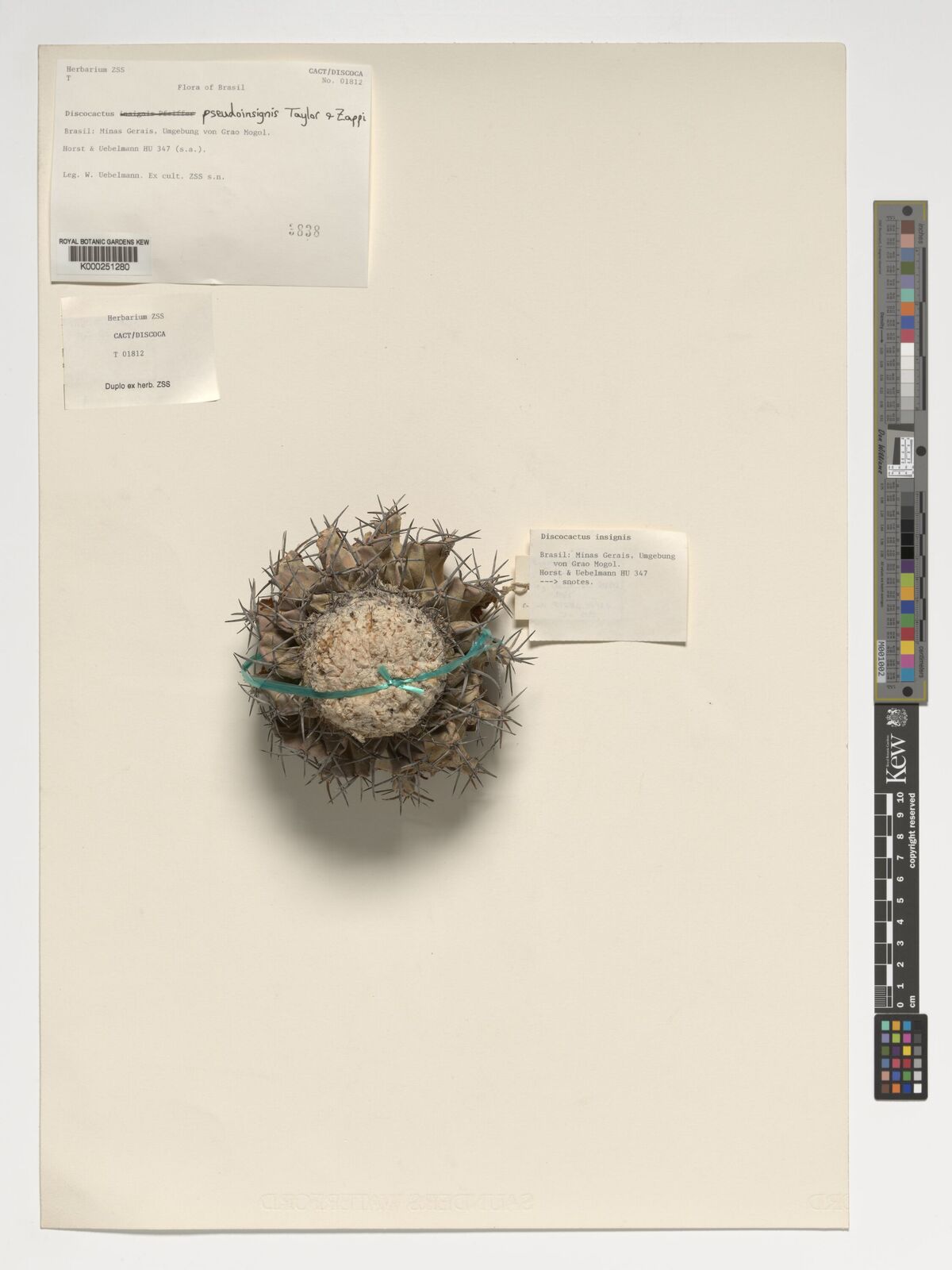 Reference image
False Insignis Cactus
Discocactus pseudoinsignis is a highly sought-after, flattened-globose cactus species belonging to the Cactaceae family 1. Renowned among collectors, it is distinguished by its unique woolly cephalium and intensely fragrant nocturnal white flowers.
Belonging to the genus Discocactus, its specific epithet "pseudoinsignis" highlights its close morphological resemblance to Discocactus insignis, although it remains taxonomically distinct due to specific spine structures and seed morphology 2.
This species is endemic to southeastern Brazil, particularly in the state of Minas Gerais 1. It thrives in seasonally dry tropical environments, growing primarily on rocky outcrops, sandy substrates, and quartzite gravel plains at high elevations.
The stem is solitary, low-globose, and dark green to grayish-green, sporting 10 to 15 ribs. Spines are stout, slightly curved, starting yellowish-brown and weathering to gray. Upon reaching maturity, the plant ceases apical growth and develops a terminal cephalium made of dense white wool and brownish bristles, from which nocturnal blooms emerge.
It is considered difficult to grow in cultivation. It demands a highly porous, acidic, mineral-based soil containing quartz sand 2. Unlike many other cacti, it cannot tolerate low winter temperatures; it must be kept at a minimum of 12°C and completely dry during the cold months.
Overwatering and low winter temperatures are the primary causes of failure, quickly leading to root rot. Insufficient light prevents the development of the characteristic cephalium and inhibits flowering.
Prefers bright, filtered sunlight. Protect from intense, direct midday sun to prevent scorching.
Water only when the substrate is completely dry. Keep entirely dry in winter.
Highly porous, lime-free mineral substrate composed of quartz sand, pumice, and minimal organic matter.
Non-toxic, but features sharp spines that can cause physical injury. Handle with care.
Hard. Highly sensitive to cold, stagnant air, and excess moisture, making it suitable for experienced growers.
Endemic to the rocky outcrops and quartzite gravel fields of Minas Gerais, Brazil, growing in nutrient-poor, acidic soils within seasonally dry tropical climates.
