
Light
Bright Indirect Light
Requires bright, filtered light. Avoid direct midday sun, which can bleach and burn the foliage.
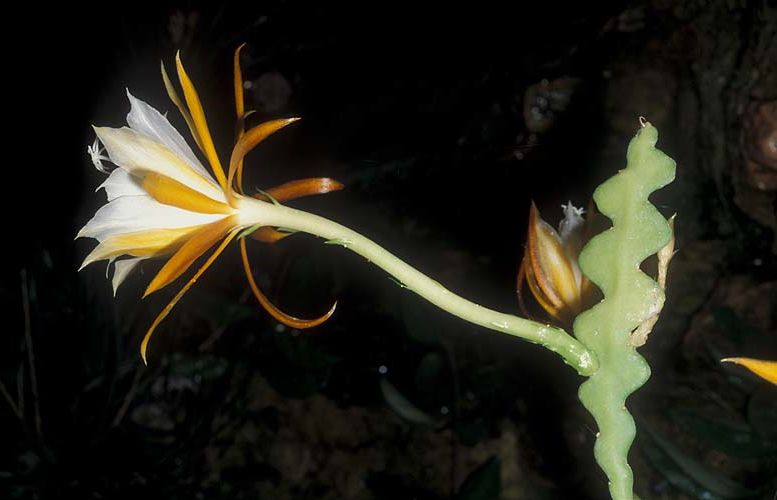 Reference image
Fishbone Cactus
Disocactus anguliger, commonly referred to as the 'Fishbone Cactus' or 'Zigzag Cactus', is an epiphytic cactus species belonging to the family Cactaceae. Known for its distinctive, deeply lobed zigzag stems and nocturnal, highly fragrant flowers, it is a highly prized ornamental plant.
Originally described by Charles Lemaire in 1851 as Phyllocactus anguliger, the species was later classified under the genus Disocactus following modern molecular and morphological studies 1. It is often found in older literature and trade under the synonym Epiphyllum anguliger.
Endemic to Mexico, this species occurs in the states of Guerrero, Jalisco, Michoacán, Nayarit, and Oaxaca 2. It grows as an epiphyte in seasonally dry tropical forests, evergreen pine-oak forests, and cloud forests at elevations of 1,100 to 1,800 meters above sea level, anchoring itself to trees and rocky cliffs.
The plant produces heavily branched, arching, spineless green stems. While the basal stems are cylindrical, the secondary branches are flattened and deeply notched in an alternating pattern, resembling a fishbone. The nocturnal blooms appear in late autumn; they are large, cream-white to pale yellow, and emit a sweet, intense fragrance. These are followed by small, greenish, edible ovoid fruits.
Unlike desert cacti, Disocactus anguliger requires bright, indirect light and higher ambient humidity. The growing medium should be well-draining, rich in organic matter, and aerated—similar to an orchid or bromeliad mix. Frequent watering is tolerated during the active summer growth, but the substrate must dry out partially between waterings.
Exposure to intense, direct afternoon sun causes unsightly leaf scorch. Overwatering and poor drainage are the primary causes of root rot. Lack of winter rest can prevent the plant from blooming.
Requires bright, filtered light. Avoid direct midday sun, which can bleach and burn the foliage.
Water once the top soil feels dry during summer. Drastically reduce watering in the winter months.
Prefers a chunky, well-aerated organic mix of cactus soil, orchid bark, and perlite.
Non-toxic to cats, dogs, and humans, making it a very safe household plant choice.
Very easy to care for, thriving in standard home temperatures and moderate humidity.
Native to the mountain regions of southern and western Mexico, growing on tree trunks in warm, seasonally dry tropical forests.
