
Light
Filtered Sun
Provide filtered sunlight or bright indirect light. Avoid direct, scorching afternoon sun.
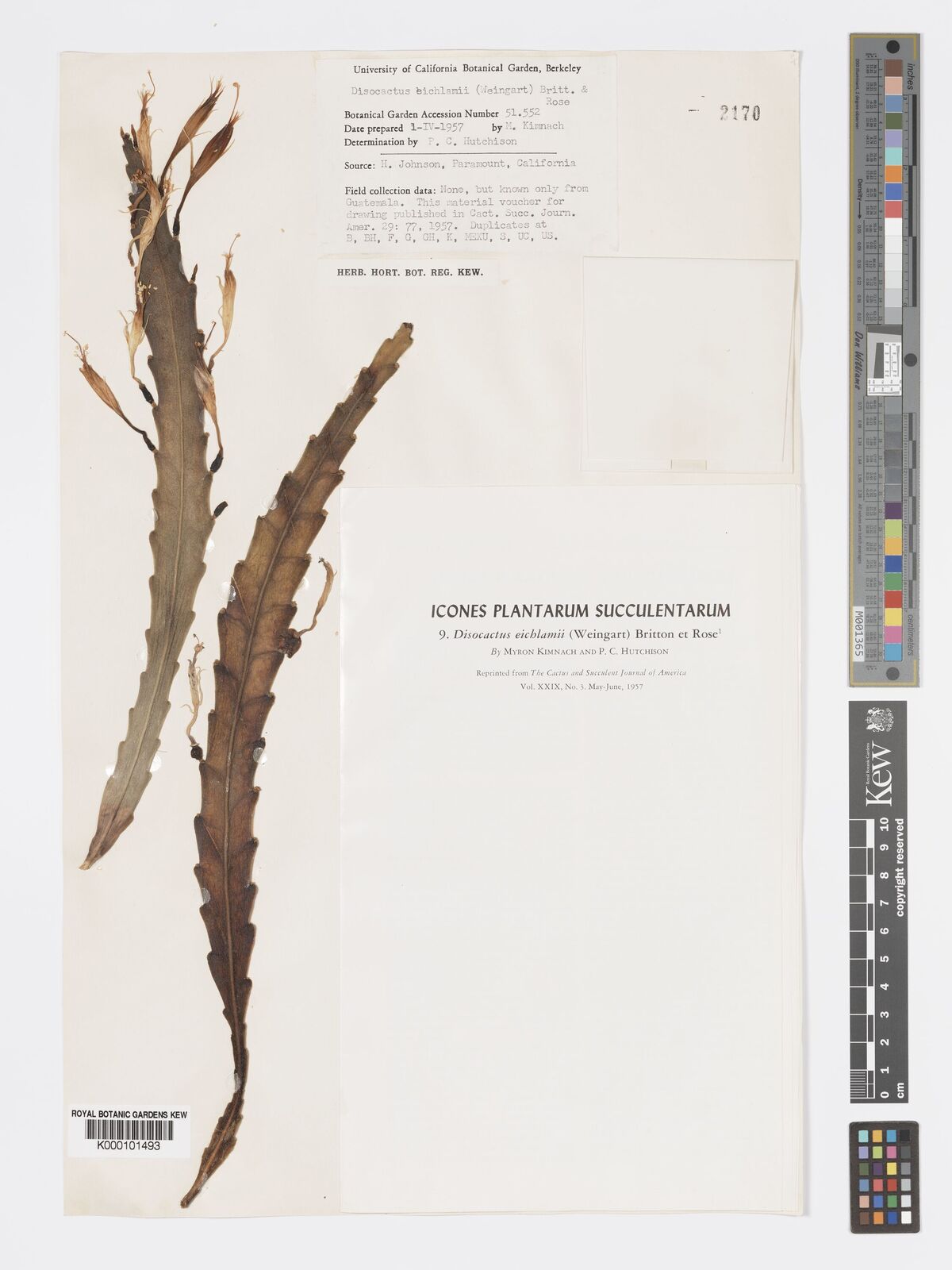 Reference image
Eichlam's Disocactus
Disocactus eichlamii is a rare tropical epiphytic cactus belonging to the family Cactaceae 1. Known for its drooping, leaf-like green branches and vibrant flowers, it is highly valued by collectors.
Originally described by Alwin Berger, the species honors Federico Eichlam, a prominent German plant collector active in Central America. The genus name Disocactus derives from Greek, hinting at the double symmetry or twin structure of the floral segments 2.
Native primarily to Guatemala and broader Central America 1, this succulent epiphyte thrives in seasonally dry tropical forests. It typically grows on tree trunks and branches, anchoring in humus pockets beneath the forest canopy.
The stems are flattened, leaf-like, lanceolate, and bright green with wavy margins. It produces tubular, stunningly red or pinkish-red flowers from the lateral areoles during spring, followed by small globose fruits 2.
Unlike desert cacti, Disocactus eichlamii requires forest-like conditions. It thrives in bright, filtered sunlight and high humidity. Epiphytic soil mixes rich in bark and perlite are essential to prevent root asphyxiation.
Overwatering in compacted soil and exposure to freezing temperatures are the primary causes of specimen decline. Placing this species in full, harsh afternoon sun will scorch the delicate leaf-like stems.
Provide filtered sunlight or bright indirect light. Avoid direct, scorching afternoon sun.
Keep the potting medium slightly moist during active growth. Reduce watering frequency in winter.
Use a well-draining, airy organic mix rich in orchid bark, peat, and coarse perlite.
Non-toxic to cats, dogs, and humans. It has no sharp spines, making it very safe.
Requires more moisture and humidity than typical desert cacti, indicating moderate difficulty.
Originates from the humid and seasonally dry tropical canopies of Guatemala, where it grows hanging from branches, soaking in dappled sunlight and absorbing airborne humidity.
