
Light
Filtered Sun
Thrives in bright indirect or filtered sunlight; avoid harsh, direct afternoon sun.
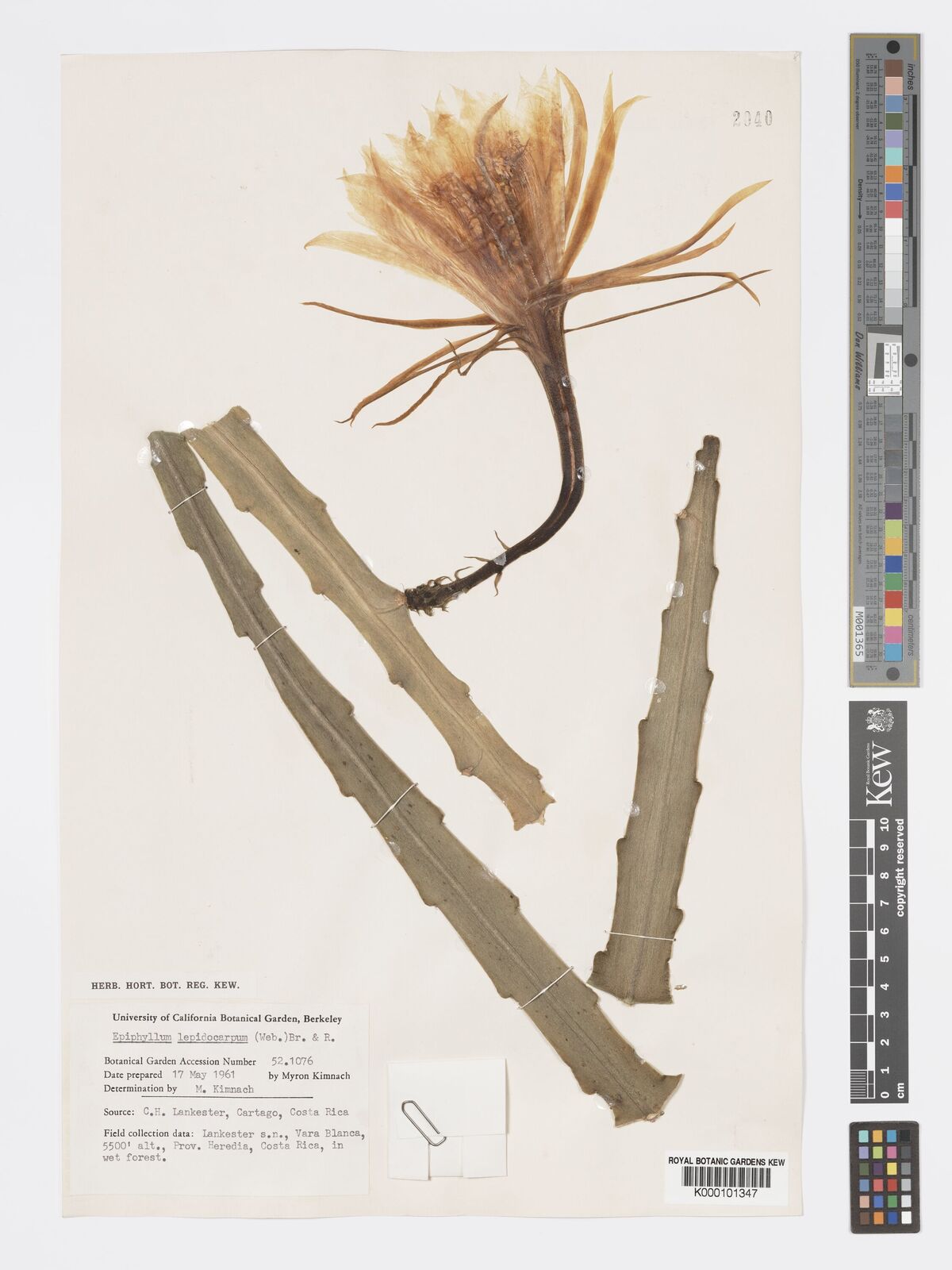 Reference image
Scaly-Fruited Disocactus
Disocactus lepidocarpus is a unique epiphytic succulent subshrub belonging to the Cactaceae family. Unlike desert cacti, it thrives on tree branches or rocky outcroppings in high-humidity montane forests rather than arid environments 1.
Originally described as Pseudorhipsalis lepidocarpa, modern molecular studies have placed this species within the genus Disocactus 2. The specific epithet lepidocarpus is derived from the Greek words lepis (scale) and karpos (fruit), directly referencing the characteristic scale-like bracts covering its developing fruits.
This species is native to Central America, primarily occupying the montane cloud forests of Costa Rica and Panama 3. It grows as an epiphyte at elevations between 1,000 and 1,600 meters, adapted to seasonally dry tropical biomes where it receives dappled sunlight through the forest canopy.
It features flattened, leaf-like, jointed green stems that are mostly spineless with undulating margins. The pendant habit makes it perfect for hanging baskets. The small, funnel-shaped flowers are creamy-white or pale yellow, followed by distinctive scaly, purplish-pink spherical fruits.
In cultivation, it requires bright, filtered light and moderate to high humidity. The potting medium should mimic its natural environment: highly organic yet extremely well-draining 1. Water thoroughly once the top inch of soil feels dry, and reduce watering frequency during the winter dormancy period.
Treating this species like a desert cactus by letting it dry out completely for extended periods or planting it in dense, heavy soils will result in root loss and stem shriveling. Poor ventilation in high humidity can also invite fungal diseases.
Thrives in bright indirect or filtered sunlight; avoid harsh, direct afternoon sun.
Keep soil slightly moist in summer, allowing the top layer to dry out; water sparingly in winter.
Prefers porous, organic, slightly acidic soil mixtures containing bark fragments and peat.
Non-toxic and virtually spineless, making it highly safe for homes with curious pets.
Moderate; requires attention to ambient humidity and avoiding waterlogged roots.
Inhabits the mid-elevation cloud forests of Central America, growing primarily on mossy tree branches.
