
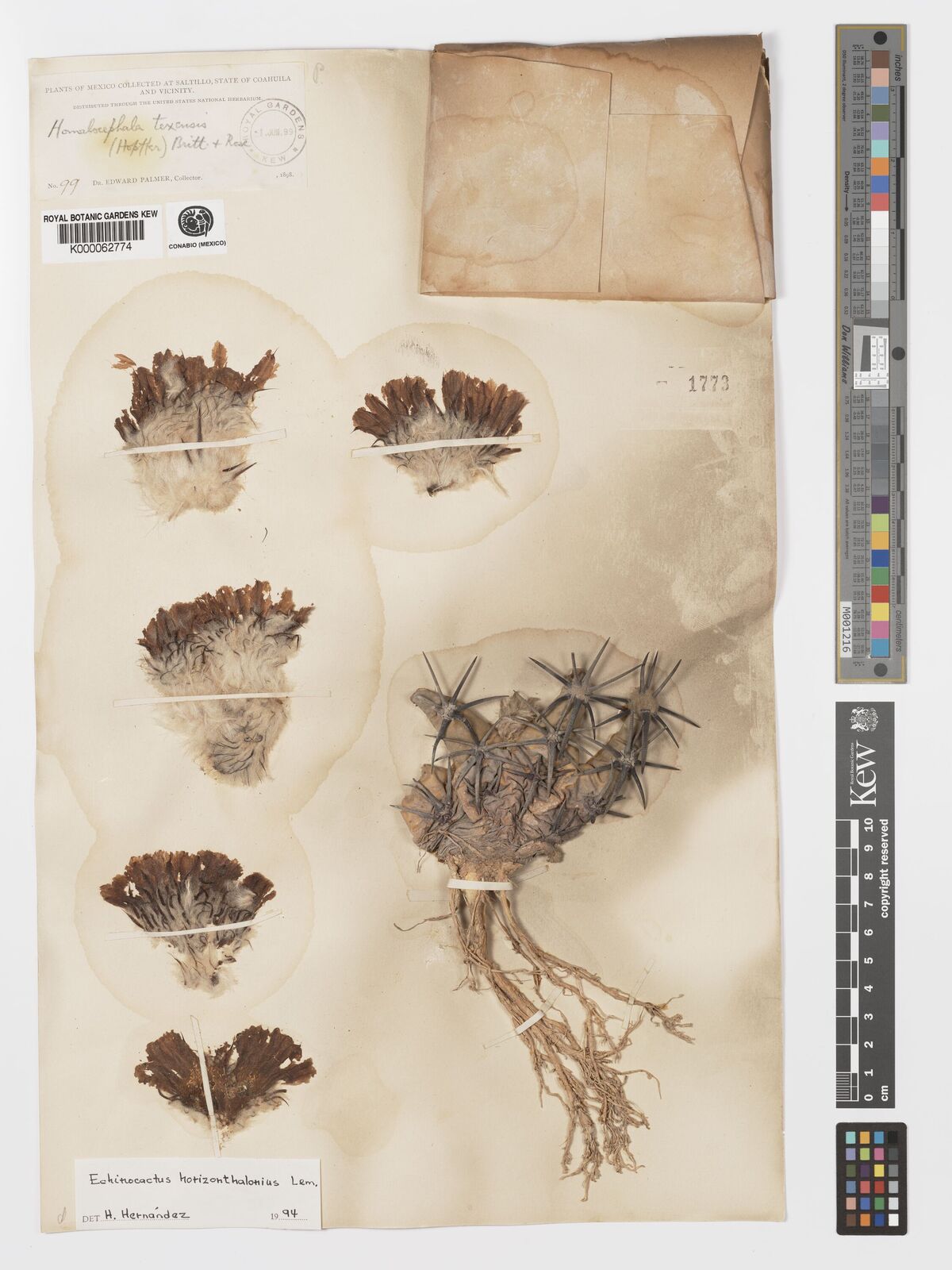
Echinocactus horizonthalonius

Turk's Head Cactus

Overview

Echinocactus horizonthalonius is a slow-growing, highly drought-tolerant cactus species belonging to the family Cactaceae. Known for its distinct blue-gray globose stem, it is highly prized among succulent collectors.

Taxonomy and Naming

First described in 1856 by George Engelmann 1, this species belongs to the genus Echinocactus. It is commonly referred to as the "Turk's Head Cactus" or "Eagle's Claw" due to its robust, curved radial spines.

Distribution and Habitat

This species is native to the southwestern United States (Texas, New Mexico) and northern to central Mexico 2. It thrives on limestone hills, arid shrublands, and rocky slopes with extreme sun exposure.

Appearance

It has a globose to short-cylindrical, gray-green or glaucous blue stem, typically featuring 8 spiral ribs. The spines are thick, ringed, grayish-pink, and curved inward. Bright pink to magenta cup-shaped flowers emerge from the woolly apex in late spring and summer.

Cultivation

In cultivation, it requires an extremely well-draining, mineral-dominant soil mix with minimal organic material. Full sun exposure and excellent air circulation are mandatory to replicate its desert habitat.

Common Cultivation Mistakes

The most frequent error is overwatering, especially in high humidity or during the winter dormancy period. Poor soil drainage inevitably leads to root and stem rot 3.

References

  1. Engelmann, G. (1856). Synopsis of the Cactaceae of the United States and Adjacent Regions. Proceedings of the American Academy of Arts and Sciences.
  2. POWO (2024). Plants of the World Online. Royal Botanic Gardens, Kew.
  3. Benson, L. (1982). The Cacti of the United States and Canada. Stanford University Press.
Light

Full Sun

Requires full sun and direct light; partial shade will cause etiolation and weaken the plant.
Watering

14-45 Days

Extremely sensitive to overwatering. Allow the potting mix to dry out completely between waterings.

Soil

Extremely well-draining, loamy-calcareous mineral mix, pumice-rich cactus soil

Use a grit-heavy, limestone-rich mineral substrate with very little to no peat content.

Safety

Risky for Pets

Possesses rigid, heavy curved spines that can cause deep puncture wounds; handle with caution.

Difficulty

Hard

High difficulty due to slow growth rate, specific mineral soil requirements, and high rot sensitivity.

Native Habitat

North America & Mexico

Native to the limestone hills of the Chihuahuan and Sonoran deserts, stretching from western Texas and southern New Mexico down into central Mexico.

Frequently Asked Questions

How often should I water my Turk's Head Cactus?
In summer, water only when the soil is completely bone-dry (roughly every 10-14 days). In winter, suspend watering entirely to prevent rot.
What kind of potting soil is best?
Use an extremely porous mineral mix consisting of pumice, lava rock, and coarse sand, with a tiny fraction of loamy limestone and under 10% organic matter.
Can it tolerate direct sunlight?
Yes, this species thrives in full sun. It requires at least 6-8 hours of direct sunlight daily to maintain its strong spine structure and glaucous blue hue.
Can I grow it indoors?
Only if placed in a very sunny south-facing window or under strong grow lights. It will not survive in dim, poorly ventilated indoor areas.
How do I encourage it to bloom?
Provide a cold (5-10°C) and completely dry winter dormancy, followed by maximum direct sunlight in late spring and summer to trigger its pink blooms.
Is it toxic to pets?
While not chemically toxic, its rigid, sharp, and curved spines pose a severe physical hazard to pets and children.
Why is it growing so slowly?
It is genetically adapted to harsh, resource-poor desert conditions. Growing only a few millimeters per year is perfectly normal for this species.
What causes yellowing or softening at the base?
Softening or yellowing near the base is a sign of root rot due to overwatering. Stop watering immediately and repot into fresh, dry mineral soil.
Should it be protected from frost in winter?
While it can survive short frosts down to -7°C if kept completely dry, container-grown plants should be shielded from freezing temperatures.
How often should I repot this cactus?
Due to its exceptionally slow growth rate, repotting is only necessary every 3-4 years. Take extra care not to damage its fragile root system.