
Light
Full Sun
Full sun; requires at least 6 hours of direct sunlight daily to thrive.
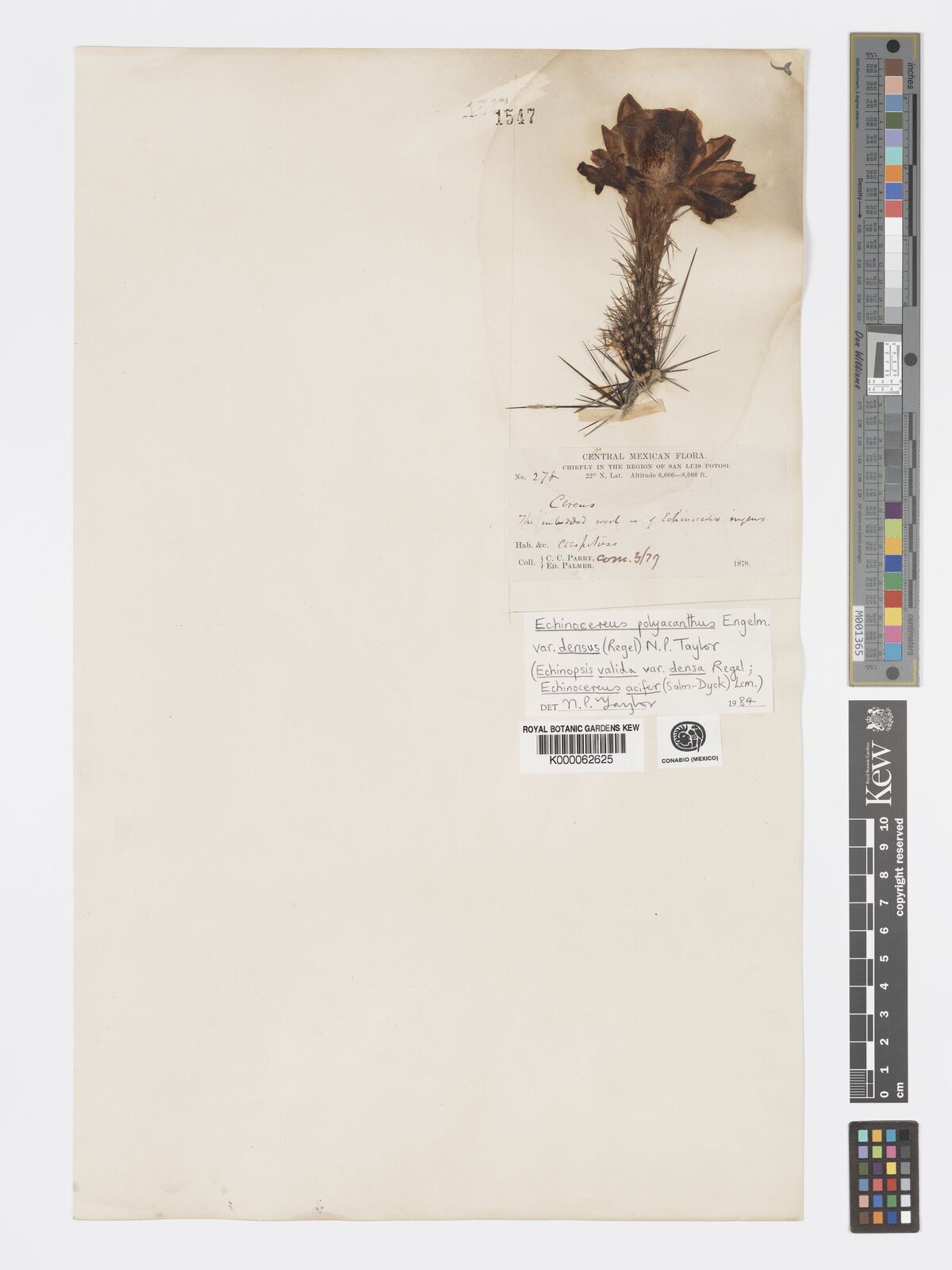 Reference image
Spiny Red Echinocereus
Echinocereus acifer is a striking member of the Cactaceae family, known for its clumping growth habit, cylindrical stems, and brilliant scarlet-to-orange flowers. This succulent subshrub is highly prized by cactus enthusiasts for its fierce spination contrasted with its glowing floral display, as well as its overall resilience.
Classified under the genus Echinocereus, the species name "acifer" derives from Latin, meaning "needle-bearing" or "sharp-spined" 1. This refers directly to the dense, rigid radial and central spines that heavily arm the ribs of its green stems.
This species is native to Mexico, spanning several northern, western, and central states including Coahuila, Durango, and San Luis Potosí 2. It thrives in arid deserts and dry shrublands, typically growing on rocky limestone slopes and gravelly flats.
The stems are cylindrical, erect, and branch from the base to form dense cushions. Each stem features distinct ribs adorned with woolly areoles bearing sharp spines. In late spring, funnel-shaped, vibrant red or bright orange-red flowers emerge near the stem tips, which are exceptionally long-lasting for cactus blooms 1.
In cultivation, it requires full sun to maintain its compact shape and produce strong spines. Watering must be done thoroughly only when the soil is completely dry. During the winter, it demands dry and cool conditions to trigger the next season's flowering.
The most frequent mistake is overwatering during the cold winter dormancy, which quickly leads to root rot. Insufficient sunlight will cause the stems to stretch abnormally (etiolation) and weaken, while also preventing any potential flower bud development.
Full sun; requires at least 6 hours of direct sunlight daily to thrive.
Allow soil to dry out completely between waterings in summer; keep completely dry in winter.
Highly porous, mineral-rich mix consisting of pumice, perlite, gravel, and minimal organic matter.
Equipped with very sharp, stiff spines. Handle with thick gloves and keep away from pets and children.
Easy; highly tolerant of neglect, provided it receives ample sunlight and is never overwatered.
Endemic to the arid deserts and dry shrublands of northern and central Mexico, where it grows on steep, rocky limestone hillsides under intense sunlight.
