
Light
Full Sun
Requires full sun (at least 6 hours of direct sunlight daily) to maintain dense spine growth.
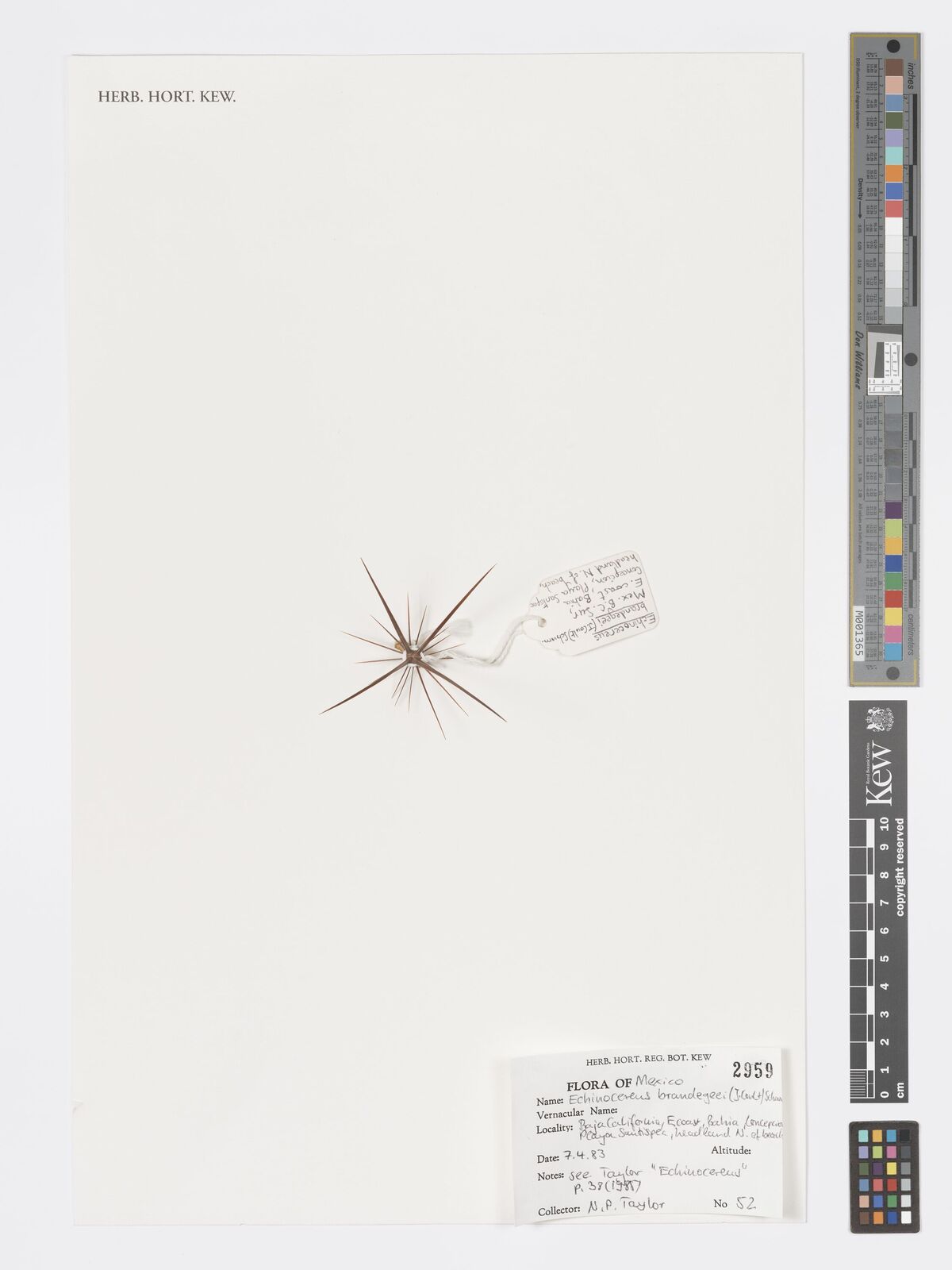 Reference image
Brandegee's Strawberry Cactus
Echinocereus brandegeei is a highly distinctive clumping cactus in the Cactaceae family, known for its heavily-armed stems and spectacular magenta blooms. It forms large, sprawling colonies of cylindrical stems covered in flattened, dagger-like spines 1. It is highly sought after by succulent collectors for its wild, sculptural appearance.
The genus name Echinocereus derives from the Greek word "echinos" (meaning hedgehog or sea urchin). The species epithet honors Townshend Stith Brandegee, a renowned American botanist who extensively documented the flora of Baja California and the Channel Islands 2.
This species is native to the Baja California Peninsula of Mexico. It is widely distributed across Baja California Sur and parts of Baja California, growing in dry desert scrublands, coastal plains, and rocky volcanic hillsides under intense sunlight 1.
The stems are cylindrical, up to 1 meter or more in length and about 6 cm in diameter. The spines are its most striking feature: heavy, flattened, yellowish to dark gray, and up to 8 cm long, completely shielding the plant. In late spring, it produces funnelform flowers in brilliant shades of pink and magenta with a darker red throat 2.
It requires full sun exposure and extremely well-draining mineral soil. Adequate air circulation is crucial. During the active growing season (spring to autumn), water only when the substrate is completely dry. In winter, maintain dry conditions to prevent root rot.
Insufficient direct light leading to weak, etiolated growth and pale coloration, and overwatering in heavy organic soil leading to collar rot. Wet soil during cold winter months is the primary cause of plant death.
Requires full sun (at least 6 hours of direct sunlight daily) to maintain dense spine growth.
Water thoroughly only when the soil is completely dry. Keep completely dry in winter.
Use a porous mineral mix high in pumice, coarse sand, and grit with very low organic matter.
Equipped with extremely sharp, stiff spines. Handle with thick leather gloves and keep away from pets.
Moderately easy for cactus lovers if bright light and dry winter conditions are met.
Found natively across the arid, rocky terrains of the Baja California Peninsula in Mexico, where it thrives in coastal sage scrubs, desert plains, and steep volcanic cliffs.
