
Light
Full Sun
Requires full sun or very bright direct sunlight to maintain compact growth and bloom.
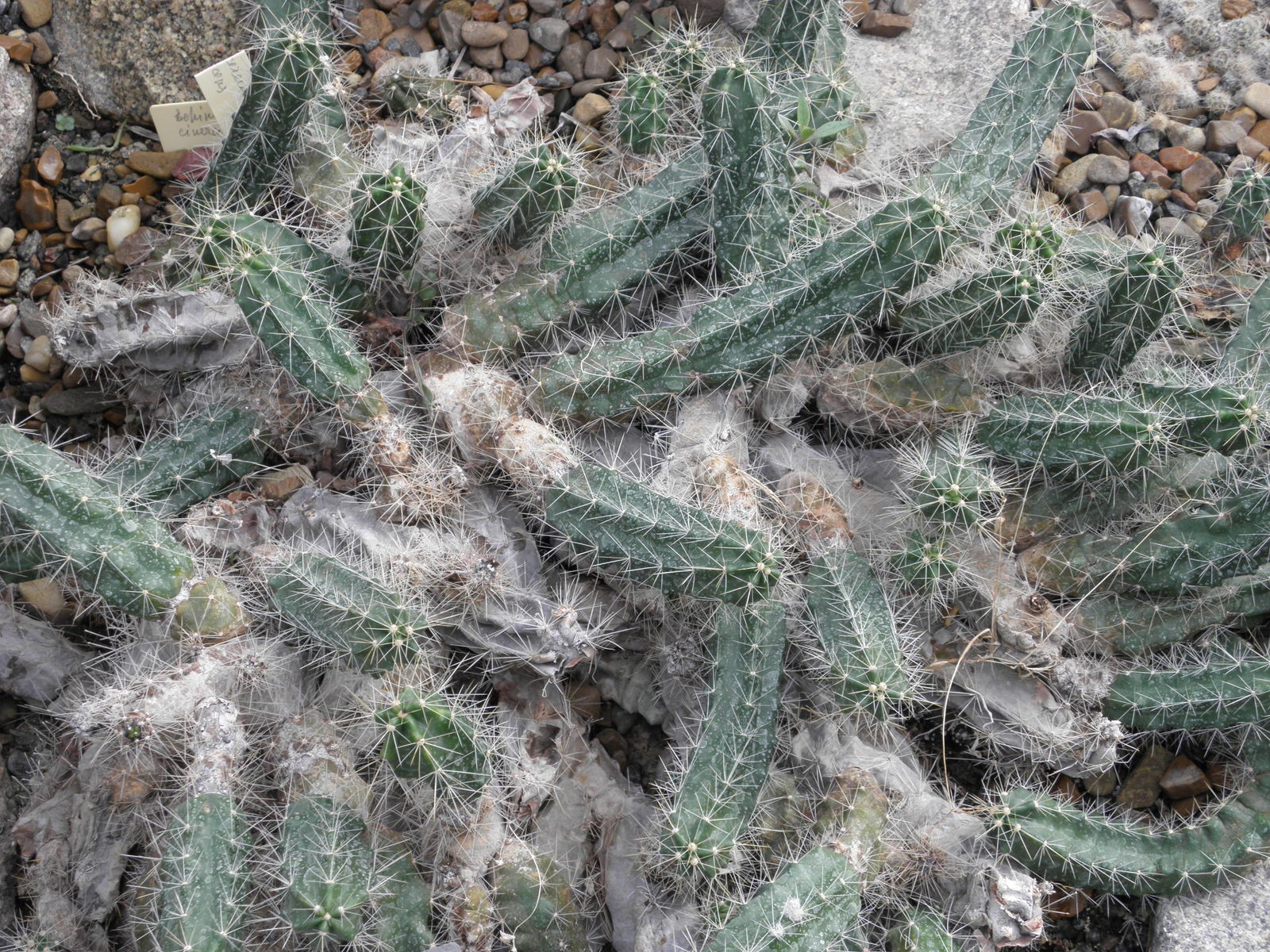 Reference image
Ashy Hedgehog Cactus
Echinocereus cinerascens is a robust, highly drought-tolerant perennial succulent subshrub in the family Cactaceae 1. Renowned for its clustering growth habit and vibrant magenta flowers, it is a highly valued species among succulent enthusiasts and botanical collections.
Belonging to the genus Echinocereus, the species name "cinerascens" is derived from Latin, meaning "becoming ash-colored" or "grayish," which describes the dense, pale-colored spine cover that typically obscures the green stems 2.
This species is native to central and northeastern Mexico 1. It is widely distributed across states such as San Luis Potosí, Hidalgo, Querétaro, Guanajuato, and Zacatecas, where it thrives in desert flats, dry shrublands, and rocky hillsides at elevations of 1,500 to 2,400 meters above sea level 2.
Stems are cylindrical, pale to gray-green, up to 30 cm long, and form large, dense clumps over time. They feature 10 to 12 ribs lined with prominent areoles bearing yellowish, white, or gray spines. In late spring, it produces spectacular, funnel-shaped flowers that are bright magenta to pink with pale throats 3.
In cultivation, it requires full sun and exceptionally well-draining mineral soil. Water thoroughly during the active growing season only when the soil has dried out completely. During winter dormancy, keep the plant entirely dry to prevent root rot. It exhibits excellent frost tolerance if kept dry 3.
The most prevalent issue is root rot due to overwatering or planting in organic-rich, heavy clay soils. Lack of sufficient direct sunlight will cause etiolation, weak growth, and prevent flowering.
Requires full sun or very bright direct sunlight to maintain compact growth and bloom.
Allow soil to dry out 100% before watering; stop watering entirely in winter.
Needs highly porous soil mixed with pumice, grit, and sand to prevent rot.
Armed with sharp spines; keep out of reach of curious pets and children.
An easy-care plant ideal for beginners, provided it gets enough sun and dry soil.
Native to the high-altitude semi-deserts, stony slopes, and arid shrublands of central and northeastern Mexico.
