
Light
Full Sun
Requires full sun, ideally 6 to 8 hours of direct sunlight daily for robust spine coloration.
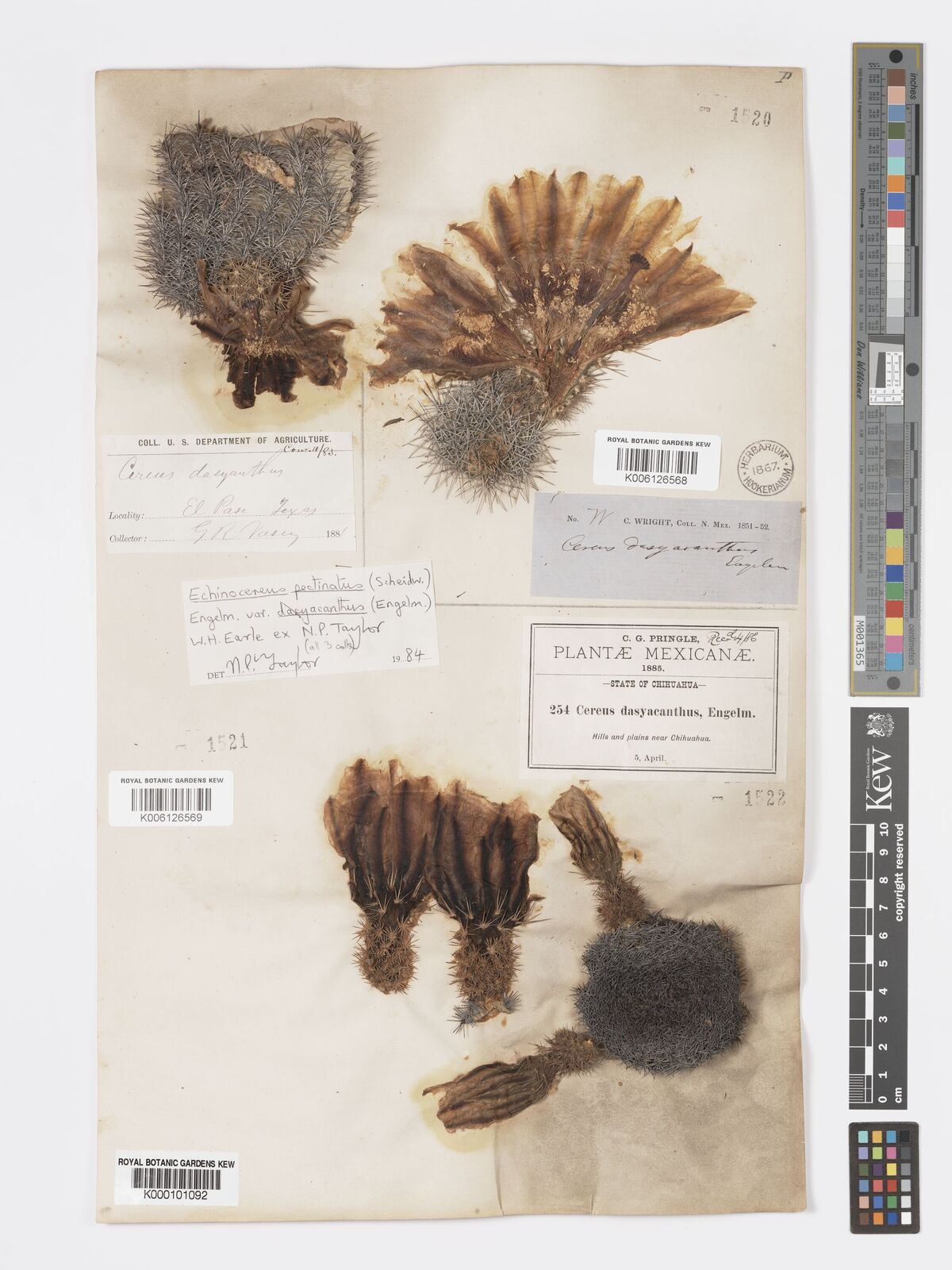 Reference image
Texas Rainbow Cactus
Echinocereus dasyacanthus is a highly sought-after desert succulent subshrub famed for its multicolored spination and large, showy yellow flowers. It represents one of the quintessential cacti of the Chihuahuan Desert 1.
Belonging to the Cactaceae family, the species was described within the genus Echinocereus. The specific epithet "dasyacanthus" derives from Greek, meaning "thickly-spined." It is commonly referred to as the "Texas Rainbow Cactus" because the growth rings of spines display varying shades of pink, yellow, and cream over different seasons 2.
This species is native to the south-central United States (primarily Texas and New Mexico) and northern Mexico (including Chihuahua, Coahuila, and Sonora). It thrives in desert shrublands, limestone hills, and gravelly slopes at elevations ranging from 600 to 1,500 meters 1.
The stems are cylindrical, usually growing solitary but occasionally clumping with age, reaching heights of 15 to 35 cm. Its defining feature is the dense, pectinate arrangement of spines that wrap around the stem in multicolored bands. In late spring, it produces spectacular, funnel-shaped yellow to bright gold flowers that can cover the top of the stem 2.
It requires full sun exposure and extremely sharp drainage. Watering should be done sparingly, keeping the soil completely dry during the winter. It has excellent cold tolerance down to -10°C if kept dry 1.
Inadequate sunlight leads to etiolation (stretching) and weak spine development. Overwatering or using rich, clay-heavy soils will rapidly cause root rot and lead to the demise of the plant.
Requires full sun, ideally 6 to 8 hours of direct sunlight daily for robust spine coloration.
Water thoroughly only when the soil is dry. Keep completely dry in winter.
Prefers a highly mineral, gritty cactus mix with excellent drainage and low organic matter.
Equipped with dense, sharp spines; handle with care and keep away from pets and children.
Very easy to maintain, provided you avoid overwatering and ensure plenty of direct sunlight.
Found across the arid grasslands, gravelly slopes, and limestone hills of Texas, New Mexico, and northern Mexican states.
