
Light
Direct Sun
Requires full sun, preferably on a south- or west-facing windowsill or outdoor rockery.
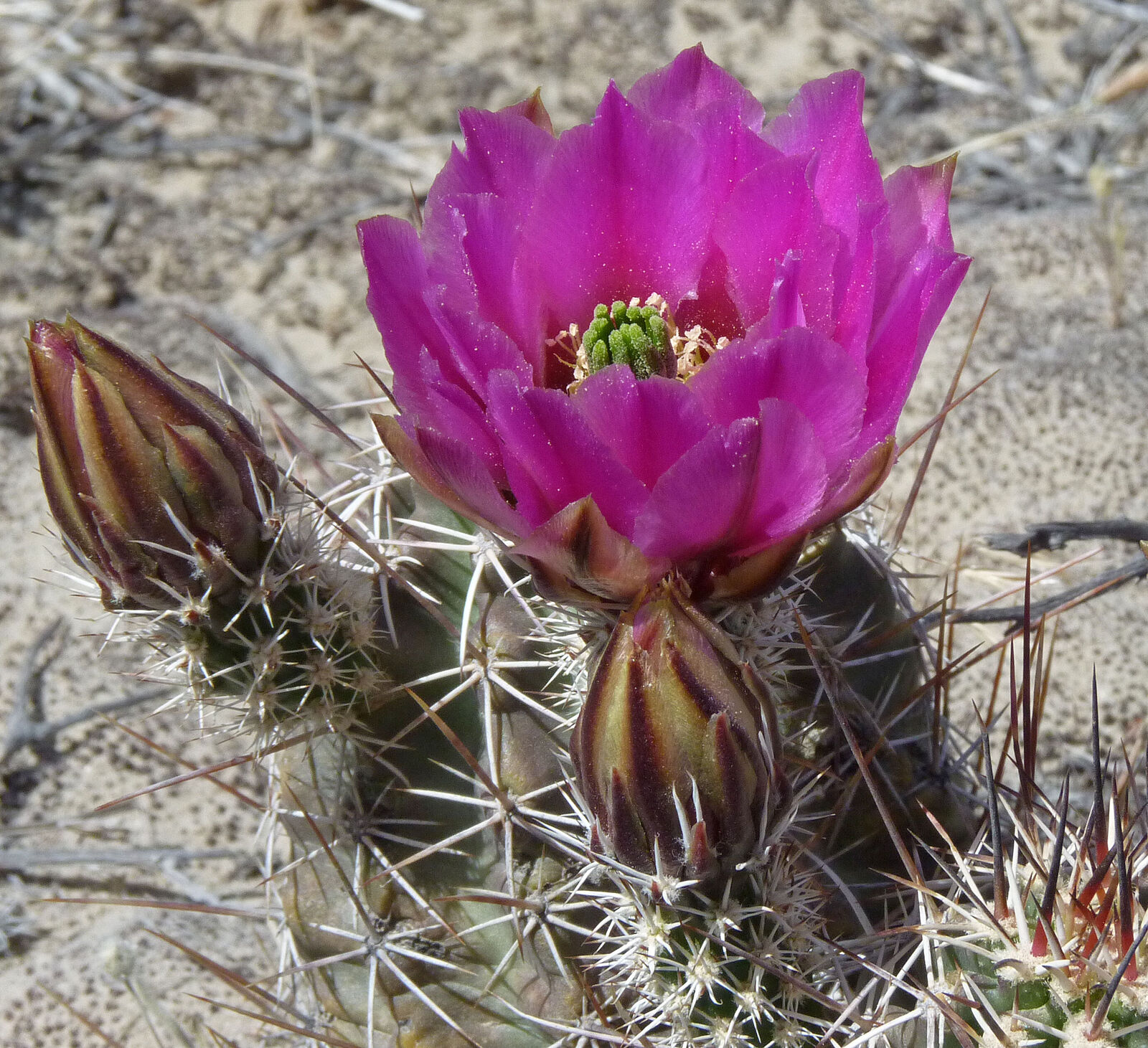 Reference image
Fendler's Hedgehog Cactus
Echinocereus fendleri, commonly known as Fendler's hedgehog cactus, is a highly frost-tolerant, perennial succulent subshrub in the family Cactaceae. It is renowned for its spectacular, large magenta-pink flowers and robust spine clusters 1.
Described initially by George Engelmann, the specific epithet honors Augustus Fendler, a pioneer botanical collector who gathered plants in New Mexico. The genus name combines the Greek 'echinos' (hedgehog) with the Latin 'cereus' (wax taper) 2.
This species is native to the South-Central United States (including Arizona, New Mexico, Colorado, and Texas) and Northern Mexico. It thrives in desert grasslands, dry shrublands, and rocky limestone slopes at elevations ranging from 1,000 to 2,400 meters 1.
Echinocereus fendleri usually grows solitary or in small, sparse clumps. The stems are semi-erect, cylindrical, and reach up to 10-30 cm in height with 8 to 12 ribs. Spines are variable, featuring a distinctive dark central spine that curves upward. The magnificent cup-shaped flowers appear in late spring, displaying vibrant magenta hues with characteristic emerald-green stigma lobes 2.
It requires full sun and extremely porous, mineral-rich soil. Watering should be deep but infrequent during the growing season, and suspended entirely in winter to allow the plant to withstand freezing temperatures 1.
Overwatering and using organic-heavy soils that retain moisture are the primary causes of root rot. Lack of sufficient sunlight leads to etiolation and prevents the plant from blooming.
Requires full sun, preferably on a south- or west-facing windowsill or outdoor rockery.
Water thoroughly only when the soil is completely dry, and stop watering entirely in winter.
Use a highly mineral substrate with 60-70% pumice, coarse sand, and perlite.
Non-toxic, but the sharp, rigid spines pose a physical hazard to pets and children.
Extremely low-maintenance and cold-hardy, provided it is kept dry in winter.
Naturally distributed across the arid valleys and rocky slopes of the desert grasslands of the American Southwest and Northern Mexican states, experiencing hot summers and freezing winters.
