
Light
Direct Sun
Requires at least 6 hours of direct sunlight daily to maintain its compact shape.
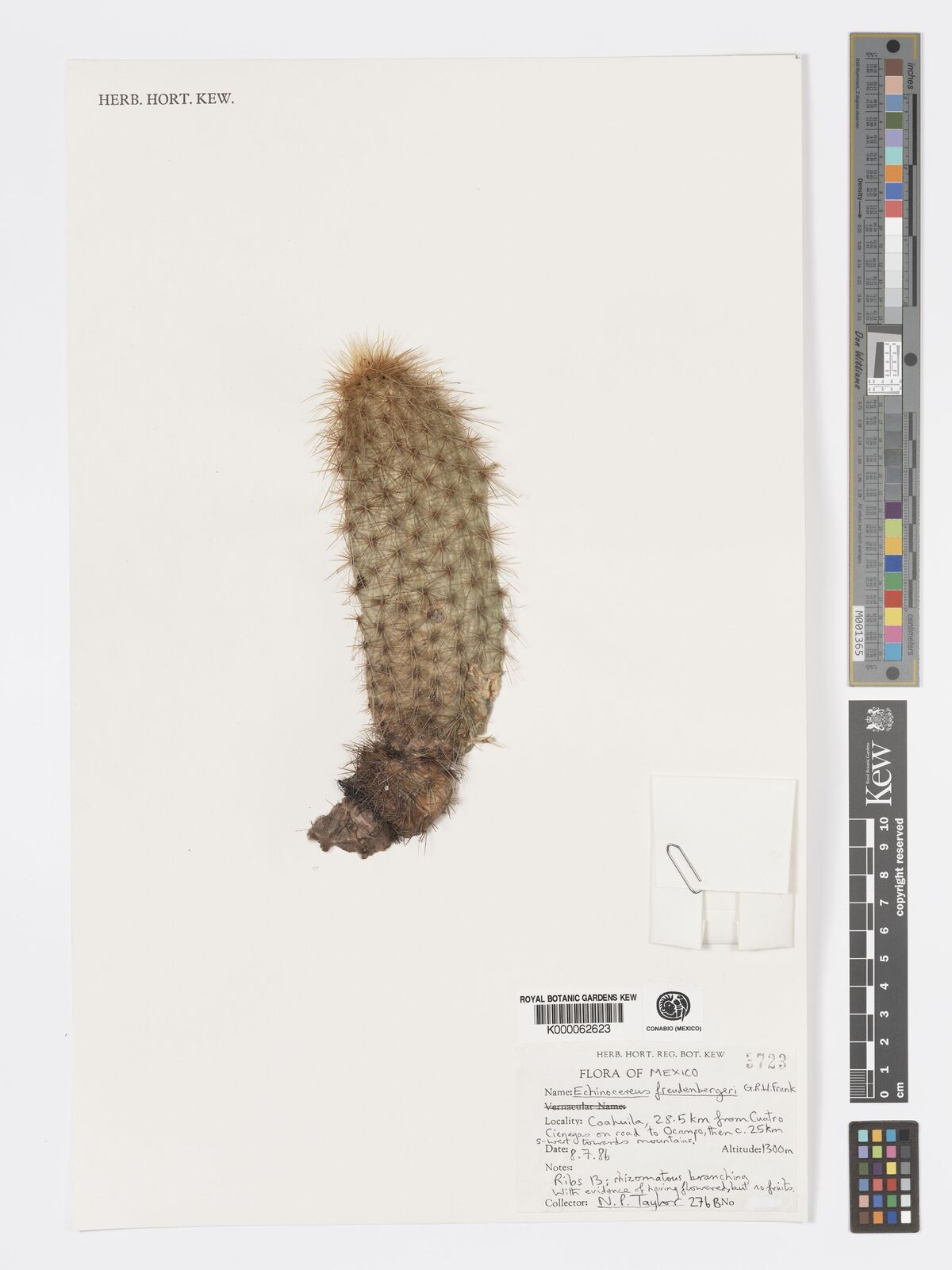 Reference image
Freudenberger's Hedgehog Cactus
Echinocereus freudenbergeri is a perennial succulent subshrub belonging to the Cactaceae family. Known for its compact growth habit and brilliant diurnal flowers, it is highly valued among cactus enthusiasts and collector gardens 1.
Classified under the prominent genus Echinocereus, this species is distinguished by its unique spination and floral characteristics. Its binomial name is accepted and documented in major taxonomic databases as a distinct species within the Mexican desert flora 1.
This species is native to northern and central Mexico, including regions such as Coahuila, Durango, Zacatecas, and San Luis Potosí 2. It typically thrives in desert biomes and dry shrublands, growing on limestone rocky slopes and gravelly soils under intense sunlight.
The stems are cylindrical, pale green to olive green, often branching from the base to form small clumps. It features prominent ribs adorned with woolly areoles and sharp, rigid spines. During late spring, it produces large, funnel-shaped, vibrant pink to magenta flowers that open in response to bright daylight.
In cultivation, it requires full sun exposure and extremely porous, mineral-rich soil. Watering should follow the 'soak and dry' method during the active growing season. In winter, the plant enters dormancy and must be kept completely dry and cool to prevent rot.
Overwatering and poor soil drainage are the most common causes of root rot and plant loss. Additionally, growing the cactus in low-light conditions leads to etiolation, where the stem becomes weak, thin, and pale.
Requires at least 6 hours of direct sunlight daily to maintain its compact shape.
Water only when the soil is dry in summer, and suspend watering entirely in winter.
Highly porous gravelly mix with minimal organic matter and excellent drainage.
Spines are sharp and stiff. Non-toxic to pets, but keep away from traffic areas.
Very easy to care for if overwatering is avoided and strong light is provided.
Native to the arid and semi-arid desert regions of northern Mexico, where it thrives in rocky limestone habitats, adapted to intense sun and severe drought.
